Scientists discover new platinum catalysts for the dehydrogenation of propane
Mar 13, 2009
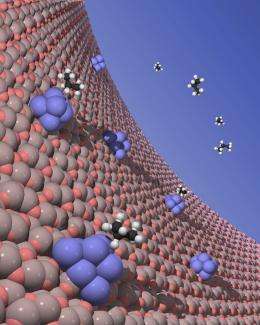
Clusters of 8-10 platinum atoms deposited in pores of an aluminum oxide membrane are highly active and selective catalysts for the oxidative dehydrogenation of propane. Art by Michael Sternberg and Faisal Mehmood. Provided by ANL.

(PhysOrg.com) -- The process to turn propane into industrially necessary propylene has been expensive and environmentally unfriendly. That was until scientists at U.S. Department of Energy's Argonne National Laboratory devised a greener way to take this important step in chemical catalysis.

"Using clusters, we have devised a way to catalyze not only in a more environmentally friendly way, but also using far less energy than previous methods," Argonne scientist Stefan Vajda said.

Alkanes are typical feedstocks for transformation to alkenes, aromatics and chemicals containing value added moieties. is a route to such transformations, but it is an requiring significant energy input.

Oxidative dehydrogenation (ODH) of propane to propylene is a multibillion dollar industrial process. ODH of alkanes is exothermic, and thus an attractive alternative to dehydrogenation. However, current ODH catalysts have limited activity and/or poor selectivity resulting from inability to prevent complete . Two classes of catalysts are used: vanadia and platinum. The vanadia based catalysts are highly selective, but their activity is relatively low. Pt-based catalysts are more active, but their selectivity is low.

Argonne scientists showed that the size preselected Pt8-10 clusters stabilized on high-surface-area supports are 40� times more active for the oxidative dehydrogenation of propane than previously studied platinum and vanadia catalysts, while at the same time maintaining high selectivity towards formation of propylene over by-products.

This new class of catalysts may lead to energy-efficient and environmentally friendly synthesis strategies and the possible replacement of petrochemical feedstocks by abundant small alkanes.

"The oxidative dehydrogenation of alkanes is a reaction that is exothermic and thus an attractive alternative to the endothermic process of dehydrogenation of alkanes," Argonne scientist Larry Curtiss said. "The endothermic process requires a significant energy input with an increased chance of environmentally unfriendly by-products."

Using high performance computing facilities at Argonne and elsewhere, Vajda and his colleagues proved theoretically that attractive interaction between the under-coordinated platinum and propane was the cause for the higher selectivity towards propylene and its high activity.

More information: Subnanometre Platinum Clusters as Highly Active and Selective Catalysts for the Oxidative Dehydrogenation of Propane can be seen Nature Materials 8, 213 (2009).

Source: Argonne National Laboratory

Explore further: Chemical probe confirms that body makes its own H2S to benefit health

add to favorites email to friend print save as pdf

Related Stories

Argonne to study fuel cell catalysts

May 26, 2005

Argonne National Laboratory will receive $3 million over three years for basic science studies that may lead to improved catalysts for hydrogen fuel cells.

New catalysts may create more, cheaper hydrogen

Aug 21, 2007

A new class of catalysts created at the U.S. Department of Energy's Argonne National Laboratory may help scientists and engineers overcome some of the hurdles that have inhibited the production of hydrogen for use in fuel ...

Less expensive fuel cell may be possible

Oct 03, 2006

Scientists at Los Alamos National Laboratory have developed a new class of hydrogen fuel-cell catalysts that exhibit promising activity and stability. The catalysts are made of low-cost nonprecious metals entrapped in something ...

Renewable Raw Materials

May 29, 2006

Petroleum and natural gas reserves are getting smaller and smaller. It is thus a real waste to burn up these valuable resources for heat or transportation especially as "black gold" is also the most important starting material ...

Catalyst breakthrough boosts hydrogen fuel cells

Feb 08, 2007

Researchers at the U.S. Department of Energy's Argonne National Laboratory have discovered new information on the behavior of nano-engineered platinum surfaces – information that may bring polymer electrolyte membrane fuel ...

Recommended for you

Counting small RNA in disease-causing organisms

Jun 18, 2013

Small molecules of RNA (tens to hundreds of nucleotides in length) play a key regulatory role in bacteria. Due to their small size, directly measuring the number of small RNA (sRNA) present in a single bacterium ...

Detecting homemade explosives, not toothpaste

Jun 13, 2013

(Phys.org) —Sandia National Laboratories researchers want airports, border checkpoints and others to detect homemade explosives made with hydrogen peroxide without nabbing people whose toothpaste happens ...

Breakthrough allows fast, reliable pathogen identification

Jun 12, 2013

Life-threatening bacterial infections cause tens of thousands of deaths every year in North America. Increasingly, many infections are resistant to first-line antibiotics. Unfortunately, current methods of culturing bacteria ...

Luminous bacterial proteins detect chemicals in water

Jun 12, 2013

While residual medications don't belong in the water, trace metals from industrial process waters handled by the recycling industry are, in contrast, valuable resources. Scientists at the Helmholtz-Zentrum ...

User comments : 0

More news stories

DNA constructs antenna for solar energy

Researchers at Chalmers University of Technology have found an effective solution for collecting sunlight for artificial photosynthesis. By combining self-assembling DNA molecules with simple dye molecules, ...

Pearly perfection

The mystery of how pearls form into the most perfectly spherical large objects in nature may have an unlikely explanation, scientists are proposing in a new study. It appears in ACS' journal Langmuir, named ...