New experiments constrain Higgs mass (w/Videos)
Mar 13, 2009
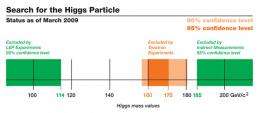
Scientists from the CDF and DZero collaborations at DOE's Fermilab have combined Tevatron data from their two experiments to increase the sensitivity for their search for the Higgs boson. While no Higgs boson has been found yet, the results announced today exclude a mass for the Higgs between 160 and 170 GeV/c² with 95 percent probability. A larger area is excluded at the 90 percent probability level. Earlier experiments at the Large Electron-Positron Collider at CERN excluded a Higgs boson with a mass of less than 114 GeV/c² at 95 percent probability. Calculations of quantum effects involving the Higgs boson require its mass to be less than 185 GeV/c². The results show that CDF and DZero are sensitive to potential Higgs signals. The Fermilab experimenters will test more and more of the available mass range for the Higgs as their experiments record more collision data and as they continue to refine their experimental analyses.

(PhysOrg.com) -- The territory where the Higgs boson may be found continues to shrink. The latest analysis of data from the CDF and DZero collider experiments at the U.S. Department of Energy's Fermilab now excludes a significant fraction of the allowed Higgs mass range established by earlier measurements. Those experiments predict that the Higgs particle should have a mass between 114 and 185 GeV/c2. Now the CDF and DZero results carve out a section in the middle of this range and establish that it cannot have a mass in between 160 and 170 GeV/c2.

"The outstanding performance of the and CDF and DZero together have produced this important result," said Dennis Kovar, Associate Director of the Office of Science for at the U.S. Department of Energy. "We're looking forward to further Tevatron constraints on the Higgs ."

The Higgs particle is a keystone in the theoretical framework known as the of and their interactions. According to the Standard Model, the explains why some elementary particles have mass and others do not.

So far, the Higgs particle has eluded direct detection. Searches at the Large Electron Positron at the European laboratory established that the Higgs boson must weigh more than 114 GeV/c2. Calculations of quantum effects involving the Higgs boson require its mass to be less than 185 GeV/c2.

This video is not supported by your browser at this time.

So far, CDF and DZero each have analyzed about three inverse femtobarns of collision data--the scientific unit that scientists use to count the number of collisions. Each experiment expects to receive a total of about 10 inverse femtobarns by the end of 2010, thanks to the superb performance of the Tevatron. The collider continues to set numerous performance records, increasing the number of proton-antiproton collisions it produces.

Provided by Fermi National Accelerator Laboratory

Explore further: New X-ray method shows how frog embryos could help thwart disease

add to favorites email to friend print save as pdf

Related Stories

Tevatron experiments double-team Higgs boson

Aug 04, 2008

Scientists from the CDF and DZero collaborations at the U.S. Department of Energy's Fermilab have combined Tevatron data from the two experiments to advance the quest for the long-sought Higgs boson. Their ...

The hunt for the Higgs steps up a gear

Aug 28, 2008

The hunt for the Higgs boson, the most highly sought-after particle in physics, received a boost this month with the release of two new results from the Tevatron particle collider at the US Department of Energy's ...

Recommended for you

Bringing life into focus

May 17, 2013

Spinning-disk confocal microscopy is an optical imaging technique that can be used to generate detailed three-dimensional fluorescence images of living cells and their contents. Although a powerful tool for ...

World's smallest droplet

May 17, 2013

(Phys.org) —Physicists may have created the smallest drops of liquid ever made in the lab. That possibility has been raised by the results of a recent experiment conducted by Vanderbilt physicist Julia Velkovska and her ...

User comments : 0

More news stories

New principle may help explain why nature is quantum

Like small children, scientists are always asking the question 'why?'. One question they've yet to answer is why nature picked quantum physics, in all its weird glory, as a sensible way to behave. Researchers ...

Manipulating Lorentz and Fano spectral line shapes

(Phys.org) —It is widely known that the optical properties of certain materials can be modified by using lasers to control the quantum states of their optical electrons. Lasers that can generate ultra-short ...

Galaxy's Ring of Fire

Johnny Cash may have preferred this galaxy's burning ring of fire to the one he sang about falling into in his popular song. The "starburst ring" seen at center in red and yellow hues is not the product of ...

US seizes Bitcoin operator accounts

US authorities seized the accounts of a Bitcoin digital currency exchange operator, claiming it was functioning as an "unlicensed money service business," court documents showed Friday.