News tagged with mass
New NIST SRM supports the fight against terrorist bombings
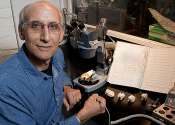
The National Institute of Standards and Technology (NIST) has released a new standard reference material (SRM) to aid in the detection of two explosive compounds that are known to be used by terrorists. Researchers ...
Chemistry / Analytical Chemistry
May 30, 2012 |
not rated yet |
0
Team finds buckyballs grow larger by 'eating' vaporized carbon
(Phys.org) -- Fullerenes were first discovered back in 1985 by a team of physicists vaporizing graphite in helium gas, one class of which, the buckminsterfullerene (C60) named after Buckminster Fuller and ...
Greenland's current loss of ice mass
The Greenland ice sheet continues to lose mass and thus contributes at about 0.7 millimeters per year to the currently observed sea level change of about 3 mm per year. This trend increases each year by a further 0.07 millimeters ...
Space & Earth / Earth Sciences
May 29, 2012 |
5 / 5 (5) |
0
10 million years needed to recover from mass extinction
(Phys.org) -- It took some 10 million years for Earth to recover from the greatest mass extinction of all time, latest research has revealed.
Space & Earth / Earth Sciences
May 27, 2012 |
4.4 / 5 (8) |
21
|
Microsoft sees 'rebirth' with new Windows 8 system
Microsoft's upcoming Windows 8 series -- featuring an upgraded cloud computing service -- marks a "rebirth" of its operating systems, chief executive Steve Ballmer said on Tuesday.
May 22, 2012 |
2.3 / 5 (3) |
14
Foul-mouthed characters in teen books have it all, study finds
Bestselling authors of teen literature portray their more foul-mouthed characters as rich, attractive and popular, a new study finds. Brigham Young University professor Sarah Coyne analyzed the use of profanity in 40 books ...
Other Sciences / Social Sciences
May 18, 2012 |
5 / 5 (2) |
2
Astronomers discovered ancient Egyptian observations of a variable star
The study of the "Demon star", Algol, made by a research group of the University of Helsinki, Finland, has received both scientific and public attention. The period of the brightness variation of this eclipsing binary star ...
Space & Earth / Space Exploration
May 16, 2012 |
5 / 5 (8) |
0
|
Virus 'barcodes' offer rapid detection of mutated strains
Researchers at the University of Leeds are developing a way to 'barcode' viral diseases to rapidly test new outbreaks for potentially lethal mutations.
May 13, 2012 |
5 / 5 (2) |
0
|
How nature shapes the birth of stars
(Phys.org) -- Using state of the art computer simulations, a team of astronomers from the University of Bonn in Germany have found the first evidence that the way in which stars form depends on their birth ...
May 11, 2012 |
4.7 / 5 (6) |
6
|
Space weather expert has ominous forecast
A stream of highly charged particles from the sun is headed straight toward Earth, threatening to plunge cities around the world into darkness and bring the global economy screeching to a halt.
Space & Earth / Space Exploration
May 08, 2012 |
4.3 / 5 (9) |
7
Diagnosing a black hole flare
(Phys.org) -- Black holes can come in a wide range of masses. Some, with only about one solar mass, result from the supernova death of a massive star, while those at the center of galaxies (called supermassive ...
May 07, 2012 |
5 / 5 (4) |
0
|
Antarctic waters changing due to climate: study
The densest waters of Antarctica have reduced dramatically over recent decades, in part due to man-made impacts on the climate, Australian scientists said Friday.
Space & Earth / Earth Sciences
May 04, 2012 |
4.4 / 5 (22) |
46
WiggleZ project reaches new heights in measuring neutrino mass
The lightest known subatomic particles in the Universe are now able to be more accurately scrutinised, in light of new astronomic research two years in the making.
Apr 30, 2012 |
4.8 / 5 (4) |
0
|
Astrophysicists uncover secret origin of brown dwarfs
The origin of brown dwarfs is one of the great unsolved mysteries facing astrophysicists today. In a new study published in The Astrophysical Journal, Western’s Shantanu Basu and University of Vienna’s Eduard ...
Apr 26, 2012 |
4.3 / 5 (3) |
0
New research suggests initial mass function for galaxies not universal
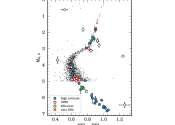
(Phys.org) -- Over the past several years there has been debate in the astrophysics community regarding the distribution of stars in galaxies, specifically their mass range. Astronomers use an initial mass ...
Mass
Mass can be defined as a quantitive measure of the resistance an object has to change in its velocity. In physics, mass (from Ancient Greek: μᾶζα) commonly refers to any of the following three properties of matter, which have been shown experimentally to be equivalent:
Mass must be distinguished from matter in physics, because matter is a poorly-defined concept, and although all types of agreed-upon matter exhibit mass, it is also the case that many types of energy which are not matter—such as potential energy, kinetic energy, and trapped electromagnetic radiation (photons)—also exhibit mass. Thus, all matter has the property of mass, but not all mass is associated with identifiable matter.
In everyday usage, "mass" is often used interchangeably with weight, and the units of weight are often taken to be kilograms (for instance, a person may state that their weight is 75kg). In scientific use, however, the two terms refer to different, yet related, properties of matter. Weight can be zero if no gravitational force is acting but mass can never be zero.
The inertial mass of an object determines its acceleration in the presence of an applied force. According to Newton's second law of motion, if a body of fixed mass M is subjected to a force F, its acceleration α is given by F/M.
A body's mass also determines the degree to which it generates or is affected by a gravitational field. If a first body of mass MA is placed at a distance r from a second body of mass MB, each body experiences an attractive force F whose magnitude is
where G is the universal constant of gravitation, equal to 6.67×10⁻¹¹ N m2kg-2. This is sometimes referred to as gravitational mass (when a distinction is necessary, M is used to denote the active gravitational mass and m the passive gravitational mass). Repeated experiments since the 17th century have demonstrated that inertial and gravitational mass are equivalent; this is entailed in the equivalence principle of general relativity.
Special relativity shows that rest mass (or invariant mass) and rest energy are essentially equivalent, via the well-known relationship (E=mc2). This same equation also connects relativistic mass and "relativistic energy" (total system energy). These are concepts that are related to their "rest" counterparts, but they do not have the same value, in systems where there is a net momentum. In order to deduce any of these four quantities from any of the others, in any system which has a net momentum, an equation that takes momentum into account is needed.
Mass (so long as the type and definition of mass is agreed upon) is a conserved quantity over time. From the viewpoint of any single unaccelerated observer, mass can neither be created or destroyed, and special relativity does not change this understanding (though different observers may not agree on how much mass is present, all agree that the amount does not change over time). However, relativity adds the fact that all types of energy have an associated mass, and this mass is added to systems when energy is added, and the associated mass is subtracted from systems when the energy leaves. In such cases, the energy leaving or entering the system carries the added or missing mass with it, since this energy itself has mass. Thus, mass remains conserved when the location of all mass is taken into account.
On the surface of the Earth, the weight W of an object is related to its mass m by
where g is the Earth's gravitational field strength, equal to about 9.81 m s−2. An object's weight depends on its environment, while its mass does not: an object with a mass of 50 kilograms weighs 491 newtons on the surface of the Earth; on the surface of the Moon, the same object still has a mass of 50 kilograms but weighs only 81.5 newtons.
For more information about Mass, read the full article at
Wikipedia.
This text uses material from Wikipedia and is available under the GNU Free Documentation License.