Robotic gardening: MIT course creates robot-tending tomatoes
Mar 10, 2009
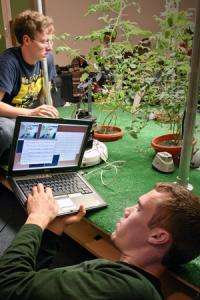
Luke Johnson and Sam Dyar program an autonomous robotic arm. Photo: Jason Dorfman

(PhysOrg.com) -- In the middle of MIT’s Computer Science and Artificial Intelligence Lab (CSAIL) sits a platform of fake grass with tomato plants nestled in terra cotta pots, growing under the light of an artificial sun. But this urban, indoor garden has a twist: the caretakers of the plants are entirely robotic.

The idea for tending to a garden without human hands came from work done by Nikolaus Correll, a postdoctoral assistant working in MIT Professor Daniela Rus’ Distributed Robotics Lab. Correll saw the possible applications of swarm robotics to an agricultural environment and thus the idea grew into a course in which students created robots capable of tending a small garden of tomatoes.

Each is outfitted with a and a watering pump, while the themselves are equipped with local soil sensing, networking and computation. This affords them the ability to communicate: plants can request water or nutrients and keep track of their conditions, including fruit produced; robots are able to minister to their charges, locate and pick a specific tomato, and even pollinate the plants.

A tool called LCM, or Lightweight Communications Marshaller, was used to allow the different robotic modules to communicate; the version used in the project came from the DARPA Grand Challenge Vehicle. The object recognition software is built on the back of LabelMe, an image annotation tool pioneered by Bryan Russell and Professors Antonio Torralba and Bill Freeman. And the robotic bases themselves? Re-imagined versions of iRobot’s Roomba.

The system, which Rus refers to as precision , has a double advantage over the way crops are currently cultivated and harvested. First, due to each plant’s ability to monitor and broadcast its own physical state, water, nutrients and care will be dispensed on an as-needed basis. This should allow for a great reduction in resources consumed in the growth process, ameliorating the heavy carbon footprint of today’s agriculture. Furthermore, a mechanical harvest removes the backbreaking work currently involved in reaping specialty crops such as fruits and vegetables.

In the long view, the researchers hope to develop a fully autonomous greenhouse, complete with robots, pots, and plants connected via computation, sensing and communication.

Correll is optimistic about future applications of the project and others like it. Looking past agriculture, he ruminated on other tasks to which this sort of system can be applied down the line. Tasks, for example, like automating services for older adults with low mobility in residential care facilities, or tending to plants in greenhouses or hydroponic farms. The technology, once perfected, is immensely adaptable, and hints at an exciting future of collaboration between humans, the natural world, and our machines, he said.

Provided by MIT

Explore further: Robots learn to take a proper handoff by following digitized human examples

add to favorites email to friend print save as pdf

Related Stories

MIT's Huggable Robot Teddy Enhances Human Relationships

Dec 17, 2008

(PhysOrg.com) -- It's probably the most sophisticated teddy bear ever designed, but that doesn't stop MIT's companion robot called "the Huggable" from being pretty adorable, as well. The Huggable is the latest ...

Meet Nexi, MIT Media Lab's latest robot and Internet star

Apr 10, 2008

A new experimental robot from the MIT Media Lab can slant its eyebrows in anger, or raise them in surprise, and show a wide assortment of facial expressions to communicate with people in human-centric terms. Called Nexi, ...

Genomics Research Focuses on Rice Variety Improvement

Jul 01, 2008

Crop varieties can be improved through the study of genomics without creating genetically transformed varieties. That is the mission of a multistate research project led by the University of Arkansas System’s Division of ...

Robotic ants building homes on Mars?

Oct 21, 2008

(PhysOrg.com) -- Recent discoveries of water and Earth-like soil on Mars have set imaginations running wild that human beings may one day colonise the Red Planet. However, the first inhabitants might not be ...

Two Robot Chefs Make Omelets

Dec 04, 2008

(PhysOrg.com) -- No "house of the future" is complete without a household robot to do the cooking and cleaning. Although today´s robots still have a ways to go before substituting for a real live-in maid, ...

Proving That Shape-Shifting Robots Can Get a Move On

Sep 16, 2004

It started with tennis balls. As a former collegiate tennis player, Daniela Rus habitually rolls two tennis balls around in her hand as she paces her office. As a robotics researcher at Dartmouth College, she ...

Recommended for you

First Look: New Xbox elegant, but much unknown

27 minutes ago

Will gamers want One? After four years of development, Microsoft unveiled the Xbox One entertainment console and touted it as an all-in-one solution for playing games, watching TV and doing everything in ...

The new consoles from Microsoft, Nintendo and Sony

13 hours ago

Microsoft is the last of the three big video game console makers to unveil its latest gaming system. Tuesday's unveiling comes nearly eight years after the Xbox 360 went on sale. It follows last fall's de ...

Microsoft readies new Xbox as entertainment hub

May 21, 2013

Microsoft offers a glimpse Tuesday at a new-generation Xbox as videogame consoles evolve into home entertainment centers and adapt to competition from smartphones and tablets.

Finnish start-up launches smartphone to rival giants

May 20, 2013

A group of ex-Nokia employees who quit over the company's decision to abandon the planned MeeGo operating system in favour of Windows presented their own smartphone on Monday, hoping to rival the sector's ...

User comments : 3

Adjust slider to filter visible comments by rank

Display comments: newest first

Szkeptik
not rated yet Mar 10, 2009
Nice experiment, but this is faaaaar away from being actually applied anywhere.
sstritt
not rated yet Mar 10, 2009
WOW! I would have been impressed by tomato-tending robots but this is phenomenal!
aroven
not rated yet Mar 11, 2009
"plants can request water or nutrients and keep track of their conditions"

uh... no, they can't. The sensors in the soil do that.

en.wikipedia.org/wiki/Pathetic_fallacy

More news stories

First Look: New Xbox elegant, but much unknown

Will gamers want One? After four years of development, Microsoft unveiled the Xbox One entertainment console and touted it as an all-in-one solution for playing games, watching TV and doing everything in ...

The new consoles from Microsoft, Nintendo and Sony

Microsoft is the last of the three big video game console makers to unveil its latest gaming system. Tuesday's unveiling comes nearly eight years after the Xbox 360 went on sale. It follows last fall's de ...

Expectations high for next Xbox

It's almost time for a new Xbox. Eight years have passed since Microsoft unveiled the Xbox 360, double the amount of time between the original Xbox debut in 2001 and its high-definition successor's launch ...

Apple case seen as possible spur to tax action

Now that tech favorite Apple Inc. has been dragged front and center into the debate over the U.S. tax code, lawmakers are hoping that the spotlight on such a high-profile company could be the catalyst for ...

Australia set to cull 10,000 wild horses

A controversial cull of up to 10,000 wild horses in Australia's harsh Outback reportedly began Wednesday in a bid to control the feral animals which officials say are destroying the land.

Study says empathy plays a key role in moral judgments

Is it permissible to harm one to save many? Those who tend to say "yes" when faced with this classic dilemma are likely to be deficient in a specific kind of empathy, according to a report published in the scientific journal ...