'Nanostitching' could strengthen airplane skins, more
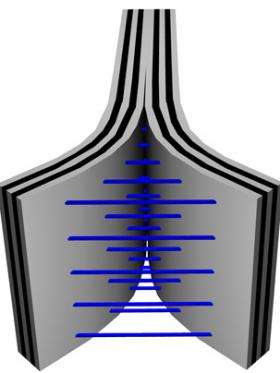
MIT engineers are using carbon nanotubes only billionths of a meter thick to stitch together aerospace materials in work that could make airplane skins and other products some 10 times stronger at a nominal increase in cost.
Moreover, advanced composites reinforced with nanotubes are also more than one million times more electrically conductive than their counterparts without nanotubes, meaning aircraft built with such materials would have greater protection against damage from lightning, said Brian L. Wardle, the Charles Stark Draper Assistant Professor in the Department of Aeronautics and Astronautics.
Wardle is lead author of a theoretical paper on the new nanotube-reinforced composites that will appear in the Journal of Composite Materials (http://jcm.sagepub.com/). He also described the work as keynote speaker at a Society of Plastics Engineers conference this week.
The advanced materials currently used for many aerospace applications are composed of layers, or plies, of carbon fibers that in turn are held together with a polymer glue. But that glue can crack and otherwise result in the carbon-fiber plies coming apart. As a result, engineers have explored a variety of ways to reinforce the interface between the layers by stitching, braiding, weaving or pinning them together.
All of these processes, however, are problematic because the relatively large stitches or pins penetrate and damage the carbon-fiber plies themselves. "And those fiber plies are what make composites so strong," Wardle said.
So Wardle wondered whether it would make sense to reinforce the plies in advanced composites with nanotubes aligned perpendicular to the carbon-fiber plies. Using computer models of how such a material would fracture, "we convinced ourselves that reinforcing with nanotubes should work far better than all other approaches," Wardle said. His team went on to develop processing techniques for creating the nanotubes and for incorporating them into existing aerospace composites, work that was published last year in two separate journals.
How does nanostitching work? The polymer glue between two carbon-fiber layers is heated, becoming more liquid-like. Billions of nanotubes positioned perpendicular to each carbon-fiber layer are then sucked up into the glue on both sides of each layer. Because the nanotubes are 1000 times smaller than the carbon fibers, they don't detrimentally affect the much larger carbon fibers, but instead fill the spaces around them, stitching the layers together.
"So we're putting the strongest fibers known to humankind [the nanotubes] in the place where the composite is weakest, and where they're needed most," Wardle said. He noted that these dramatic improvements can be achieved with nanotubes comprising less than one percent of the mass of the overall composite. In addition, he said, the nanotubes should add only a few percent to the cost of the composite, "while providing substantial improvements in bulk multifunctional properties."
Source: Massachusetts Institute of Technology


