China plans space station with module launch in 2010
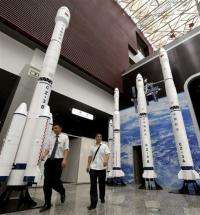
China will launch a space module next year and carry out the nation's first space docking in 2011 as a step towards its goal of building a space station, state media said Sunday.
The Tiangong-1, or "Heavenly Palace-1" is scheduled for launch in late 2010 and will dock with a Shenzhou-8 spacecraft early the following year, Xinhua news agency said, citing officials with China's space programme.
"The module, named Tiangong-1, is designed to provide a 'safe room' for Chinese astronauts to live and conduct scientific research in zero gravity," the report said.
"Weighing about 8.5 tonnes, Tiangong-1 is able to perform long-term unattended operation, which will be an essential step toward building a space station."
Space programme officials have previously said China is expected to place in orbit several modules like the Tiangong and link them up to form a semi-permanent space platform.
It was not immediately clear if the Tiangong-1 would eventually serve as China's first manned space station, or whether it would be a base to test docking and space station technology.
The planned 2011 docking would be remotely carried out by scientists on the ground and would not involve astronauts, the report said.
The announcement of the Tiangong mission came as China's first lunar probe, the Chang'e-1 impacted the moon's surface Sunday afternoon, after a nearly 16 month mission photographing and mapping the lunar surface, Xinhua said in a separate report.
The Chang'e-1 was launched on October 24, 2007, signalling China's rising space ambitions and Beijing's participation in a renewed race against Asian rivals Japan and India to explore the moon.
The probe, named after a legendary Chinese goddess who flew to the moon, is the first stage of China's lunar programme, which includes landing an unmanned rover on the surface by 2012 and a manned mission by around 2020.
China became the third nation to put a man in space when Yang Liwei piloted the one-man Shenzhou-5 space mission in 2003.
Last September, the Shenzhou-7, piloted by three "taikonauts" or astronauts, carried out China's first space walk.
This year, China's space programme will focus on building several prototypes of the Tiangong, while upgrades to the carrier rocket that will launch the module into space would also be carried out, Xinhua said.
Following the Shenzhou-8 flight, China also hopes to begin the mass production of Shenzhou spacecraft which will be used to transport astronauts to the space station, it said.
The International Space Station began with the launch into orbit of the first station element, a Russian-built module on November 20, 1998.
It orbits 350 kilometres (190 miles) above the earth's surface with a permanent crew of three astronauts, who remain aboard for stays lasting several months.
(c) 2009 AFP


