Otherworldly Solar Eclipse
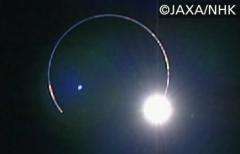
For the first time, a spacecraft from Earth has captured hi-resolution images of a solar eclipse while orbiting another world.
Japan's Kaguya lunar orbiter accomplished the feat on Feb. 9, 2009, when the Sun, Earth and Moon lined up in a nearly perfect row. From Kaguya's point of view, Earth moved in front of the Sun, producing an otherworldly "diamond-ring" eclipse. Click here to launch a movie of the event recorded by Kaguya's onboard HDTV camera.
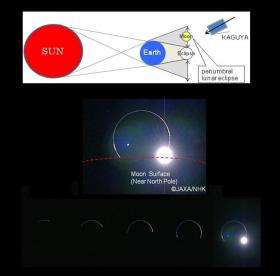
The sequence begins in complete darkness. At first, Kaguya couldn't see the eclipse because it was blocked by the lunar horizon: see diagram. Soon, however, the viewing angle improves and a thin ring of light appears. This is Earth's atmosphere backlit by the sun. (Inside that ring, sleepy-headed Earthlings are experiencing the first light of dawn.) Just as the arc is about to join ends to complete the circle—bloom! A sliver of the Sun's disk emerges, bringing the eclipse to a sudden, luminous end.
Kaguya is the largest mission to the Moon since the Apollo program. Launched in late 2007, the spacecraft consists of a mother ship plus two smaller orbiters that work together to relay data to Earth even from the Moon's farside. Kaguya bristles with 13 scientific instruments powered by 3.5 kilowatts of electricity, enough to light up good-sized home on Earth. So far the spacecraft has laser-mapped the Moon's surface in 3D, searched polar craters for signs of lunar ice, probed the gravitational field of the farside of the Moon—and much more.
The eclipse images are a bonus. Strictly speaking, Kaguya's HDTV cameras (there are two of them) are not part of the scientific payload. They were included on the spacecraft as a means of outreach—to share Kaguya's view with Japanese citizens. Near real-time transmissions broadcast on Japanese public television are reportedly very popular.
Kaguya's cameras would have come in handy forty years ago.
On April 24, 1967, NASA's Surveyor 3 lunar lander witnessed an Earth-eclipse of the Sun from a crater in Mare Cognitium. Only a crude snapshot, right, chronicles the event.
In Nov. 1969, Apollo 12 astronauts saw their own diamond ring. It was "a marvelous sight," said Alan Bean. He was flying home from the Moon along with crewmates Pete Conrad and Dick Gordon when their spaceship flew through Earth's shadow. "Our home planet [eclipsed] our own star," he marveled. Bean's photo of the event (click here) improved upon Surveyor 3's, but couldn't match Kaguya's modern video.
Later this year, NASA will up the ante with the launch of Lunar Reconnaissance Orbiter (LRO). The probe carries its own suite of advanced scientific instruments including a camera powerful enough to capture the outlines of moonbuggies and other hardware left behind on the lunar surface by Apollo astronauts. Not even Hubble has been able to do that.
When LRO reaches the Moon, it will join Japan's Kaguya, China's Chang'e-1 and India's Chandrayaan-1 missions already in orbit. Never before has such an international fleet assembled for lunar research. With so many spacecraft on duty, it is only a matter of time before Kaguya's eclipse is itself eclipsed by something even more marvelous. Stay tuned.
Provided by Dr. Tony Phillips, Science@NASA


