Geriatric pulsar still kicking
Feb 26, 2009
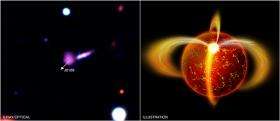
Credit: X-ray: NASA/CXC/Penn State/G.Pavlov et al.; Optical: ESO/VLT/UCL/R.Mignani et al.; Illustration: NASA/CXC/M.Weiss.

(PhysOrg.com) -- The oldest isolated pulsar ever detected in X-rays has been found with NASA's Chandra X-ray Observatory. This very old and exotic object turns out to be surprisingly active.

The pulsar, PSR J0108-1431 (J0108 for short) is about 200 million years old. Among isolated pulsars -- ones that have not been spun-up in a binary system -- it is over 10 times older than the previous record holder with an X-ray detection. At a distance of 770 light years, it is one of the nearest pulsars known.

Pulsars are born when stars that are much more massive than the Sun collapse in supernova explosions, leaving behind a small, incredibly weighty core, known as a neutron star. At birth, these neutron stars, which contain the densest material known in the Universe, are spinning rapidly, up to a hundred revolutions per second. As the rotating beams of their radiation are seen as pulses by distant observers, similar to a lighthouse beam, astronomers call them "pulsars".

Astronomers observe a gradual slowing of the rotation of the pulsars as they radiate energy away. Radio observations of J0108 show it to be one of the oldest and faintest pulsars known, spinning only slightly faster than one revolution per second.

The surprise came when a team of astronomers led by George Pavlov of Penn State University observed J0108 in X-rays with Chandra. They found that it glows much brighter in X-rays than was expected for a pulsar of such advanced years.

Some of the energy that J0108 is losing as it spins more slowly is converted into X-ray radiation. The efficiency of this process for J0108 is found to be higher than for any other known pulsar.

"This pulsar is pumping out high-energy radiation much more efficiently than its younger cousins," said Pavlov. "So, although it's clearly fading as it ages, it is still more than holding its own with the younger generations."

It's likely that two forms of X-ray emission are produced in J0108: emission from particles spiraling around magnetic fields, and emission from heated areas around the neutron star's magnetic poles. Measuring the temperature and size of these heated regions can provide valuable insight into the extraordinary properties of the neutron star surface and the process by which charged particles are accelerated by the pulsar.

The younger, bright pulsars commonly detected by radio and X-ray telescopes are not representative of the full population of objects, so observing objects like J0108 helps astronomers see a more complete range of behavior. At its advanced age, J0108 is close to the so-called "pulsar death line," where its pulsed radiation is expected to switch off and it will become much harder, if not impossible, to observe.

"We can now explore the properties of this pulsar in a regime where no other pulsar has been detected outside the radio range," said co-author Oleg Kargaltsev of the University of Florida. "To understand the properties of 'dying pulsars,' it is important to study their radiation in X-rays. Our finding that a very old pulsar can be such an efficient X-ray emitter gives us hope to discover new nearby pulsars of this class via their X-ray emission."

The Chandra observations were reported by Pavlov and colleagues in the January 20, 2009, issue of The Astrophysical Journal. However, the extreme nature of J0108 was not fully apparent until a new distance to it was reported on February 6 in the PhD thesis of Adam Deller from Swinburne University in
Australia. The new distance is both larger and more accurate than the distance used in the Chandra paper, showing that J0108 was brighter in X-rays than previously thought.

"Suddenly this pulsar became the record holder for its ability to make X-rays,"
said Pavlov, "and our result became even more interesting without us doing much extra work."

The position of the pulsar seen by Chandra in X-rays in early 2007 is slightly different from the radio position observed in early 2001. This implies that the pulsar is moving at a velocity of about 440,000 miles per hour, close to a typical value for pulsars.

Currently the pulsar is moving south from the plane of the Milky Way galaxy, but because it is moving more slowly than the escape velocity of the Galaxy, it will eventually curve back towards the plane of the Galaxy in the opposite direction.

The detection of this motion has allowed Roberto Mignani of University College London, in collaboration with Pavlov and Kargaltsev, to possibly detect J0108 in optical light, using estimates of where it should be found in an image taken in 2000. Such a multi-wavelength study of old pulsars is critical for understanding the long-term evolution of neutron stars, such as how they cool with time, and how their powerful magnetic fields evolve.

The team of astronomers that worked with Pavlov also included Gordon Garmire and Jared Wong at Penn State. NASA's Marshall Space Flight Center in Huntsville, Ala., manages the Chandra program for NASA's Science Mission Directorate in Washington. The Smithsonian Astrophysical Observatory controls Chandra's science and flight operations from Cambridge, Mass.

Source: Chandra X-ray Center

Explore further: Hubble reveals the ring nebula's true shape

add to favorites email to friend print save as pdf

Related Stories

Fermi's motion produces a study in spirograph

Feb 27, 2013

(Phys.org)—NASA's Fermi Gamma-ray Space Telescope orbits our planet every 95 minutes, building up increasingly deeper views of the universe with every circuit. Its wide-eyed Large Area Telescope (LAT) sweeps ...

Pulsar jackpot scours old data for new discoveries

Feb 28, 2013

Chalk another one up for Citizen Science.  Earlier this month, researchers announced the discovery of 24 new pulsars. To date, thousands of pulsars have been discovered, but what's truly fascinating abou ...

NASA Goddard astrophysicist wins prize for pulsar work

Feb 04, 2013

To say that Alice Harding, an astrophysicist at NASA's Goddard Space Flight Center in Greenbelt, Md., has a passion for pulsars is a bit of an understatement. On Jan. 24, she was named a winner of the 2013 ...

Vela Pulsar

Jan 08, 2013

(Phys.org)—This movie from NASA's Chandra X-ray Observatory shows a fast moving jet of particles produced by a rapidly rotating neutron star, and may provide new insight into the nature of some of the densest ...

Recommended for you

Hubble reveals the ring nebula's true shape

12 hours ago

(Phys.org) —The Ring Nebula's distinctive shape makes it a popular illustration for astronomy books. But new observations by NASA's Hubble Space Telescope of the glowing gas shroud around an old, dying, ...

A hidden population of exotic neutron stars

17 hours ago

(Phys.org) —Magnetars – the dense remains of dead stars that erupt sporadically with bursts of high-energy radiation - are some of the most extreme objects known in the Universe. A major campaign using ...

Very Large Telescope celebrates 15 years of success

22 hours ago

(Phys.org) —With this new view of a spectacular stellar nursery ESO is celebrating 15 years of the Very Large Telescope—the world's most advanced optical instrument. This picture reveals thick clumps ...

Fragile mega-galaxy is missing link in history of cosmos

May 22, 2013

Two hungry young galaxies that collided 11 billion years ago are rapidly forming a massive galaxy about 10 times the size of the Milky Way, according to UC Irvine-led research published Wednesday in the journal ...

User comments : 7

Adjust slider to filter visible comments by rank

Display comments: newest first

earls
1 / 5 (7) Feb 26, 2009
These "things" are spinning contradictions. Virtually completely theoretical, I would argue aspects of the article, but we might as well be talking about the number of hairs on the Easter Bunny.
earls
3 / 5 (4) Feb 27, 2009
You disagree, but have nothing smart to say. No surprise there.
smiffy
not rated yet Feb 27, 2009
I'm at a loss to understand how an electrically neutral body can generate any magnetic field or EMR, let alone huge quantities of both.

Is my understanding of Electromagnetic theory remiss? Or my understanding of Neutron stars? Both maybe?
earls
1 / 5 (2) Feb 27, 2009
It's the magic super-fluid interior, smiffy. The incredible rate of rotation produces an incredible dynamo effect which produces an incredible magnetic field. So the numbers say.
earls
1 / 5 (2) Feb 27, 2009
And just for the record, no success yet creating an artificial dynamo:

http://complex.umd.edu/

http://complex.umd.edu/interestingdata/

Induced magnetic fields, sure... Which are consistent with the dynamo effect theory:

http://abyss.uore...ect.html

Just don't forget there has to be an initial external magnetic field FIRST.
smiffy
not rated yet Feb 27, 2009
It's the magic super-fluid interior
I suppose my problem with that explanation (ignoring the sarcastic tone for a moment) is that if there is superfluidity the I would expect any ionized particles to be mobile enough to find each other and thereby neutralise themselves. Is there supposed to be some sort of centrifuge effect which keeps them apart? And if so, how come this isn't discharged by the equivalent of lightning? Not to mention the independence of the magnetic axis to the spin axis.
But then again I still haven't understood how the Earth can produce a magnetic field; and that certainly exists.
earls
1 / 5 (1) Feb 27, 2009
Heat, pressure, gravity, quarks, oh my.

Like I said in my original post, there's no solid data or understanding about these objects. Besides the "known facts" (rate of spin, result of supernova, radiation produced) they are purely mathematical constructs.

http://en.wikiped...ron_star

???

What's really odd is that they're not running out of energy (despite the energies radiated), which is pretty much the point of this article.

More news stories

A hidden population of exotic neutron stars

(Phys.org) —Magnetars – the dense remains of dead stars that erupt sporadically with bursts of high-energy radiation - are some of the most extreme objects known in the Universe. A major campaign using ...

Hubble reveals the ring nebula's true shape

(Phys.org) —The Ring Nebula's distinctive shape makes it a popular illustration for astronomy books. But new observations by NASA's Hubble Space Telescope of the glowing gas shroud around an old, dying, ...

Century-old science helps confirm global warming

(Phys.org) —Ocean measurements taken more than 135 years ago during the scientific expedition of HMS Challenger have provided further confirmation of human-produced global warming over the past century.

Hormone replacement therapy—clarity at last

The British Menopause Society and Women's Health Concern have today released updated guidelines on Hormone Replacement Therapy (HRT) to provide clarity around the role of HRT, the benefits and the risks. The new guidelines ...

Controlling mood through the motions of mitochondria

(Medical Xpress)—Regulating the distribution of power in neurons is done by a system that makes the national electric grid look simple by comparison. Each neuron has several thousand mitochondria confined ...

A quantum simulator for magnetic materials

Physicists understand perfectly well why a fridge magnet sticks to certain metallic surfaces. But there are more exotic forms of magnetism whose properties remain unclear, despite decades of intense research. ...