Researchers shed light on how proteins find their shapes
Feb 23, 2009
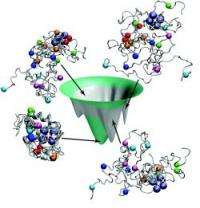
The UCSD model of the folding energy landscape for cytochrome c. The landscape was probed experimentally at Caltech, using time-resolved fluorescence energy transfer from six donor labels (represented as single spheres of differing colors) to the heme acceptor. [Credit: Peter Weinkam, UCSD]

(PhysOrg.com) -- Researchers from the California Institute of Technology (Caltech) and the University of California at San Diego (UCSD) have brought together UCSD theoretical modeling and Caltech experimental data to show just how amino-acid chains might fold up into unique, three-dimensional functional proteins.

Their insights were recently published in the February 10 issue of the Proceedings of the National Academy of Sciences (PNAS).

The paper details the matching of a series of protein-folding models created by the UCSD team (led by Peter Wolynes, UCSD professor of chemistry and biochemistry and physics) with experimental data gathered using a novel technique created by the Caltech team (led by Faculty Associate in Chemistry Jay Winkler and Harry Gray, Caltech's Arnold O. Beckman Professor of Chemistry and founding director of the Beckman Institute).

The Winkler-Gray method of watching proteins as they crumple and fold involves the use of a picosecond camera that captures fluorescent flashes as a laser pulse excites a donor probe, which emits light and transfers that light to an acceptor probe. The distance between the donor and acceptor change as the amino-acid chain transforms itself into a three-dimensional protein.

In the PNAS paper, the two groups combined the Caltech experimental technique--first described in a 2002 paper published in the Journal of the American Chemical Society--with Wolynes's protein-folding models to see if they could come up with the precise folding pattern of cytochrome c, a protein that is part of the mitochondrial electron-transfer chain that turns food into cellular energy.

At first the models and the experimental data seemed to be describing two entirely different things, according to Winkler. "The researchers had to account for charge-charge interactions between amino acids that appear to be important--the way that like charges repel and opposite charges attract," he explains. "And they had to consider the hydrophobic interactions--the way that oily parts of the proteins like to stick together but are repelled by the watery parts. When their models took account of these interactions, it fit the experimental data."

"It was the first time anyone has been able to develop a theoretical model able to account for the results we've been getting with our time-resolved energy-transfer experiments," adds Gray.

Other coauthors on the PNAS paper, entitled "Electrostatic effects on funneled landscapes and structural diversity in denatured protein ensembles," are Patrick Weinkam from UCSD and Ekaterina Pletneva, formerly at Caltech and now at Dartmouth College.

Source: California Institute of Technology

Explore further: Researchers discover a way to detect new viruses

add to favorites email to friend print save as pdf

Related Stories

Study uncovers secrets of biological soil crusts

Jun 14, 2013

They lie dormant for years, but at the first sign of favorable conditions they awaken. This sounds like the tagline for a science fiction movie, but it describes the amazing life-cycles of microbial organisms ...

Mathematical models to better combat HIV

May 31, 2013

The first few hours to days following exposure to human immunodeficiency virus (HIV) can be of critical importance in determining if infection occurs in a patient. But the low numbers of viruses and infected cells at this ...

Recommended for you

Long distance calls by sugar molecules

14 hours ago

All our cells wear a coat of sugar molecules, so-called glycans. ETH Zurich and Empa researchers have now discovered that glycans rearrange water molecules over long distances. This may have an effect on ...

Researchers discover a way to detect new viruses

Jun 17, 2013

(Phys.org) —In research published in Biochemical and Biophysical Research Communications, Saint Louis University researchers describe a technology that can detect new, previously unknown viruses. The te ...

Genomic assay as an alternative to animal testing

Jun 14, 2013

The method developed by the group in Lund is based on human cells grown in a laboratory. The cells are exposed to a chemical and then parts of their genetic content are filtered out and transferred to a microchip.

User comments : 0

More news stories

Long distance calls by sugar molecules

All our cells wear a coat of sugar molecules, so-called glycans. ETH Zurich and Empa researchers have now discovered that glycans rearrange water molecules over long distances. This may have an effect on ...

Counting small RNA in disease-causing organisms

Small molecules of RNA (tens to hundreds of nucleotides in length) play a key regulatory role in bacteria. Due to their small size, directly measuring the number of small RNA (sRNA) present in a single bacterium ...

Dish won't submit revised bid for Sprint

Satellite TV operator Dish Network Corp. said Tuesday it would not submit a revised bid for Sprint, leaving the path open for the wireless carrier to accept what it already considers a superior offer from Japan's Softbank.

Cape Wind gets $200M investment from Danish fund

The Cape Wind offshore wind project has secured a $200 million investment from a Danish pension fund in what the wind farm's president said Tuesday is a milestone for the long-delayed project.