Samsung Announces First Validated 40-nanometer Class DRAM
Feb 05, 2009

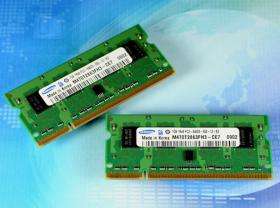
Samsung Electronics announced today that it has developed and validated the first 40-nanometer (nm) class DRAM chip and module. This new 1-Gigabit DDR2 component (x8) and a corresponding 1-Gigabyte 800Mbps (Megabits per second) DDR2 SODIMM (small outline DRAM inline memory module) - both to be processed at 40-nm - have been certified in the Intel Platform Validation program for use with the Intel GM45 series Express mobile chipsets.

"Securing extremely advanced technology and system/platform validated operability underscores our commitment as technology leader to deploying the most efficient means of producing DRAM in the marketplace," said Kevin Lee, vice president, technical marketing, Samsung Semiconductor, Inc.

The migration to 40-nm class process technology is expected to accelerate the time-to-market cycle by 50 percent - to just one year. Samsung plans to apply its 40-nm class technology to also develop a 2Gb DDR3 device for mass production by the end of 2009.

The new 40-nm class process technology will drive further reductions in voltage against a 50-nm class device, which Samsung expects to translate into about a 30 percent power savings

The finer DRAM technology node also delivers an approximately 60 percent increase in productivity over 50-nm class process technology.

In addition, Samsung expects that its 40-nm process node will mark a significant step toward the development of next generation, ultra-high performance DRAM technologies such as DDR4.

Provided by Samsung

Explore further: Congress gets mixed advice on regulating drones

add to favorites email to friend print save as pdf

Related Stories

Recommended for you

Congress gets mixed advice on regulating drones

May 17, 2013

(AP)—The growing use of unmanned surveillance "eyes in the sky" aircraft raises a thicket of privacy concerns, but the U.S. Congress is getting mixed advice on what, if anything, to do about it.

Makr Shakr uses three arms for drink-recipe collabs

May 15, 2013

(Phys.org) —We're told it's the wave of the future. Design, make, enjoy. Beyond home-based 3-D printers, there will be new machines and display screens and apps that will invite you to have day to day products ...

Nokia unveils metallic smartphone, stock tumbles (Update)

May 14, 2013

Nokia Corp. on Tuesday unveiled its first Lumia smartphone with a metal cover, low-light camera features and new social network apps. But the new model failed to impress investors, who sent the company's stock down more than ...

User comments : 0

More news stories

Congress gets mixed advice on regulating drones

(AP)—The growing use of unmanned surveillance "eyes in the sky" aircraft raises a thicket of privacy concerns, but the U.S. Congress is getting mixed advice on what, if anything, to do about it.

Makr Shakr uses three arms for drink-recipe collabs

(Phys.org) —We're told it's the wave of the future. Design, make, enjoy. Beyond home-based 3-D printers, there will be new machines and display screens and apps that will invite you to have day to day products ...

RIM unveils cheaper BlackBerry (Update 2)

Research In Motion unveiled a lower-cost BlackBerry aimed at consumers in emerging markets on Tuesday, and said it will offer its once-popular BlackBerry Messenger service on iPhones and devices running Google's ...

Morocco to harness the wind in energy hunt

Morocco is ploughing ahead with a programme to boost wind energy production, particularly in the southern Tarfaya region, where Africa's largest wind farm is set to open in 2014.

Galaxy's Ring of Fire

Johnny Cash may have preferred this galaxy's burning ring of fire to the one he sang about falling into in his popular song. The "starburst ring" seen at center in red and yellow hues is not the product of ...