Helium rains inside Jovian planets
Jan 26, 2009
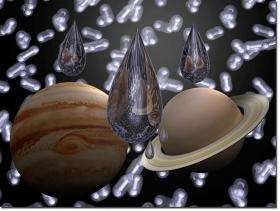
As Jupiter and Saturn cool, the interior of the planets will approach temperatures where hydrogen and helium no longer mix. This process, which is likely to have already occurred in Saturn, could lead to the formation of helium droplets that would "rain down" towards the center of the planet and provide an additional source of heat. Illustration by Jonathan DuBois

(PhysOrg.com) -- Models of how Saturn and Jupiter formed may soon take on a different look.

By determining the properties of hydrogen-helium mixtures at the millions of atmospheres of pressure present in the interior of Saturn and Jupiter, physicists at Lawrence Livermore National Laboratory and the University of Illinois at Urbana-Champaign have determined the temperature at a given pressure when helium becomes insoluble in dense metallic hydrogen. The results are directly relevant to models of the interior structure and evolution of Jovian planets.

Hydrogen and helium are the two lightest and most common elements in the universe. Because of their ubiquitous nature, they are critical in cosmological nucleosynthesis and are essential elements of stars and giant planets. Hydrogen by itself in the observable universe provides clues to the origin and large-scale structures of galaxies.

However, scientists have struggled to determine what conditions are needed for the two elements to mix.

Using first-principle molecular dynamics simulations, Miguel Morales, a DOE Stewardship Science graduate fellow from David Ceperley’s group at the University of Illinois worked with LLNL’s Eric Schwegler, Sebastien Hamel, Kyle Caspersen and Carlo Pierleoni from the University of L’Aquila in Italy to determine the equation of state of the hydrogen-helium system at extremely high temperatures (4,000-10,000 degrees Kelvin), similar to what would be found in the interior of Saturn and Jupiter.

The team used LLNL’s extensive high-performance computing facilities to conduct simulations over a wide range of density, temperature and composition to locate the equation of state of the two elements.

“Our simulation results are consistent with the idea that a large portion of the interior of Saturn has conditions such that hydrogen and helium phase separate,” Morales said. “This can account for the apparent discrepancy between the current evolutionary models for Saturn and observational data.”

In addition to being made mostly of hydrogen and helium, a characteristic of Jovian planets is that they radiate more energy than they take in from the sun. Various models of their evolution and structure have been developed to describe a relation between the age, volume and mass of the planet and its luminosity.

While this model works for Jupiter by modeling the energy radiation left over from its formation 4.55 billion years ago, it doesn’t exactly work for Saturn. Instead, the model seriously underestimates the current luminosity of Saturn.

So the researchers decided to try something different. They determined where helium and hydrogen mix as well as at what temperature they don’t mix.

It turned out the temperature where the two elements don’t mix is high enough that helium is “partially mixable over a significant fraction of the interior of the Jovian planets with the corresponding region of Saturn being larger than in Jupiter,” Schwegler said. “This, in fact, could change the current interior models of Saturn and Jupiter.”

The new findings appear in the Jan. 26 online edition of the journal, Proceedings of the National Academy of Science.

Provided by Lawrence Livermore National Laboratory

Explore further: South Africa's new radio telescope reveals giant outbursts from binary star system

add to favorites email to friend print save as pdf

Related Stories

Saturn's youthful appearance explained

Apr 30, 2013

(Phys.org) —As planets age they become darker and cooler. Saturn however is much brighter than expected for a planet of its age - a question that has puzzled scientists since the late sixties. New research ...

By measuring lithium, researchers study star structure

Oct 25, 2012

During its nuclear fusion processes, a burning star does not make the element lithium. Rather, over time, stars consume their lithium supply that was originally created during the Big Bang that gave birth to our universe.

Researchers create "MRI" of the Sun's interior motions

Oct 03, 2012

(Phys.org)—A team of scientists has created an "MRI" of the sun's interior plasma motions, shedding light on how it transfers heat from its deep interior to its surface. The result, which appeared in the ...

Elements of ExoPlanets

Feb 02, 2012

By looking at the wavelengths of light from nearby stars, researchers have determined the abundance of certain elements for more than a hundred stars. Trace elements in such stars may influence their habitable ...

Recommended for you

4C+29.30: Black hole powered jets plow into galaxy

May 15, 2013

(Phys.org) —This composite image of a galaxy illustrates how the intense gravity of a supermassive black hole can be tapped to generate immense power. The image contains X-ray data from NASA's Chandra X-ray ...

A space-time magnifying glass

May 15, 2013

(Phys.org) —Bright arcs are smeared around the heart of galaxy cluster Abell S1077 in this image taken by the NASA/ESA Hubble space telescope. The arcs are stretched images of distant galaxies distorted ...

Orion's hidden fiery ribbon

May 15, 2013

(Phys.org) —This dramatic new image of cosmic clouds in the constellation of Orion reveals what seems to be a fiery ribbon in the sky. This orange glow represents faint light coming from grains of cold ...

User comments : 8

Adjust slider to filter visible comments by rank

Display comments: newest first

LuckyBrandon
1 / 5 (1) Jan 26, 2009
ah who cares...were just gonna tap them out of both in the future anyways
brant
not rated yet Jan 26, 2009
Cuckcoo, cuckcooo....... What next, Jovian cooks with their flames too high?
Mercury_01
not rated yet Jan 27, 2009
Bet that's refreshing, but i think ll still take an umbrella.
theophys
not rated yet Jan 27, 2009
Neato. I thought we only had bomb awesome rains on Titan and Venus, but now it looks like I'll have to plan a summer trip to the Jovians.
Now, do they mean all the Jovians? Because they only mentioned Jupiter and Saturn.
Honor
not rated yet Jan 27, 2009
the monolith is gona turn it into a star anyways.
LuckyBrandon
1 / 5 (1) Jan 29, 2009
honor-
one hell of an idea...and too much stargate...all at one time :D its my favorite show of all time by far, so I aint knockin ya :)
all in all to do so though, it would turn out easier to make a plasma based artificial sun within earth orbit. you figure you would have to increase the pressure in a jovian planet to meet or exceed the pressure within a star at birth to force the hydrogen to fuse. this would be a bi**h to say the least. I'd say 100-200 years and we can do it though. But even then, the additional gravitational pull of a second star in the solar system would completely rearrange the orbits of all celestial objects, most likely resulting in life ending catastrophic results on all colonized planets at the time. So, we'd need to mess up a different solar system, then terra-form, then move there.
theophys
not rated yet Jan 30, 2009
I don't think you could make a viable star out of a jovian planet without adding a bunch of hydrogen to it. You could try compressinga Jupiter-like planet until hydrogen fuses, but do you realise how dense that would have to be? The result would be more like a fireball than a star. It would go up in a flame the size of teaxas(maybe smaller) and would only last long enough to say "ooh, aah" before it ran out of fuel and exploded.
Props for the stargate fans, though.
searcher
not rated yet Feb 11, 2009
An interesting example of mixture separation. Unfortunately, it occures at such high values of pressure and temperature. And so far away to be of practical value...

More news stories

Alaska volcano shoots ash 15,000 feet into the air

(AP)—One of Alaska's most restless volcanoes has shot an ash cloud 15,000 feet into the air in an ongoing eruption that has drawn attention from a nearby community but isn't expected to threaten air traffic.

Chinese, Indian airlines face EU pollution fines

Eight Chinese and two Indian airlines face fines of up to several million euros for not paying for their greenhouse gas emissions during flights within the bloc, the European Commission said on Friday.

Yahoo Japan suspects 22 million IDs stolen

Yahoo Japan Corp. has said it suspects up to 22 million user IDs may have been stolen during an unauthorised attempt to access the administrative system of its Yahoo! Japan portal.

US seizes Bitcoin operator accounts

US authorities seized the accounts of a Bitcoin digital currency exchange operator, claiming it was functioning as an "unlicensed money service business," court documents showed Friday.

Temporal processing in the olfactory system

The neural machinery underlying our olfactory sense continues to be an enigma for neuroscience. A recent review in Neuron seeks to expand traditional ideas about how neurons in the olfactory bulb might encode information about ...