Even stars get fat -- And 'stellar cannibalism' is the reason
Jan 14, 2009
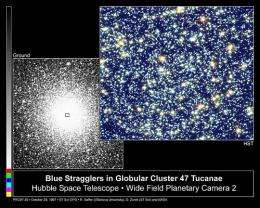
The core of globular cluster 47 Tucanae is home to many blue stragglers, rejuvenated stars that glow with the blue light of young stars. A ground-based telescope image (on the left) shows the entire crowded core of 47 Tucanae, located 15,000 light-years away in the constellation Tucana. Peering into the heart of the globular cluster's bright core, the Hubble Space Telescope's Wide Field and Planetary Camera 2 separated the dense clump of stars into many individual stars (image on right). Some of these stars shine with the light of old stars; others with the blue light of blue stragglers. The yellow circles in the Hubble telescope image highlight several of the cluster's blue stragglers. Analysis for this observation centered on one massive blue straggler. Astronomers theorize that blue stragglers are formed either by the slow merger of stars in a double-star system or by the collision of two unrelated stars. For the blue straggler in 47 Tucanae, astronomers favor the slow merger scenario. This image is a 3-color composite of archival Hubble Wide Field and Planetary Camera 2 images in the ultraviolet (blue), blue (green), and violet (red) filters. Color tables were assigned and scaled so that the red giant stars appear orange, main-sequence stars are white/green, and blue stragglers are appropriately blue. The ultraviolet images were taken on Oct. 25, 1995, and the blue and violet images were taken on Sept. 1, 1995. Credit: Rex Saffer (Villanova University) and Dave Zurek (STScI), and NASA. Credit: NASA Goddard Space Flight Center (NASA-GSFC)

Researchers have discovered evidence that blue stragglers in globular clusters, whose existence has long puzzled astronomers, are the result of 'stellar cannibalism' in binary stars. In other words, binary stars are eating each other and turning into a blue straggler.

The findings appear in the most recent issue of Nature, published today.

According to conventional theories, blue stragglers—massive rogue stars within globular clusters of about 100,000 stars—should have died long ago because all stars in a cluster are born at the same time. And yet the chubby blue stragglers, though they appear young, are found in virtually every observed cluster.

"We've known of these star abnormalities for 55 years now," says Alison Sills, associate professor in the Department of Physics & Astronomy at McMaster University. "Over time two main theories have emerged: that blue stragglers were created through collisions with other stars; or that one star in a binary system was 'reborn' by pulling matter off its companion."

Sills and her colleagues—Nathan Leigh, a PhD student in Physics & Astronomy at McMaster, and Christian Knigge, Reader in the School of Physics and Astronomy at Southampton University—looked at blue stragglers in more than 50 globular clusters. They found that the total number of blue stragglers in a given cluster did not correlate with the predicted collision rate—dispelling theory number one.

But more interestingly, they found a connection between the number of blue stragglers and the mass in the cluster's core, and hence the number of binary stars. This points to "stellar cannibalism" as the primary mechanism for forming blue stragglers.

"This is the strongest and most direct evidence to date that most blue stragglers, even those found in the cluster cores, are the offspring of two stars transferring matter," said Knigge. "In our future work we will want to determine whether the binary parents of blue stragglers evolve mostly in isolation, or whether dynamical encounters with other stars in the clusters are required somewhere along the line in order to explain our results."

This discovery comes as the world celebrates the International Year of Astronomy in 2009.

Source: McMaster University

Explore further: Galaxy's Ring of Fire

add to favorites email to friend print save as pdf

Related Stories

Stars reveal the secrets of looking young

Dec 19, 2012

Some people are in great shape at the age of 90, while others are decrepit before they're 50. We know that how fast people age is only loosely linked to how old they actually are—and may have more to do ...

Stars ancient and modern?

Oct 31, 2012

(Phys.org)—This colourful view of the globular star cluster NGC 6362 was captured by the Wide Field Imager attached to the MPG/ESO 2.2-metre telescope at ESO's La Silla Observatory in Chile. This new picture, ...

Recommended for you

Galaxy's Ring of Fire

May 18, 2013

Johnny Cash may have preferred this galaxy's burning ring of fire to the one he sang about falling into in his popular song. The "starburst ring" seen at center in red and yellow hues is not the product of ...

4C+29.30: Black hole powered jets plow into galaxy

May 15, 2013

(Phys.org) —This composite image of a galaxy illustrates how the intense gravity of a supermassive black hole can be tapped to generate immense power. The image contains X-ray data from NASA's Chandra X-ray ...

A space-time magnifying glass

May 15, 2013

(Phys.org) —Bright arcs are smeared around the heart of galaxy cluster Abell S1077 in this image taken by the NASA/ESA Hubble space telescope. The arcs are stretched images of distant galaxies distorted ...

User comments : 1

Adjust slider to filter visible comments by rank

Display comments: newest first

Thecis
not rated yet Jan 26, 2009
Star hungry...
ding dong

More news stories

Mice, gerbils perish in Russia space flight

A number of mice and eight gerbils sent into space in a Russian capsule destined to find out how well organisms can withstand extended flights perished during their journey, scientists said Sunday as the ...

Fracking risks to ground water assessed

(Phys.org) —Extraction of "unconventional" gas from sedimentary rocks such as shale could provide a clean energy source and help some regions to become energy independent, but concerns have been raised ...

Kinks and curves at the nanoscale

One of the basic principles of nanotechnology is that when you make things extremely small—one nanometer is about five atoms wide, 100,000 times smaller than the diameter of a human hair—they are going ...

Honeybees trained in Croatia to find land mines

(AP)—Mirjana Filipovic is still haunted by the land mine blast that killed her boyfriend and blew off her left leg while on a fishing trip nearly a decade ago. It happened in a field that was supposedly ...

German energy shift faces headwinds

Tense engineers have their eyes peeled on complex colour-coded diagrams on a wall-sized screen that makes their control room look like the inside of a spaceship.