Sensor in artery measures blood pressure
Jan 05, 2009
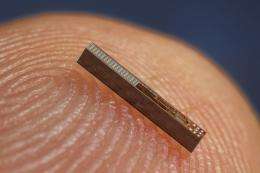
The tiny pressure sensor - depicted here on a finger - measures blood pressure directly in the femoral artery. © Fraunhofer IMS

(PhysOrg.com) -- High blood pressure can be a trial of patience for doctors and for sufferers, whose blood pressure often has to be monitored over a long time until it can be regulated. This will now be made easier by a pressure sensor that is inserted in the femoral artery.

If a person’s blood flows through their arteries at too high a pressure, even when they are lying still on the sofa, they could be in danger. High blood pressure causes the heart to constantly pump at full speed, which strains both the heart and vessel walls. Drugs can provide relief, but in many cases the patient’s blood pressure is still difficult to regulate and has to be consistently monitored over a long period of time. This is a tedious process: Patients have to wear a small case containing the blood pressure meter close to their body.

An inflatable sleeve on their arm records their blood pressure values, for which it is regularly pumped up and deflated. This is a burden on the patients, particularly at night. The whole process is now due to become easier thanks to a tiny implant that could replace the current method. It is being developed by Fraunhofer researchers together with the company Dr. Osypka GmbH and other partners in a BMBF-funded project called “Hyper-IMS” (Intravascular Monitoring System for Hypertension Patients).

“A doctor introduces the pressure sensor directly into the femoral artery in the groin,” explains head of department Dr. Hoc Khiem Trieu of the Fraunhofer Institute for Microelectronic Circuits and Systems IMS in Duisburg.

“The sensor, which has a diameter of about one millimeter including its casing, measures the patient’s blood pressure 30 times per second. It is connected via a flexible micro-cable to a transponder unit, which is likewise implanted in the groin under the skin. This unit digitizes and encodes the data coming from the micro-sensor and transmits them to an external reading device that patients can wear like a cell phone on their belt. From there, the readings can be forwarded to a monitoring station and analyzed by the doctor.” Because the researchers use special components in CMOS technology, the system requires little energy. The micro-implants can be supplied with electricity wirelessly via coils.

Implantable pressure sensors are also suitable for other applications, such as monitoring patients suffering from cardiac insufficiency. The researchers are currently performing the first clinical trials.

Provided by Fraunhofer-Gesellschaft

Explore further: Sensitive bomb detector to rove in search of danger

add to favorites email to friend print save as pdf

Related Stories

Mice, gerbils perish in Russia space flight

May 19, 2013

A number of mice and eight gerbils sent into space in a Russian capsule destined to find out how well organisms can withstand extended flights perished during their journey, scientists said Sunday as the ...

Engineers monitor heart with paper-thin flexible 'skin'

May 15, 2013

(Phys.org) —Engineers combine layers of flexible materials into pressure sensors to create a wearable heart monitor thinner than a dollar bill. The skin-like device could one day provide doctors with a ...

Bubble mattress reduces drag in fluidic chip

May 14, 2013

Researchers at the University of Twente's MESA+ research institute have given the first demonstration of how the drag exerted on liquids flowing through tiny "fluidic chips" is affected by the introduction of diminutive gas ...

Water governs cell movement

May 14, 2013

Water gives life. Researchers at Linköping University in Sweden now show how the cells in our bodies are driven mainly by water power – a discovery that in the long run opens the way for a new strategy ...

Recommended for you

Sensitive bomb detector to rove in search of danger

May 24, 2013

European researchers have developed and tested a light-weight device capable of detecting extremely minute quantities of explosives from up to 20 metres away, providing an invaluable law-enforcement tool ...

How soon could car seats enter the 3-D comfort zone?

May 23, 2013

New 3D textiles made of recyclable polyester fibres could contribute help cars be easier to recycle. But recycling technology has yet to progress in separating seat material from other car components.

NASA: Austin, calling Austin. 3-D pizzas to go

May 22, 2013

(Phys.org) —The idea of living with 3-D printed food is neither unthinkable nor new; designers and futurists have been looking to 3-D printing as food's next frontier. In 2012, there was news that the Thiel ...

User comments : 0

More news stories

Yahoo, pay-TV operators among Hulu bidders

Online video site Hulu is again up for sale, with Yahoo and pay TV operators DirecTV and Time Warner Cable among the seven bidders, according to a person with direct knowledge of the matter.

Radiation leak at Japan lab; small impact expected

An atomic research lab in northern Japan has reported a radiation leak that may have affected about 50 people, though none were hospitalized and no impact was expected outside the facility, the lab's operator ...