Gold nanoparticles for controlled drug delivery
Dec 30, 2008
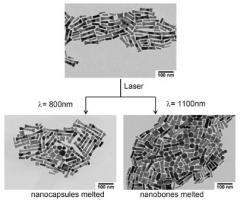
The top image shows a mixture of gold nanoparticles. The longer particles are called nanobones, and the smaller are nanocapsules. Bottom left: After the nanoparticles are hit with 800 nanometer wavelength infrared light, the nanocapsules melt and release their payload. Nanobones remain intact. Right: After the nanoparticles are hit with 1100 nanometer wavelength infrared light, the nanobones melt and release their payload. Nanocapsules remain intact. Image: Andy Wijaya

(PhysOrg.com) -- Using tiny gold particles and infrared light, MIT researchers have developed a drug-delivery system that allows multiple drugs to be released in a controlled fashion.

Such a system could one day be used to provide more control when battling diseases commonly treated with more than one drug, according to the researchers.

"With a lot of diseases, especially cancer and AIDS, you get a synergistic effect with more than one drug," said Kimberly Hamad-Schifferli, assistant professor of biological and mechanical engineering and senior author of a paper on the work that recently appeared in the journal ACS Nano.

Delivery devices already exist that can release two drugs, but the timing of the release must be built into the device — it cannot be controlled from outside the body. The new system is controlled externally and theoretically could deliver up to three or four drugs.

The new technique takes advantage of the fact that when gold nanoparticles are exposed to infrared light, they melt and release drug payloads attached to their surfaces.

Nanoparticles of different shapes respond to different infrared wavelengths, so "just by controlling the infrared wavelength, we can choose the release time" for each drug, said Andy Wijaya, graduate student in chemical engineering and lead author of the paper.

The team built two different shapes of nanoparticles, which they call "nanobones" and "nanocapsules." Nanobones melt at light wavelengths of 1,100 nanometers, and nanocapsules at 800 nanometers.

In the ACS Nano study, the researchers tested the particles with a payload of DNA. Each nanoparticle can carry hundreds of strands of DNA, and could also be engineered to transport other types of drugs.

In theory, up to four different-shaped particles could be developed, each releasing its payload at different wavelengths.

Provided by Massachusetts Institute of Technology

Explore further: Nano-needles can force medicine into cells, even when they resist taking it

add to favorites email to friend print save as pdf

Related Stories

Bovine blood keeps gold nanoparticles stable

May 14, 2013

(Phys.org) —A protein from cow blood has the remarkable ability to keep gold nanoparticles from clumping in a solution. The discovery could lead to improved biomedical applications and contribute to projects ...

Researchers develop chemically specialised germanium surface

Mar 08, 2013

Researchers at the Ruhr Universität Bochum have developed a new method for attaching proteins to the surface of germanium crystals – for the first time also membrane proteins. This enables time-resolved tracking of the ...

Photo-immunotherapy boosts nanoparticle delivery to tumors

Feb 22, 2013

(Phys.org)—One of the main reasons that nanoparticles can boost the effectiveness of an anticancer drug while decreasing its toxicity is that they are able to accumulate at cancerous sites in the body through the abnormally ...

Recommended for you

Radioactive nanoparticles target cancer cells

May 21, 2013

Cancers of all types become most deadly when they metastasize and spread tumors throughout the body. Once cancer has reached this stage, it becomes very difficult for doctors to locate and treat the numerous tumors that can ...

How gold nanoparticles can help fight ovarian cancer

May 21, 2013

Positively charged gold nanoparticles are usually toxic to cells, but cancer cells somehow manage to avoid nanoparticle toxicity. Mayo Clinic researchers found out why, and determined how to make the nanoparticles effective ...

User comments : 0

More news stories

Galaxies fed by funnels of fuel

(Phys.org) —Computer simulations of galaxies growing over billions of years have revealed a likely scenario for how they feed: a cosmic version of swirly straws.