Scientists spend a white Christmas in Antarctica
December 22, 2008

Scientists spend a white Christmas in Antarctica

Enlarge

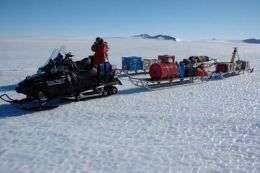
Taking a tea break out on the blue ice. The sledges are loaded with petrol, camping gear, a survival kit, food and of course scientific equipment. All trips out are being used to survey the height of the ice surface using kinematic GPS. The Global Navigation Satellite System (GNSS) antenna mounted on the tripod is on the back of the sledge. The picture shows a blue ice area without snow cover.

(PhysOrg.com) -- The idea of a white Christmas may seem magical for many of us, but spare a thought for a team of scientists forgoing the festive season to take part in a novel campaign being carried out in one of the most inhospitable regions on Earth to support ESA's CryoSat mission.

German scientists from the Technical University of Dresden and the Alfred Wegener Institute are spending up to four months venturing out onto the vast frozen reaches of what is known as the 'blue ice' region near the Russian Novo airbase in Dronning Maud Land in Antarctica. The aim is to take very accurate measurements of the surface topography, both from the air and on the ground to contribute to the validation programme for CryoSat-2.

With diminishing ice cover fast becoming a reality, ESA's CryoSat-2 mission has been designed to measure the exact rate of change in the thickness of both ice floating in the oceans and ice sheets on land. To measure the thickness of relatively thin sea ice as well as survey the surface of ice sheets that are kilometres thick requires specialised instrumentation and data processing methods. To achieve this, CryoSat-2, which will launch towards the end of 2009, carries an innovative radar altimeter called the Synthetic Aperture Interferometric Radar Altimeter-2 (SIRAL-2).

Unlike most other glaciers or ice caps in polar regions, the Antarctic blue ice region in the Schirmacher Oasis is unique in that it is characterised by a sheet of hard glistening polished ice, completely devoid of snow. It is this unusual icy surface with its lack of overlying snow that makes it particularly useful for determining the accuracy of the altimeter on board CryoSat.

"The blue ice region is a unique area for CryoSat calibration and validation," says Professor Reinhard Dietrich from the University of Dresden who is managing the project for the University. "Because the surface is essentially polished ice, the CryoSat radar signal from space will be reflected directly by the surface, without penetrating into the snow. This will give us a much-improved understanding of the accuracy of the CryoSat surface-height measurement, which is critical for making estimates of change in the total mass of ice caps through the altimeter measurements."

Currently, a party composed of two scientists from the Technical University of Dresden – Axel Ruelke and Franziska Kube – are out on the ice, painstakingly taking surface-height measurements using sophisticated GPS equipment towed by snowmobiles. This allows them to measure surface height variations down to centimetre accuracy. The team of two has been taking measurements since 10 November and hope to complete their first traverse across the region by Christmas. If all goes well, the team will finish the whole set of measurements by February 2009 and then head back to Germany via Cape Town, South Africa, to start with the detailed analysis of the precious data they collected. In addition to ESA, the German Space Agency DLR is also supporting the analysis.

In parallel to the efforts on the ground, the Alfred Wegner Institute (AWI) will be flying their POLAR5 aircraft across the blue ice site – starting just before Christmas and finishing before the New Year. From the plane, the AWI team will collect laser and radar height measurements along the very same tracks as the ground team. To do this they are using ESA's Airborne Synthetic Aperture and Interferometric Radar Altimeter System (ASIRAS), which simulates the measurements CryoSat.

By comparing the ground measurements with data from the airborne instruments the team will be have a better estimate of the accuracy of the measurements that the CryoSat altimeter will soon make from space.

"This campaign represents the very first ESA CryoSat campaign in the Antarctic," says Malcolm Davidson, ESA CryoSat Validation Manager. "The Antarctic 2008 campaign in the blue ice region will help us better understand how CryoSat radar signals interact with the ice surface and, ultimately, help prepare for the critical accuracy assessments required for the CryoSat mission once it is launched. I would like to thank the campaign team for their efforts and DLR for their financial support to the scientists."

Provided by European Space Agency

Filter


Move the slider to adjust rank threshold, so that you can hide some of the comments.


Display comments: newest first

Nartoon
Dec 22, 2008

Rank: 3.7 / 5 (3)
Since most ice IS covered with snow, wouldn't it make more sense to try and see how CryoSat elevation compares to locally gotten GPS elevations, under varying amounts of snow?
Rank 4 /5 (1 vote)
Relevant PhysicsForums posts

More news stories

Land and sea species differ in climate change response: study

(Phys.org) -- Marine and terrestrial species will likely differ in their responses to climate warming, new research by Simon Fraser University and Australia’s University of Tasmania has found.

Space & Earth / Environment

created 7 hours ago | popularity 3.8 / 5 (4) | comments 5 | with audio podcast

Yale study concludes public apathy over climate change unrelated to science literacy

Are members of the public divided about climate change because they don't understand the science behind it? If Americans knew more basic science and were more proficient in technical reasoning, would public consensus match ...

Space & Earth / Environment

created 9 hours ago | popularity 4.8 / 5 (5) | comments 20 | with audio podcast

10 million years needed to recover from mass extinction

It took some 10 million years for Earth to recover from the greatest mass extinction of all time, latest research has revealed.

Space & Earth / Earth Sciences

created 9 hours ago | popularity 4 / 5 (4) | comments 1 | with audio podcast

Sophisticated simulations predict future warming

The chances of our planet being hit by a global warming of 3 degrees Celsius by 2050 is as likely as it being hit by an increase of 1.4 degrees, new research shows. Presented in the journal Nature Geoscience, the British study ...

Space & Earth / Earth Sciences

created May 22, 2012 | popularity 3.8 / 5 (11) | comments 51

Aliens don't want to eat us, says former SETI director

Alien life probably isn’t interested in having us for dinner, enslaving us or laying eggs in our bellies, according to a recent statement by former SETI director Jill Tarter.

Space & Earth / Space Exploration

created May 25, 2012 | popularity 4.4 / 5 (15) | comments 41


Stunning image of smallest possible five-ringed structure

Scientists have created and imaged the smallest possible five-ringed structure – about 100,000 times thinner than a human hair – and you'll probably recognise its shape.

'Unzipped' carbon nanotubes could help energize fuel cells, batteries

Multi-walled carbon nanotubes riddled with defects and impurities on the outside could replace some of the expensive platinum catalysts used in fuel cells and metal-air batteries, according to scientists at ...

Change in developmental timing was crucial in the evolutionary shift from dinosaurs to birds: study

At first glance, it's hard to see how a common house sparrow and a Tyrannosaurus Rex might have anything in common. After all, one is a bird that weighs less than an ounce, and the other is a dinosaur that ...

Computer model used to pinpoint prime materials for efficient carbon capture

When power plants begin capturing their carbon emissions to reduce greenhouse gases – and to most in the electric power industry, it's a question of when, not if – it will be an expensive undertaking.

T cells 'hunt' parasites like animal predators seek prey, study shows

By pairing an intimate knowledge of immune-system function with a deep understanding of statistical physics, a cross-disciplinary team at the University of Pennsylvania has arrived at a surprising finding: T cells use a movement ...

Scientists develop ultra-sensitive test that detects diseases in their earliest stages

Scientists have developed an ultra-sensitive test that should enable them to detect signs of a disease in its earliest stages, in research published today in the journal Nature Materials.