Tiny delivery system with a big impact on cancer cells
Dec 15, 2008
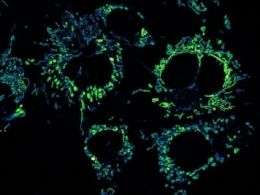
A new group of nanocomposite particles could lead to improved anti-cancer drugs, researchers report. Credit: Hari S. Muddana

Researchers in Pennsylvania are reporting for the first time that nanoparticles 1/5,000 the diameter of a human hair encapsulating an experimental anticancer agent, kill human melanoma and drug-resistant breast cancer cells growing in laboratory cultures. The discovery could lead to the development of a new generation of anti-cancer drugs that are safer and more effective than conventional chemotherapy agents, the scientists suggest. The research is scheduled for the Dec. 10 issue of ACS' Nano Letters.

In the new study, Mark Kester, James Adair and colleagues at Penn State's Hershey Medical Center and University Park campus point out that certain nanoparticles have shown promise as drug delivery vehicles. However, many of these particles will not dissolve in body fluids and are toxic to cells, making them unsuitable for drug delivery in humans. Although promising as an anti-cancer agent, ceramide also is insoluble in the blood stream making delivery to cancer cells difficult.

The scientists report a potential solution with development of calcium phosphate nanocomposite particles (CPNPs). The particles are soluble and with ceramide encapsulated with the calcium phosphate, effectively make ceramide soluble. With ceramide encapsulated inside, the CPNPs killed 95 percent of human melanoma cells and was "highly effective" against human breast cancer cells that are normally resistant to anticancer drugs, the researchers say.

Penn State Research Foundation has licensed the calcium phosphate nanocomposite particle technology known as "NanoJackets" to Keystone Nano, Inc. MK and JA are CMO and CSO, respectively.

Article: "Calcium Phosphate Nanocomposite Particles for In Vitro Imaging and Encapsulated Chemotherapeutic Drug Delivery to Cancer Cells", pubs.acs.org/stoken/presspac/presspac/full/10.1021/nl802098g

Provided by ACS

Explore further: Carbon nanotube harpoon catches individual brain-cell signals

add to favorites email to friend print save as pdf

Related Stories

Taking the fight into the enemy's territory

May 29, 2013

(Phys.org) —German researchers have developed a scheme for the preparation of nanoparticles that offer a highly versatile system for targeted drug delivery directly into diverse types of tumor cells.

Gold nanoparticles: A new delivery for cancer drugs

May 08, 2013

(Phys.org) —The protein tumor necrosis factor-alpha (TNF-alpha) is a powerful weapon in the arsenal to control cancer. Unfortunately, as is the case with many potent cancer therapies, the use of TNF-alpha as an anti-cancer ...

Kryptonite for cancer cells

Mar 19, 2013

(Phys.org) —Every available cancer drug is susceptible to resistance, according to Mansoor Amiji, Distinguished Professor and chair of the Department of Pharmaceutical Sciences. Tumors grow more quickly ...

Recommended for you

Sweet solutions for detecting disease

23 hours ago

Based at the Institute of Chemistry in the Slovak Academy of Sciences, Ján Tkáč's research combines glycomics – the study of sugars in organisms – with biochip sensors based on nanoparticles and nanotubes. ...

Nanoparticles for controlled drug release

Jun 13, 2013

Scientists from CIC bioGUNE and the Laboratoire de Chimie des Polymères Organiques (LCPO) in Bordeaux have jointly undertaken a project to develop "smart" nanoparticles. These polymeric particles act as "nanomissiles" against ...

User comments : 1

Adjust slider to filter visible comments by rank

Display comments: newest first

E_L_Earnhardt
1 / 5 (1) Dec 16, 2008
o.k.! Whatever works that can be brought to market!

More news stories

Danish chemists in molecular chip breakthrough

Electronic components built from single molecules using chemical synthesis could pave the way for smaller, faster and more green and sustainable electronic devices. Now for the first time, a transistor made ...

Sound waves precisely position nanowires

(Phys.org) —The smaller components become, the more difficult it is to create patterns in an economical and reproducible way, according to an interdisciplinary team of Penn State researchers who, using ...

Dusty surprise around giant black hole

(Phys.org) —ESO's Very Large Telescope Interferometer has gathered the most detailed observations ever of the dust around the huge black hole at the centre of an active galaxy. Rather than finding all of ...

How do bees make honey? It's not just bee barf

(Phys.org) —Last weekend, my daughter asked me how bees made honey, and I realized that I didn't know the answer. How do bees make honey? I did some homework, and can now explain it to her – and to you.