November 25, 2008 feature
Finding could lead to advance in nano-surgery
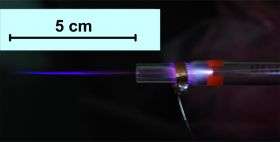
(PhysOrg.com) -- One of the problems with laser surgery is that the heat produced can damage tissue, and even lead to cell death. Attempts are being made to replace laser surgery with non-thermal plasma interaction, potentially allowing for the possibility of single cell removal without affecting the surrounding cells and tissue. While this specific use is for the future, important steps are being taken now to further study the interaction between non-thermal atmospheric (room temperature) plasma and living tissue.
A group at The George Washington University in Washington, D.C. is studying the effects of using a cold plasma atmospheric jet on tissue using fibroblast cells. “We were able to see several effects without damage to the tissue,” Michael Keidar, a member of the Mechanical and Aerospace Engineering Department, and one of the scientists on the project, tells PhysOrg.com. The results of the experiment can be found in Applied Physics Letters: “Living tissue under treatment of cold plasma atmospheric jet.”
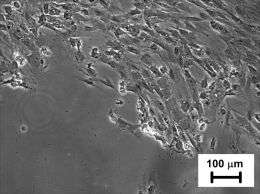
“Our experiment was set up to observe the cell migration effect,” says Mary Ann Stepp, from the Deptartment of Anatomy and Regenerative Biology and of Ophthalmology, another team member. “We observed the plasma interaction, allowing cells to sit in a culture dish taking photos about every ten minutes. We could then observe the photos together and see a time -lapse movie that shows us how the cell is moving.”
The GWU team discovered that when the intensity of the jet was altered, there were different effects. Alexey Shashurin (also a member of the Mechanical and Aerospace Engineering Department), points out that as the intensity of the jet increased, a cell migration rate was slowed and then a cell detached from its protein matrix. “Finally, when you increase the intensity even more,” he continues, you find that the cell becomes somewhat frozen. Its movement basically stops.”
Right now, the plasma jets are not small enough to do work on the level of individual cells. Shashurin explains: “At some point, though, we’d like to refine the technique and go to micro and nanoscale size plasma sources. We’d like this to be useful on the nanoscale.”
However, there are some implications from the present efforts. At The George Washington University, the team has shown how that certain processes can be triggered in cells, and there are potential applications if more can be learned about how cells work when reacting with this atmospheric plasma. Stepp says that studying cell movement, as illustrated by this experiment, can be of benefit in wound healing studies. “Being able to control the rate of cell migration could enhance wound healing – or even inhibit it, if that is what’s needed.”
Keidar admits that right now things are at an early stage. “We’ve observed this cell migration, and this cell freezing,” he says, “but we don’t understand completely the mechanism that the plasma jet is triggering. And we need to understand the plasma itself; we are looking at how we can change different plasma properties to control plasma-cell interactions.”
The members of the GWU group are looking forward to the future, however. Stepp points out that they are working on ways to narrow the treatment zone to reach the goal of single cell extraction: “Even though we still need to do some more studies, we have already discovered that this is an exciting new tool for biotechnology.”
More information:
Keidar’s Laboratory website: cobweb.seas.gwu.edu/~mpnl/
Stepp’s Laboratory website: www.gwumc.edu/anatomy/mastepp.html
Shashurin, Keidar, Bronnikov, Jurjus, and Stepp. “Living tissue under treatment of cold plasma atmospheric jet.” Applied Physics Letters (2008). Available online:
link.aip.org/link/?APPLAB/93/181501/1.
Copyright 2007 PhysOrg.com.
All rights reserved. This material may not be published, broadcast, rewritten or redistributed in whole or part without the express written permission of PhysOrg.com.


