Transforming Urine into Water: Astronauts to Install New Space Station Water System
Nov 15, 2008
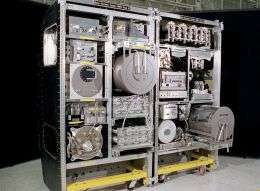
NASA´s new Water Recovery System will make it possible to double to six the number of crewmembers who can live aboard the International Space Station. Michigan Tech researchers helped optimize the design, increasing its efficiency by 30 percent. [NASA Marshall Space Flight Center (NASA-MSFC)]

Two hundred and fifty miles above the Earth puts you a long way from the nearest kitchen tap. And at $10,000 a pint, the cost of shipping fresh water aboard the space shuttle is, well, astronomical.

So astronauts on the International Space Station have to recapture every possible drop. That includes water evaporated from showers, shaving, tooth brushing and hand washing, plus perspiration and water vapor that collects within the astronauts' space suits. They even transfer water from the fuel cells that provide electric power to the space shuttle.

Until now, however, NASA has not attempted to tap one major potential source of water: urine. That will soon change with the deployment of the new Water Recovery System. It departed Friday, Nov. 14, from the Kennedy Space Center on the Space Shuttle Endeavor.

The Water Recovery System, made possible in part by researchers at Michigan Technological University, can transform ordinary pee into water so pure it rivals the cleanest on Earth.

David Hand was the lead researcher on the project, which ran from 1993 to 1997 at Tech. It was a memorable time. "We received jars of sweat from NASA," he said. "Then we did experiments on the system, measured it at every step, evaluated it and made recommendations."

Under the new system, urine undergoes an initial distillation process and then joins the rest of the recovered fluids in the water processor. The processor filters out solids such as hair and lint and then sends the wastewater through a series of multifiltration beds, in which contaminants are removed through adsorption and ion exchange.

"What's left over in the water are a few non adsorbing organics and solvents, like nail polish remover, and they go into a reactor that breaks them all down to carbon dioxide, water and a few ions," said Hand, a professor of civil and environmental engineering.

After a final check for microbes, the water is again clean and ready to drink.

NASA's Layne Carter, the Water Recovery System lead engineer at Marshall Spaceflight Center in Huntsville, Ala., credits Hand and the rest of the Tech research team with making the system as good as it is. "Without a doubt, if it hadn't been for their modeling effort, we never would have been able to redesign the multifiltration beds and achieve that level of efficiency," Carter said. "They did a fantastic job."

Using mathematical models, the Tech researchers helped improve the overall design of the multifiltration beds, The redesigned beds have 30 percent more capacity, which means that NASA doesn't have to send about 60 pounds of additional supplies up to the space station annually. "That may seem trivial, but it saves NASA about $600,000 each year," Carter said.

For more information on the Water Recovery System, visit www.nasa.gov/home/hqnews/2008/may/HQ_08119_ISS_Water_System.html .

Provided by Michigan Technological University

Explore further: Field tests in Mojave Desert pave way for human exploration of small bodies

add to favorites email to friend print save as pdf

Related Stories

Landing is key puzzle in Mars trip, experts say

May 08, 2013

Landing astronauts safely on Mars is one of the biggest technological hurdles for any future manned mission to the Red Planet, even more complicated than last year's daring rover touchdown.

Weather forecasts on Mars

May 08, 2013

(Phys.org) —In the north of the red planet snowfalls occur with great regularity. Expeditions of Mars rovers into this region could therefore be easily planned.

Recommended for you

Mars rover Opportunity examines clay clues in rock

18 hours ago

(Phys.org) —NASA's senior Mars rover, Opportunity, is driving to a new study area after a dramatic finish to 20 months on "Cape York" with examination of a rock intensely altered by water.

NASA's STEREO detects a CME from the sun

May 17, 2013

On 5:24 a.m. EDT on May 17, 2013, the sun erupted with an Earth-directed coronal mass ejection or CME, a solar phenomenon that can send billions of tons of solar particles into space that can reach Earth ...

Nine-year-old Mars rover passes 40-year-old record

May 17, 2013

While Apollo 17 astronauts Eugene Cernan and Harrison Schmitt visited Earth's moon for three days in December 1972, they drove their mission's Lunar Roving Vehicle 19.3 nautical miles (22.210 statute miles ...

Bright explosion on the Moon

May 17, 2013

For the past 8 years, NASA astronomers have been monitoring the Moon for signs of explosions caused by meteoroids hitting the lunar surface. "Lunar meteor showers" have turned out to be more common than anyone ...

User comments : 4

Adjust slider to filter visible comments by rank

Display comments: newest first

Going
4 / 5 (2) Nov 15, 2008
Its still a little unappetizing though and I doubt itwould sell well in bottles in restaurants.
humanist
5 / 5 (2) Nov 15, 2008
It's just like the popular press to vaunt "astronauts drink urine!" when they're really just drinking water..
zevkirsh
3.3 / 5 (4) Nov 15, 2008
why not just capture the solar wind...there should be plenty of hydrogen and perhaps even some oxygen ( or we could just recycle the oxygen on the space ship, to creat ample amounts of water from outerspace without having to deal with urine. would purifying urine be more difficult than trapping and recovering hyrdrogen from the solar wind?
Ablee
1 / 5 (2) Nov 16, 2008
PARKER'S PATHWAYS W/ DR. WINN PARKER

http://www.republ...ramID=20

That's all to be said in regard to drinking the of pee of my neighbour

More news stories

Galaxy's Ring of Fire

Johnny Cash may have preferred this galaxy's burning ring of fire to the one he sang about falling into in his popular song. The "starburst ring" seen at center in red and yellow hues is not the product of ...

Alaska volcano shoots ash 15,000 feet into the air

(AP)—One of Alaska's most restless volcanoes has shot an ash cloud 15,000 feet into the air in an ongoing eruption that has drawn attention from a nearby community but isn't expected to threaten air traffic.

Chinese, Indian airlines face EU pollution fines

Eight Chinese and two Indian airlines face fines of up to several million euros for not paying for their greenhouse gas emissions during flights within the bloc, the European Commission said on Friday.

US seizes Bitcoin operator accounts

US authorities seized the accounts of a Bitcoin digital currency exchange operator, claiming it was functioning as an "unlicensed money service business," court documents showed Friday.

Morocco to harness the wind in energy hunt

Morocco is ploughing ahead with a programme to boost wind energy production, particularly in the southern Tarfaya region, where Africa's largest wind farm is set to open in 2014.