Prehistoric pelvis offers clues to human development
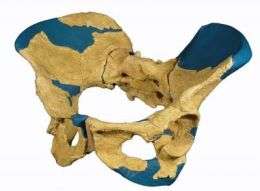
Discovery of the most intact female pelvis of Homo erectus may cause scientists to reevaluate how early humans evolved to successfully birth larger-brained babies. "This is the most complete female Homo erectus pelvis ever found from this time period," said Indiana University Bloomington paleoanthropologist Sileshi Semaw. "This discovery gives us more accurate information about the Homo erectus female pelvic inlet and therefore the size of their newborns."
A reconstruction of the 1.2 million-year-old pelvis discovered in 2001 in the Gona Study Area at Afar, Ethiopia, that has led researchers to speculate early man was better equipped than first thought to produce larger-brained babies. The actual fossils remain in Ethiopia.
The discovery will be published in Science this week (Nov. 14) by Semaw, leader of the Gona Project in Ethiopia, where the fossil pelvis was discovered with a group of six other scientists that includes IU Department of Geosciences graduate student Melanie Everett.
Reconstructing pelvis bone fragments from the 1.2 million-year-old adult female, Semaw and his co-workers determined the early ancestor's birth canal was more than 30 percent larger than earlier estimates based on a 1.5-million-year-old juvenile male pelvis found in Kenya. The new female fragments were discovered in the Gona Study Area in Afar, Ethiopia, in 2001 and excavation was completed in 2003.
Scientists also were intrigued by other unique attributes of the specimen, such as its shorter stature and broader body shape more likely seen in hominids adapted to temperate climates, rather than the tall and narrow body believed to have been efficient for endurance running.
Early humans became taller and narrower over time, scientists believe, partly due to long distance running and to help them maintain a constant body temperature. One consequence, however, is that a narrower pelvis would have been less accommodating to producing larger-brained offspring.
But rather than a tall, narrow hominid with the expected slight pelvic region, Semaw and the Gona researchers found evidence of a hominid ready to produce offspring with a much larger brain size.
"The female Homo erectus pelvic anatomy is basically unknown," Semaw said. "And as far as the fossil pelvis of ancestral hominids goes, all we've had is Lucy (dated at 3.2 million years and also found in Ethiopia), and she is very much farther back in time from modern humans."
Scientists studying early man predominantly find fragments of craniums and dental remains, while fossil bones from the neck down are rarely discovered. Even more difficult to verify are Homo erectus fossil bones that can be identified as those belonging to a female.
Scientists had thought early adult Homo erectus females, because of the assumed small birth canal, would produce offspring with only a limited neonatal brain size. These young would have then experienced rapid brain growth while still developmentally immature, leading researchers to envision a scenario of maternal involvement and child-rearing on par with that of modern humans. But those theories had been based upon extrapolations from the existing male skeleton from Kenya.
"This find will give us far more accurate information," Semaw said. Semaw is also a research scientist at the Stone Age Institute, a research center near Bloomington dedicated to the study of early human evolution and culture. It is affiliated with Indiana University's CRAFT, the Center for Research into the Anthropological Foundations of Technology.
Gona has turned out to be a productive dig site for Semaw. In 1997 Semaw and colleagues reported the oldest known stone tools used by ancestral humans. Then in 2004 he coauthored a paper summarizing Gona's geological properties and the site's cornucopia of hominid fossils spanning several million years. At the time, Science gave the article an "Editor's Choice" recognition. In 2005 he and colleagues published an article in Nature announcing the discovery of Ardipithecus ramidus, one of the earliest ancestral hominids, dating between 4.3 and 4.5 million years ago.
Source: Indiana University


