Scientists create tiny backpacks for cells
Nov 05, 2008 By Anne Trafton
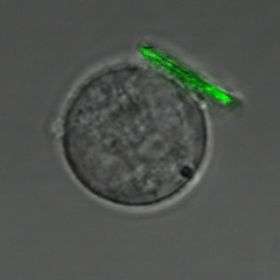
MIT researchers have developed a technique to attach tiny polymer "backpacks" to cells. This immune system cells, a B lymphocyte sports one. The scale bar is 10 micrometers. Image courtesy / American Chemical Society

(PhysOrg.com) -- MIT engineers have outfitted cells with tiny “backpacks” that could allow them to deliver chemotherapy agents, diagnose tumors or become building blocks for tissue engineering.

Michael Rubner, director of MIT’s Center for Materials Science and Engineering and senior author of a paper on the work that appeared online in Nano Letters on Nov. 5, said he believes this is the first time anyone has attached such a synthetic patch to a cell.

The polymer backpacks allow researchers to use cells to ferry tiny cargoes and manipulate their movements using magnetic fields. Since each patch covers only a small portion of the cell surface, it does not interfere with the cell’s normal functions or prevent it from interacting with the external environment.

“The goal is to perturb the cell as little as possible,” said Robert Cohen, the St. Laurent Professor of Chemical Engineering at MIT and an author of the paper.

The researchers worked with B and T cells, two types of immune cells that can home to various tissues in the body, including tumors, infection sites, and lymphoid tissues — a trait that could be exploited to achieve targeted drug or vaccine delivery.

“The idea is that we use cells as vectors to carry materials to tumors, infection sites or other tissue sites,” said Darrell Irvine, an author of the paper and associate professor of materials science and engineering and biological engineering.

Cellular backpacks carrying chemotherapy agents could target tumor cells, while cells equipped with patches carrying imaging agents could help identify tumors by binding to protein markers expressed by cancer cells.

Another possible application is in tissue engineering. Patches could be designed that allow researchers to align cells in a certain pattern, eliminating the need for a tissue scaffold.

The polymer patch system consists of three layers, each with a different function, stacked onto a surface. The bottom layer tethers the polymer to the surface, the middle layer contains the payload, and the top layer serves as a “hook” that catches and binds cells.

Once the layers are set up, cells enter the system and flow across the surface, getting stuck on the polymer hooks. The patch is then detached from the surface by simply lowering the temperature, and the cells float away, with backpacks attached.

“The rest of the cell is untouched and able to interact with the environment,” said Albert Swiston, lead author of the paper and a graduate student in materials science and engineering.

The researchers found that T cells with backpacks were able to perform their normal functions, including migrating across a surface, just as they would without anything attached.

By loading the backpacks with magnetic nanoparticles, the researchers can control the cells’ movement with a magnetic field.

Because the polymer synthesis and assembly takes place before the patches are attached to cells, there is plenty of opportunity to tweak the process to improve the polymers’ effectiveness and ensure they won’t be toxic to cells, the researchers say.

Other authors of the paper are Soong Ho Um, a postdoctoral associate in the Departments of Materials Science and Engineering and Biological Engineering, and Connie Cheng, a recent Harvard graduate.

The research was funded by the National Science Foundation Materials Research Science and Engineering Center and an NSF Graduate Research Fellowship.

Provided by NIT

Explore further: Building 3-D fractals on a nanoscale: Structure repeats itself from micro to nano

add to favorites email to friend print save as pdf

Related Stories

The science of sculpture, nano-style

Jun 14, 2013

(Phys.org) —The next breakthrough in highly efficient battery technologies and solar cells may very well be nanoscopic crystals of silicon assembled like skyscrapers on wafer-scale substrates. An important ...

Purifying dairy wastewater while producing electricity

Jun 14, 2013

In an EU-funded project the Fraunhofer Institute for Interfacial Engineering and Biotechnology IGB in Stuttgart is developing, together with industrial and scientific partners, a modular system to purify dairy wastewater ...

Weather balloon takes solar cell experiment toward sun

Jun 11, 2013

(Phys.org) —How do solar cells behave at high altitudes? Do they perform better the closer they get to the sun? Those simple questions propelled four undergraduate students from Northwestern University's McCormick School ...

Recommended for you

Hybrid material as gold-leaf substitute

Jun 18, 2013

(Phys.org) —A team of researchers headed by Professor Raffaele Mezzenga has created a hybrid material out of gold and milk proteins that looks like a wafer-thin gold leaf. Thanks to its properties, it could ...

Antioxidant with a long shelf life

Jun 17, 2013

(Phys.org) —Scientists from ETH Zurich have developed a nanomaterial that protects other molecules from oxidation. Unlike many such active substances in the past, the ETH-Zurich researchers' antioxidant ...

Fast pollutant degradation by nanosheets

Jun 17, 2013

(Phys.org) —Waste from textile and paint industries often contains organic dyes such as methylene blue as pollutants. Photocatalysis is an efficient means of reducing such pollution, and molybdenum trioxide ...

Unzipped nanotubes unlock potential for batteries

Jun 13, 2013

(Phys.org) —Researchers at Rice University have come up with a new way to boost the efficiency of the ubiquitous lithium ion (LI) battery by employing ribbons of graphene that start as carbon nanotubes.

Nanoparticle opens the door to clean-energy alternatives

Jun 13, 2013

(Phys.org) —Cheaper clean-energy technologies could be made possible thanks to a new discovery. Research team members led by Raymond Schaak, a professor of chemistry at Penn State University, have found ...

User comments : 2

Adjust slider to filter visible comments by rank

Display comments: newest first

bmcghie
not rated yet Nov 05, 2008
picture picture picture please! :) Sounds awesome. I would love to know how big, relative to common lymphocytes, these backpacks are. They say it doesn't impede movement... but what about diapedesis?
ajs
not rated yet Nov 06, 2008
We can adjust the size using the lithography step, and using the current technique can get down to ~7micron diameter backpacks. There should be images posted to the MIT News site soon...

More news stories

Danish chemists in molecular chip breakthrough

Electronic components built from single molecules using chemical synthesis could pave the way for smaller, faster and more green and sustainable electronic devices. Now for the first time, a transistor made ...

Sound waves precisely position nanowires

(Phys.org) —The smaller components become, the more difficult it is to create patterns in an economical and reproducible way, according to an interdisciplinary team of Penn State researchers who, using ...

Sony chief says time needed to study proposal

Sony Corp. needs more time to study a key proposal from a U.S. hedge fund to spin off a part of its entertainment unit as a way to propel its fledgling revival, the chief executive told shareholders Thursday.

China astronauts float water blob in kids' lecture

Astronauts struck floating martial arts poses, twirled gyroscopes and manipulated wobbling globes of water during a lecture Thursday from China's orbiting space station that's part of efforts to popularize ...