Arctic sea ice thinning at record rate
Oct 28, 2008
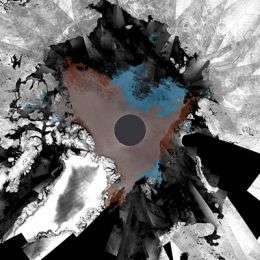
Arctic sea ice extent as seen by Envisat’s Advanced Synthetic Aperture Radar (ASAR) sensor during mid-September 2007 and mid-September 2008. The Arctic sea areas covered by ice in September 2008, but ice-free in September 2007, are visible in blue. The Arctic sea areas covered by ice in September 2007, but ice free in September 2008, are visible in dark brown. The Arctic sea covered by ice both in September 2007 and September 2008 are visible in light brown. Credits: ESA

(PhysOrg.com) -- The thickness of sea ice in large parts of the Arctic declined by as much as 19% last winter compared to the previous five winters, according to data from ESA's Envisat satellite.

Using Envisat radar altimeter data, scientists from the Centre for Polar Observation and Modelling at University College London (UCL) measured sea ice thickness over the Arctic from 2002 to 2008 and found that it had been fairly constant until the record loss of ice in the summer of 2007.
Unusually warm weather conditions were present over the Arctic in 2007, which some scientists have said explain that summer ice loss. However, this summer reached the second-lowest extent ever recorded with cooler weather conditions present.

Dr Katharine Giles of UCL, who led the study, said: "This summer's low ice extent doesn't seem to have been driven by warm weather, so the question is, was last winter's thinning behind it?"

The research, reported in Geophysical Research Letters, showed that last winter the average thickness of sea ice over the whole Arctic fell by 26 cm (10%) compared with the average thickness of the previous five winters, but sea ice in the western Arctic lost around 49 cm of thickness.

Giles said the extent of sea ice in the Arctic is down to a number of factors, including warm temperatures, currents and wind, making it important to know how ice thickness is changing as well as the extent of the ice.

"As the Arctic ice pack is constantly moving, conventional methods can only provide sparse and intermittent measurements of ice thickness from which it is difficult to tell whether the changes are local or across the whole Arctic," Giles said.

"Satellites provide the only means to determine trends and a consistent and wide area basis. Envisat altimeter data have provided the critical third dimension to the satellite images which have already revealed a dramatic decrease in the area of ice covered in the Arctic."

The team, including Dr Seymour Laxon and Andy Ridout, was the first to measure ice thickness throughout the Arctic winter, from October to March, over more than half of the Arctic.

"We will continue to use Envisat to monitor the evolution of ice thickness through this winter to see whether this downward trend will continue," Laxon said. "Next year we will have an even better tool to measure ice thickness in the shape of ESA's CryoSat-2 mission which will provide higher resolution data and with almost complete coverage to the pole."

Provided by European Space Agency

Explore further: The tropical upper atmosphere 'fingerprint' of global warming

add to favorites email to friend print save as pdf

Related Stories

Ice-free Arctic may be in our future, says research

May 09, 2013

Analyses of the longest continental sediment core ever collected in the Arctic, recently completed by an international team led by Julie Brigham-Grette of the University of Massachusetts Amherst, provide ...

NASA rover prototype set to explore Greenland ice sheet

May 01, 2013

(Phys.org) —NASA's newest scientific rover is set for testing May 3 through June 8 in the highest part of Greenland. The robot known as GROVER, which stands for both Greenland Rover and Goddard Remotely ...

Antarctic team digs deep to predict climate future

Apr 06, 2013

Nancy Bertler and her team took a freezer to the coldest place on Earth, endured weeks of primitive living and risked spending the winter in Antarctic darkness, to go get ice—ice that records our climate's ...

Recommended for you

NASA's Landsat satellite looks for a cloud-free view

12 hours ago

For decades, Landsat satellites have documented the desiccation of the Aral Sea in Central Asia. Once one of the largest seas in the world, it shrunk to a tenth of its original volume after Russia diverted ...

Volcanoes cause climate gas concentrations to vary

20 hours ago

Trace gases and aerosols are major factors influencing the climate. With the help of highly complex installations, such as MIPAS on board of the ENVISAT satellite, researchers try to better understand the ...

Explainer: Why are tornadoes so destructive?

20 hours ago

Tornadoes are a part of life for people living in the Great Plains of the United States. In Oklahoma, a state that averages 62 tornadoes a year, people are prepared as best as they can be and are well warned.

User comments : 2

Adjust slider to filter visible comments by rank

Display comments: newest first

GrayMouser
3 / 5 (2) Oct 31, 2008
Since they've only been collecting data for 8 years they have no baselines. Any conclusions for long term behavior is suspect.
mikiwud
1 / 5 (1) Nov 02, 2008
Lets see what this winter brings.

More news stories

Forecast for Titan: Wild weather could be ahead

(Phys.org) —Saturn's moon Titan might be in for some wild weather as it heads into its spring and summer, if two new models are correct. Scientists think that as the seasons change in Titan's northern hemisphere, ...

Scientists announce Top 10 New Species from 2012

An amazing glow-in-the-dark cockroach, a harp-shaped carnivorous sponge and the smallest vertebrate on Earth are just three of the newly discovered top 10 species selected by the International Institute for ...

Theorists weigh in on where to hunt dark matter

(Phys.org) —Now that it looks like the hunt for the Higgs boson is over, particles of dark matter are at the top of the physics "Most Wanted" list. Dozens of experiments have been searching for them, but ...