Research around the North Pole
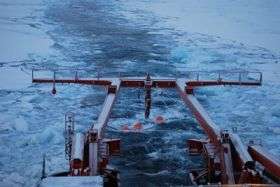
The German research vessel Polarstern has returned today to Bremerhaven from the Arctic Sea. It has cruised as the first research vessel ever both the Northeast and the Northwest Passages and thereby circled the North Pole. The third part of the research vessel's 23rd Arctic expedition, operated by the Alfred Wegener Institute in the Helmholtz Association, started its journey on August 12th in Reykjavik and ended it on October 17th in Bremerhaven.
The ship travelled a distance of 10.800 nautical miles, equivalent to 20.000 kilometres. On board were 47 researchers from 12 nations, for example from Belgium, Germany, France, Japan, Canada, Korea, the Netherlands, Russia and the USA. Because of the small ice cover, the expedition members were able to research hitherto uncharted waters. The small sea ice cover presents a cause for concern regarding climate change in the Arctic Ocean. The aim of this expedition was to gather data on the development of the geology of the Arctic area.
The researchers around cruise leader Dr. Wilfried Jokat, geophysicist at the Alfred Wegener Institute, have discovered large sliding masses close beneath the seafloor of the East-Siberian continental shelf by means of sediment-acoustic parasound measurements. "Sliding masses are witnesses of great sediment relocations which appear, for instance, when large amounts of sediments are deposited", explains Jokat. The continental slope becomes instable and sediments slide down. Such a large amount of sediments causing a shift can only have one reason: the sediments were frozen in the ice masses of the East-Siberian mainland, thawed during an interglacial and unloaded their sediments with the melt water into the ocean. "This is a spectacular finding. Large-scale glaciations in eastern Siberia within the younger geological past of 60.000 years and older are so far unknown", explains Prof. Dr. Rüdiger Stein, geologist at the Alfred Wegener Institute. Additional acoustic (seismic) data show that the East-Siberian Shelf was covered with ice over the last three million years only during a few glacial periods.
Further investigations are necessary to confirm this finding and particularly to time the reported events chronologically. The scientists have brought material in the form of sediment cores to Bremerhaven to achieve this. 16 soil samples could be taken on a transect of 700 kilometres from the Canada Basin via the Mendeleev Ridge into the Makarov Basin. The analysis will allow for the first time to compare the glacial history of the Northern USA and Canada with Siberia and to elaborate differences and parallels in detail. Furthermore, the data from the sediment cores can deliver information on the temporal and spatial changes of ocean currents and the extent of sea ice in the central Arctic Ocean. "We expect from these investigations important new insights into the control procedures of long and short term climate changes in the Arctic", says a delighted Stein.
Another focal point of this cruise was on the geological development of the Arctic Ocean during the last 90 million years. Seismic, an acoustic measurement method, allows peeking into the deep layers under the ocean floor down to 4.000 metres depth. "The collected data show that the ocean basin between the two Arctic ridge systems, the Lomonossov and the Mendeleev Ridge, are considerably older than estimated so far. Thus, the basins in the old part of the Arctic Ocean, the Makarov and the Canada Basin, have developed at about the same", reports Jokat. "The following detachment of the Lomonossov Ridge from the East-Siberian Shelf took place 60 million years ago – not without massive changes to the environment. The data present evidence of strong relocation processes in the deep-sea sediments", continues the geophysicist. "Many model representations about the development of the Arctic Ocean must be rethought on the basis of the new data", concludes Jokat.
Oceanographers regularly collect data on water temperature, density and salinity from the ship. Additionally, they brought out buoys on ice floes which autonomously conduct these measurements over one or two years. The oceanographers can thereby better understand how the water masses circulate in the Arctic Ocean. Integrated into long-term measurements, they can describe changing water temperatures and sea ice cover regarding climate change.
Biologists on board investigated the occurrence and distribution of the copepod Oithona similis in the Arctic Ocean. This small crab is an important part of the food web. It feeds, among other things, on small algae and animals and serves on its part as food for fish larvae. Another biological programme is aimed at collecting data on the distribution of birds, seals, whales and polar bears along the route. An almost continuous measurement of the seafloor and a programme for water probes rounded off the interdisciplinary scientific programme.
The measurements contribute to research within the framework of the International Polar Year, the European project DAMOCLES and the North Atlantic project of the German Federal Ministry of Education and Research. After the usual maintenance and repair work, Polarstern will leave on October 31st with the destination Cape town. There begins the Antarctic season 2008/09.
Source: Helmholtz Association of German Research Centres


