Moist Convection Can Drive Jet Streams on All Four Giant Planets
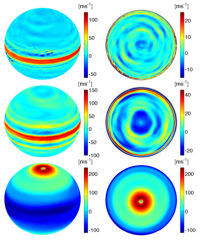
(PhysOrg.com) -- Turbulence generated by thunderstorms can drive the multiple east-west jet streams on the giant planets – Jupiter, Saturn, Uranus, and Neptune – and explain a long-standing conundrum concerning the puzzling differences between the innermost two planets, Jupiter and Saturn, and the outermost two, Uranus and Neptune.
Scientists have been trying to understand the mechanisms that form the jet streams and control their structure since the first high-resolution images of the giant planets were returned by the Pioneer and Voyager spacecrafts in the 1970s and 1980s.
The jet streams are narrow rivers of air that flow east-west. On Earth, they are major component of the planet's global circulation and control much of the large-scale weather experienced by the United States and other countries outside of the tropics.
Analogous jet streams dominate the circulation of Jupiter, Saturn, Uranus, and Neptune, reaching up to 400 miles per hour on Jupiter and nearly 900 miles per hour on Saturn and Neptune.
The question of what causes these jet streams and sets their structure remains one of the most important unsolved problems in the study of planetary atmospheres.
Yuan Lian and Adam Showman of The University of Arizona have found how storms can generate the jet streams. They presented the findings today at the 40th annual meeting of Division of Planetary Sciences of the American Astronomy Society in Ithaca, NY. Lian is a graduate student and Showman is an associate professor at UA.
Lian and Showman performed state-of-the-art computer simulations showing how moist convection – essentially, thunderstorms – can produce patterns of jet streams resembling those on the four giant planets. In the simulations, condensation of water vapor generates small hurricane-like storms, which interact with each other to form global jet streams. The study is the first to self-consistently describe both the generation of these storms and their interaction with the global circulation.
"Thunderstorms have been known to exist on Jupiter and Saturn since the early 1980s, and it has repeatedly been proposed that they drive the jet streams on these planets, but before now this idea had never been adequately tested," said Lian. "We showed that such storms can indeed drive jet streams similar to those observed."
A long-standing puzzle is the dichotomy between sister planets Jupiter and Saturn on the one hand and Uranus and Neptune on the other.
"Unlike Earth, Jupiter and Saturn have about 20 jet streams each, which are associated with the banded cloud patterns on those planets," Showman said. "In contrast, Uranus and Neptune have only three jet streams each. Another conundrum is that the jet stream on the equator flows eastward on Jupiter and Saturn but westward on Uranus and Neptune. Understanding that dichotomy has been a hard nut to crack."
The simulations successfully produced about 20 jet streams each for Jupiter and Saturn and three jet streams each for Uranus and Neptune, consistent with observations. Moreover, the simulations were able to explain the direction of the equatorial winds on all four planets – eastward on Jupiter and Saturn but westward on Uranus and Neptune.
"Previous investigations generally predicted that the equatorial jet stream would have the same direction on all four planets, inconsistent with observations," Lian said. "Our study is among the first to provide an explanation for these differences."
In the simulations, the differences are controlled by the abundance of water vapor, which is modest on Jupiter and Saturn but expected to be large on Uranus and Neptune.
The storms produced in the simulations also bear an encouraging resemblance to those observed on Jupiter and Saturn, Showman noted.
Lian cautioned that much work remains to be done. "Our study provides a mechanism that can generate the jets on the giant planets. However, the wind speeds in our computer simulations are generally too weak. Overcoming this discrepancy will require continued improvements in our models."
Provided by University of Arizona


