Tsunami Invisibility Cloak
Sep 26, 2008
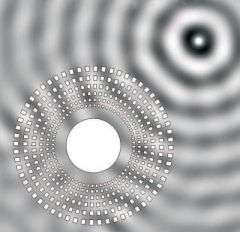
Laboratory experiments show that obstacles arranged in fluids in certain patterns can effectively make objects they surround invisible to waves. If it works as well in in scaled-up versions, it could lead to new ways to protect ocean-based platforms and coasts from devastating tsunamis. Credit: M. Farhat, S. Enoch, S. Guenneau and A.B. Movchan

Rather than building stronger ocean-based structures to withstand tsunamis, it might be easier to simply make the structures disappear.

A collaboration of physicists from the Centre National de la Recherche Scientifique (CNRS) and Aix-Marseille Universite in France and the University of Liverpool in England have conducted laboratory experiments showing that it's possible to make type of dike that acts as an invisibility cloak that hides off-shore platforms from water waves. The principle is analogous to the optical invisibility cloaks that are currently a hot area of physics research.

Tsunami invisibility cloaks wouldn't make structures disappear from sight, but they could manipulate ocean waves in ways that makes off-shore platforms, and possibly even coastlines and small islands, effectively invisible to tsunamis.

If the scheme works as well in the real world as the lab-scale experiments suggest, a tsunami should be able to pass right by with little or no effect on anything hidden behind the cloak.

Citation: M. Farhat, S. Enoch, S. Guenneau and A.B. Movchan, Physical Review Letters (forthcoming article)

Source: American Physical Society

Explore further: New X-ray method shows how frog embryos could help thwart disease

add to favorites email to friend print save as pdf

Related Stories

Researcher construct invisibility cloak for thermal flow

May 08, 2013

By means of special metamaterials, light and sound can be passed around objects. KIT researchers now succeeded in demonstrating that the same materials can also be used to specifically influence the propagation ...

Cassini observes meteors colliding with Saturn's rings

Apr 25, 2013

(Phys.org) —NASA's Cassini spacecraft has provided the first direct evidence of small meteoroids breaking into streams of rubble and crashing into Saturn's rings. These observations make Saturn's rings ...

Recommended for you

Bringing life into focus

May 17, 2013

Spinning-disk confocal microscopy is an optical imaging technique that can be used to generate detailed three-dimensional fluorescence images of living cells and their contents. Although a powerful tool for ...

World's smallest droplet

May 17, 2013

(Phys.org) —Physicists may have created the smallest drops of liquid ever made in the lab. That possibility has been raised by the results of a recent experiment conducted by Vanderbilt physicist Julia Velkovska and her ...

User comments : 1

Adjust slider to filter visible comments by rank

Display comments: newest first

superhuman
4 / 5 (1) Sep 26, 2008
Tsunamis have wavelengths on the order of tens of kilometers which makes any such approach completely impractical (as the structures would have to have comparable size).

In other words tsunamis should be thought of more as a temporary increase in water level then big waves.

More news stories

New principle may help explain why nature is quantum

Like small children, scientists are always asking the question 'why?'. One question they've yet to answer is why nature picked quantum physics, in all its weird glory, as a sensible way to behave. Researchers ...

Manipulating Lorentz and Fano spectral line shapes

(Phys.org) —It is widely known that the optical properties of certain materials can be modified by using lasers to control the quantum states of their optical electrons. Lasers that can generate ultra-short ...