Oxford turbines to harvest energy from tides
Sep 10, 2008
Oxford turbines to harvest energy from tides
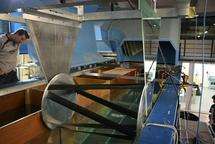
A prototype turbine, above, has already performed well in tests. The full-scale device would measure up to 10m in diameter.

Oxford researchers have developed a new tidal turbine which has the potential to harness tidal energy more efficiently and cheaply, using a device which is simpler and more robust and scaleable than current designs.

The team includes Prof Guy Houlsby, Professor of Civil Engineering at Oxford, Dr Malcolm McCulloch of the electrical power group, and Prof Martin Oldfield from mechanical engineering. They have designed, built and tested the device, a horizontal axis water turbine, to intersect the largest possible area of current. The rotor is cylindrical and rolls around its axis, catching the current.

A prototype 0.5m-diameter turbine has already performed well in tests, proving the benefits of the blade design. A full-scale device would measure up to 10m in diameter, and a series of turbines can be chained together across a tidal channel.

The team has calculated that a tidal site 1km in width could produce 60 Megawatts of energy.

The turbine is mechanically far less complicated than anything available today, and requires fewer generators and foundations, meaning it will cost less to build and maintain. The manufacturing costs are about 60% lower and the maintenance costs are 40% lower than current tidal devices.

By 2009 the team plans to conduct sea trials in open water, leading to a full commercial scale up by 2013.

The UK is estimated to have 10% of the global extractable tidal resource. Tidal currents are sub-surface, so tidal turbines have minimum visual impact, unlike wind farms or estuary barrage schemes.

Isis Innovation, the University’s technology transfer company, has patented the turbine device, and is looking out for potential investors and development partners.

Provided by Oxford University

Explore further: Multiview 3-D photography made simple

add to favorites email to friend print save as pdf

Related Stories

New research to support the huge potential of tidal power

Jan 17, 2013

(Phys.org)—New research from a global group of scientists and engineers, including from the University of Southampton, has been published in a special issue journal of the Royal Society. The work is in support of tidal ...

New energy technologies promise brighter future

Nov 19, 2012

In three studies published in the current issue of Technology and Innovation – Proceedings of the National Academy of Inventors, innovators unveil creative technologies that could change our sources of energy, change our use of energy ...

Monitoring marine mammals

Sep 25, 2012

A new instrument to detect whales, dolphins and other marine mammals, and provide immediate alerts during the development of offshore wind, wave and tidal installations, will be showcased to an international ...

Ocean mavericks in Maine turn tide for electrical grid

Sep 19, 2012

(Phys.org)—Sadly speaking, the U.S. ocean-energy industry has had to take a back seat to Europe, where government subsidies help entrepreneurs and innovative companies work on their technologies. Happily ...

Scotland passes turbine test to harness tidal power

May 20, 2012

(Phys.org) -- An underwater turbine being used for harnessing tidal power to generate electricity for homes and businesses has successfully completed its testing period in the island of Eday, one of Orkney’s ...

Recommended for you

Multiview 3-D photography made simple

23 hours ago

Computational photography is the use of clever light-gathering tricks and sophisticated algorithms to extract more information from the visual environment than traditional cameras can.

Giant 3-D printed bugs shed light on insect anatomy

23 hours ago

Minute insects, from the Australian National Insect Collection, have been super sized by up to forty times using a novel 3D scanning system and printed using a state of the art 3D printer.

Mathematical algorithms cut train delays

Jun 18, 2013

Commuters are already seeing a reduction in delays and waiting times thanks to new software able to adapt railway schedules in real time following unforeseen disruptions.

User comments : 1

Adjust slider to filter visible comments by rank

Display comments: newest first

jerryd
not rated yet Aug 22, 2009

Won't work long. These people need to learn more about the marine environment or they will never build successful tidal/river generators. I built a batch in the 70's that worked fine.

More news stories

Sony chief says time needed to study proposal

Sony Corp. needs more time to study a key proposal from a U.S. hedge fund to spin off a part of its entertainment unit as a way to propel its fledgling revival, the chief executive told shareholders Thursday.

Taiwan's Hon Hai to hire 3,000 after Mozilla tie-up

Taiwan's Hon Hai Precision said Thursday it aims to hire up to 3,000 new employees to develop devices and software for Mozilla's Firefox operating system as it seeks to diversify from its core manufacturing services.

Dusty surprise around giant black hole

(Phys.org) —ESO's Very Large Telescope Interferometer has gathered the most detailed observations ever of the dust around the huge black hole at the centre of an active galaxy. Rather than finding all of ...

NASA image: Rare clear view of Alaska

(Phys.org) —On most days, relentless rivers of clouds wash over Alaska, obscuring most of the state's 6,640 miles (10,690 kilometers) of coastline and 586,000 square miles (1,518,000 square kilometers) ...