Safer skies for the flying public
Sep 03, 2008
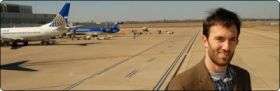
Dr. Caramanis is working on a mathematical model that combines theories and calculations from probability, statistics, optimization modeling, economics and game theory to be used for a new air traffic control system. Credit: Erin McCarley

University of Texas professor Constantine Caramanis and colleagues at the Massachusetts Institute of Technology (MIT) are working on a air traffic decision-making system that rapidly adapts its flight recommendations without human input based on thousands of changing variables. The computer model Caramanis, lead researcher Cynthia Barnhart, and other colleagues from MIT are developing will monitor weather conditions as well as current airplane locations and probable routes.

"There is currently no unified decision-making framework for air traffic flow optimization," said Dr. Caramanis. "The complicated nature of the process, and the need to make quick adjustments when changes occur, will best be addressed with a mathematical model that combines theories and calculations from probability, statistics, optimization modeling, economics and game theory."

The Federal Aviation Administration (FAA) provides each airline with a set limit of planes that can take off and land during any given timeframe. These slot decisions are based on estimates of what will optimize air traffic flow, taking into consideration imperfect weather predictions, the changing mix of flights airlines wants to move, and other variables for the thousands of flights that crisscross U.S. skies daily. The airlines then choose the flights.

While developing the air traffic optimization model, the researchers will also consider new ways to lessen delays and flight cancellations. For example, they will consider the possibility of allowing airlines to barter for slots when one airline can't get a flight off the ground and others could do so.

"The idea is to have an overarching optimization model that allows balance and flexibility to the decisions being made so that we can successfully exploit whatever slack in the system we can," Caramanis said. "Our model will have autonomous re-configurability which is the ability to adapt to new information on its own."

Source: University of Texas at Austin

Explore further: Sensitive bomb detector to rove in search of danger

add to favorites email to friend print save as pdf

Related Stories

Automobile plants make more with less

Apr 12, 2013

Competition is fierce in the automobile industry. Worldwide overcapacity has created price pressures that are particularly challenging for manufacturers that are already having a tough time managing their ...

New ultra-efficient HPC data center debuts

Mar 12, 2013

Scientists and researchers at the U.S. Department of Energy's National Renewable Energy Laboratory (NREL) are constantly innovating, integrating novel technologies, and "walking the talk." Since 1982, NREL ...

Recommended for you

Sensitive bomb detector to rove in search of danger

May 24, 2013

European researchers have developed and tested a light-weight device capable of detecting extremely minute quantities of explosives from up to 20 metres away, providing an invaluable law-enforcement tool ...

How soon could car seats enter the 3-D comfort zone?

May 23, 2013

New 3D textiles made of recyclable polyester fibres could contribute help cars be easier to recycle. But recycling technology has yet to progress in separating seat material from other car components.

NASA: Austin, calling Austin. 3-D pizzas to go

May 22, 2013

(Phys.org) —The idea of living with 3-D printed food is neither unthinkable nor new; designers and futurists have been looking to 3-D printing as food's next frontier. In 2012, there was news that the Thiel ...

User comments : 0

More news stories

Yahoo, pay-TV operators among Hulu bidders

Online video site Hulu is again up for sale, with Yahoo and pay TV operators DirecTV and Time Warner Cable among the seven bidders, according to a person with direct knowledge of the matter.

Radiation leak at Japan lab; small impact expected

An atomic research lab in northern Japan has reported a radiation leak that may have affected about 50 people, though none were hospitalized and no impact was expected outside the facility, the lab's operator ...