Eco-architecture could produce 'grow your own' homes
Aug 21, 2008
TAU/Plantware
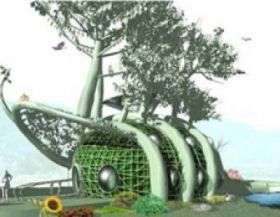
A computer-generated illustration of a TAU/Plantware "home." Credit: AFTAU

A bus stop that grows its own foliage as shade? A children's playground, made entirely from trees? A shelter made from living tree roots that could provide natural protection against earthquakes in California?

"Eco-architecture" may sound like a Buck Rogers vision of an ecologically-sustainable future, but that future is now thanks to the guidance of Tel Aviv University Professors Yoav Waisel and Amram Eshel. The concept of shaping living trees into useful objects -- known as tree shaping, arborsculpture, living art or pooktre –– isn't new. But scientists are now ready to use this concept as the foundation of a new company that will roll out these structures worldwide.

Pilot projects now underway in the United States, Australia and Israel include park benches for hospitals, playground structures, streetlamps and gates. "The approach is a new application of the well-known botanical phenomenon of aerial root development," says Prof. Eshel. "Instead of using plant branches, this patented approach takes malleable roots and shapes them into useful objects for indoors and out."

A Scientific and Commercial Partnership

The original "root-breaking" research was conducted at the Sarah Racine Root Research Laboratory at Tel Aviv University, the first and largest aeroponics lab in the world. Founded by Prof. Waisel 20 years ago, the lab enables scientists to conduct future-forward and creative research that benefits mankind and the environment.

Commercial applications of the research are being developed by Plantware, a company founded in 2002. TAU and Plantware researchers working together found that certain species of trees grown aeroponically (in air instead of soil and water) do not harden. This developed into a new method for growing "soft roots," which could easily turn living trees into useful structures.

Completing the informal collaboration between Plantware founders and the university, the company's director of operations, Yaniv Naftaly, holds a degree in life sciences from TAU.

An Eco-Positive Abode

It's even possible that, in the near future, entire homes will be constructed with the eco-friendly technology. An engineer by trade, Plantware's CEO Gordon Glazer hopes the first home prototype will be ready in about a decade. While the method of "growing your own home" can take years, the result is long lasting and desirable especially in the emerging field of green architecture.

Prof. Eshel's team is also working on a number of other projects to save the planet's resources. They are currently investigating a latex-producing shrub, Euphoria tirucalii, which can be grown easily in the desert, as a source for biofuel; they are also genetically engineering plant roots to ensure "more crop per drop," an innovative approach to irrigation.

Source: Tel Aviv University

Explore further: US spy chief: Plot against Wall Street foiled

add to favorites email to friend print save as pdf

Related Stories

Cultural products have evolutionary roots

Jun 12, 2013

From Brad Pitt fighting zombies to Superman falling for Lois Lane, summer blockbuster season is upon us. But while Hollywood keeps trotting out new movies for the masses, plotlines barely change.

Wood not so green a biofuel

Jun 11, 2013

Using wood for energy is considered cleaner than fossil fuels, but a Dartmouth College-led study finds that logging may release large amounts of carbon stored in deep forest soils. The results appear in the journal Global Ch ...

Extinct species revival raises hopes, fears

Jun 05, 2013

The world's last passenger pigeons perished a century ago. But a Santa Cruz, Calif.-based research project could send them flocking into the skies again, using genetic engineering to restore the once-abundant species and ...

Tightest job market ever for China's college grads

May 29, 2013

(AP)—Chemistry student Jiang Wenying graduated three years ago and decided the job market was so tough she might as well go back to school for a graduate degree. Now she's finding it even worse, in what ...

Striking a balance on taxes

May 22, 2013

Now that April 15 has come and gone, most Americans have turned their attention away from taxes. But MIT student Stefanie Stantcheva continues to ponder the trade-offs associated with taxation.

Recommended for you

US spy chief: Plot against Wall Street foiled

17 hours ago

The U.S. foiled a plot to bomb the New York Stock Exchange because of the sweeping surveillance programs at the heart of a debate over national security and personal privacy, officials said Tuesday at a rare ...

Tablets thrust Thai classrooms into digital era

Jun 18, 2013

In a rural classroom in the Thai highlands, hill tribe children energetically slide their fingertips over tablet computer screens practicing everything from English to mathematics and music.

Research examines how technology can break down barriers

Jun 17, 2013

A small, pilot study is examining how mobile technology might support deaf and hard-of-hearing college students when an interpreter can't physically be present at the time the services are requested. The University of Cincinnati ...

Hands-free texting still distracting for drivers (Update)

Jun 12, 2013

Using voice commands to send text messages and emails from behind the wheel, which is marketed as a safer alternative for drivers, actually is more distracting and dangerous than simply talking on a cellphone, ...

User comments : 13

Adjust slider to filter visible comments by rank

Display comments: newest first

superhuman
4.6 / 5 (13) Aug 21, 2008
They desperately need to hire a skilled artist, the concept allows for some really beautiful structures yet their computer-generated illustration is extremely ugly.
TJ_alberta
5 / 5 (4) Aug 21, 2008
take a look at their website: http://www.plantw...lery.htm
mostly curiosity items but could develop into something interesting.
GrayMouser
3.4 / 5 (5) Aug 21, 2008
I want whatever they are taking...
tikay
3.3 / 5 (3) Aug 21, 2008
Thanks TJ...for the site.
DonR
4.5 / 5 (4) Aug 21, 2008
I can see a whole new employment industry springing out of "home maintenence". A growing home will obviously require a fair amount of tending.
Arikin
4.8 / 5 (9) Aug 21, 2008
How do I kill the bugs in my house without killing off half the wall? :-)
CreepyD
4.3 / 5 (4) Aug 22, 2008
I was thinking the same thing. Wouldn't it be infested with critters? These would need a lining of some kind I guess to prevent damp and insects.
seanpu
3.8 / 5 (6) Aug 22, 2008
the bus stops around me get smashed up every month. shaming up a tree might be a bit more difficult, but take much longer to rectify.
Valentiinro
3.3 / 5 (4) Aug 22, 2008
Uhm, there are plants that bugs don't like, are there not? I'm sure they could grow some plants that dispel bugs in the midst of their tree roots.
Would garlic growing around the edges of the walls do the trick?
NewDimension
5 / 5 (2) Aug 25, 2008
I like this kind of new architecture concept very much and genetic engineering already gave us square tomatoes.
There are a lot of bug repealing plants I guess Garlic or onions could do the trick even having a snack while waiting for transportation.
Egnite
not rated yet Aug 25, 2008
So in all honesty, they are still a long way off producing 'grow your own' homes. The benches and coat stands look pretty kewl and would be perfectly practical. Here's hoping the venture takes off so it can advance into bigger and more complex structures.

Corban
not rated yet Aug 25, 2008
This reminds me vaguely of D&D and elves.
Valentiinro
not rated yet Sep 25, 2008
This reminds me vaguely of D&D and elves.


Morrowind.
There is a culture in there called the Telvanni, and generally, every single one of them lives in a house made of mushrooms and trees magically grown into livable spaces. It's roughly the same concept.

More news stories

Multiview 3-D photography made simple

Computational photography is the use of clever light-gathering tricks and sophisticated algorithms to extract more information from the visual environment than traditional cameras can.

Sound waves precisely position nanowires

(Phys.org) —The smaller components become, the more difficult it is to create patterns in an economical and reproducible way, according to an interdisciplinary team of Penn State researchers who, using ...

'Ugly' finding: Unattractive workers suffer more

People who are considered unattractive are more likely to be belittled and bullied in the workplace, according to a first-of-its-kind study led by a Michigan State University business scholar.