Dutch researchers take flight with three-gram 'dragonfly'
Jul 22, 2008
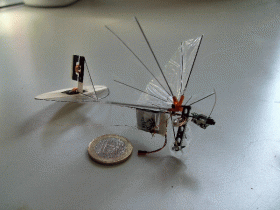
The DelFly Micro is a ´Micro Air Vehicle´ (MAV), an exceptionally small remote-controlled aircraft with camera and image recognition software. The Micro, weighing just 3 grams and measuring 10 cm (wingtip to wingtip) is the considerably smaller successor to the successful DelFly I (2005) and DelFly II (2006).

(PhysOrg.com) -- On Wednesday 23 July, TU Delft will be presenting the minute DelFly Micro air vehicle. This successor to the DelFly I and II weighs barely 3 grams, and with its flapping wings is very similar to a dragonfly.

Ultra-small, remote-controlled micro aircraft with cameras, such as this DelFly, may well be used in the future for observation flights in difficult-to-reach or dangerous areas. The DelFly Micro will make a short demonstration flight during the presentation.


Video: DelFly micro first test flight. TU Delft

The DelFly Micro is a 'Micro Air Vehicle' (MAV), an exceptionally small remote-controlled aircraft with camera and image recognition software. The Micro, weighing just 3 grams and measuring 10 cm (wingtip to wingtip) is the considerably smaller successor to the successful DelFly I (2005) and DelFly II (2006). The DelFly Micro, with its minuscule battery weighing just 1 gram, can fly for approximately three minutes and has a maximum speed of 5 m/s.

Ultra-small remote-controlled, camera-equipped aircraft are potentially of great interest because they could eventually be used for observation flights in difficult-to-reach or dangerous areas.

The basic principle of the DelFly is derived from nature. The 'dragonfly' has a tiny camera (about 0.5 grams) on board that transmits its signals to a ground station. With software developed by TU Delft itself, objects can then be recognised independently.

The camera transmits TV quality images, and therefore allows the DelFly II to be operated from the computer. It can be manoeuvred using a joystick as if the operator was actually in the cockpit of the aircraft. The aim is to be able to do this with the DelFly Micro too.

The development of the DelFly is above all the story of continuing miniaturisation of all the parts, from the DelFly I (23 grams and 50 cm) via the DelFly II (16 grams and 30 cm) to the present DelFly Micro (3 grams and 10 cm).

The DelFly II drew huge attention in 2006 because it could fly horizontally (21 km/hr) as well as hover, just like a hummingbird, and also fly backwards. The DelFly Micro, incidentally, cannot do this just yet.

In a few years time, the new objective of the project, the DelFly NaNo (5 cm, 1 gram) will have been developed. The Micro is an important intermediate step in this development process. A second objective for the future is for the DelFly to be able to fly entirely independently thanks to image recognition software.

See www.delfly.nl for more information on all DelFly's.

Source: TU Delft

Explore further: Researchers use light projector and single-pixel detectors to create 3-D images

add to favorites email to friend print save as pdf

Related Stories

Recommended for you

GPS solution provides 3-minute tsunami alerts

May 17, 2013

Researchers have shown that, by using global positioning systems (GPS) to measure ground deformation caused by a large underwater earthquake, they can provide accurate warning of the resulting tsunami in ...

Innovative concrete to facilitate building rehabilitation

May 16, 2013

The Structural Technology Group of the Universitat Politècnica de Catalunya, BarcelonaTech (UPC), in collaboration with the company PROMSA, is participating in the rehabilitation of the Gaudí House Museum in Barcelona's P ...

User comments : 5

Adjust slider to filter visible comments by rank

Display comments: newest first

googleplex
3.5 / 5 (4) Jul 22, 2008
Cool.
Better performance could be obtained with a micro helium blimp. Blimps make ideal observation platforms. You would have to engineer the tedlar into thinner sheets.
Mercury_01
1.7 / 5 (7) Jul 22, 2008
Big brother uses these as survailance bots, only theirs are very advanced and look just like real dragonflies. if you see one, smash it and make off with it before the suits come to retrieve it.
Doug_Huffman
not rated yet Jul 22, 2008
You may be confusing 'Dune' with your doom.
jeffsaunders
1 / 5 (1) Jul 23, 2008
Great little gadget - but it must be easier to make a miniature propeller than build a robot dragon fly. Not that I am complaining about what these guys have done - great work.

But why not build a miniature plane - it would last longer - go further and be quieter as well.
warmer
not rated yet Jul 23, 2008
I think these little guys are meant to be disposable. The cost involved in making one of these is probably around $5-10 in parts.

As far as the blimp idea goes, add a light windy and you just lost your target.

Plus this guy has the potential, from far away, to look like a dragon fly. If you colored it correctly I'm sure you could fool people that weren't actually looking at it with a great deal of scrutiny.

More news stories

Morocco to harness the wind in energy hunt

Morocco is ploughing ahead with a programme to boost wind energy production, particularly in the southern Tarfaya region, where Africa's largest wind farm is set to open in 2014.

US seizes Bitcoin operator accounts

US authorities seized the accounts of a Bitcoin digital currency exchange operator, claiming it was functioning as an "unlicensed money service business," court documents showed Friday.

Galaxy's Ring of Fire

Johnny Cash may have preferred this galaxy's burning ring of fire to the one he sang about falling into in his popular song. The "starburst ring" seen at center in red and yellow hues is not the product of ...

US psychiatry gets makeover in new manual

The latest makeover to a massive psychiatric tome honored by some, reviled by others and even called the "Bible" of mental disorders is being released Saturday with a host of new changes.