'Nanosculpture' could enable new types of heat pumps, energy converters
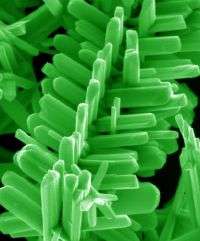
A new technique for growing single-crystal nanorods and controlling their shape using biomolecules could enable the development of smaller, more powerful heat pumps and devices that harvest electricity from heat.
Researchers at Rensselaer Polytechnic Institute have discovered how to direct the growth of nanorods made up of two single crystals using a biomolecular surfactant. The researchers were also able to create "branched" structures by carefully controlling the temperature, time, and amount of surfactant used during synthesis.
"Our work is the first to demonstrate the synthesis of composite nanorods with branching, wherein each nanorod consists of two materials — a single-crystal bismuth telluride nanorod core encased in a hollow cylindrical shell of single-crystal bismuth sulfide," said G. Ramanath, professor of materials science and engineering at Rensselaer and director of the university's Center for Future Energy Systems, who led the research project. "Branching and core-shell architectures have been independently demonstrated, but this is the first time that both features have been simultaneously realized through the use of a biomolecular surfactant."
Most nanostructures comprised of a core and a shell generally require more than one step to synthesize, but these new research results demonstrate how to synthesize such nanorods in only one step.
"Our single-step synthesis is an important development toward realizing large-scale synthesis of composite nanomaterials in general," said Arup Purkayastha, who worked on the project as a postdoctoral researcher at Rensselaer and is now a scientist with Laird Technologies in Bangalore, India.
Because of their attractive properties, core-shell nanorods are expected to one day enable the development of new nanoscale thermoelectric devices for power generation, as well as nanoscale heat pumps for cooling hot spots in nanoelectronics devices.
"Our discovery enables the realization of two very important attributes for heat dissipation and power generation from heat," Ramanath said. "First, the core-shell junctions in the nanorods are conducive for heat removal upon application of an electrical voltage, or generating electrical power from heat. Second, the branched structures open up the possibility of fabricating miniaturized conduits for heat removal alongside nanowire interconnects in future device architectures."
The researchers discovered that synthesis at high temperatures or with low amounts of the biomolecular surfactant L-glutathonic acid (LGTA) yields branched nanorod structures in highly regulated patterns. In contrast, synthesis at low temperatures or with high levels of LGTA results in straight nanorods without any branching. It is interesting to note that at the point of branching, atoms in the branch resemble a mirror image of the parent crystal – a finding that reinforces Ramanath's conclusion that LGTA is able to induce branching through atomic-level sculpture.
"Since LGTA is similar to biological molecules, our discovery could be conceivably used as a starting point to explore the use of proteins and enzymes to atomically sculpt such nanorod architectures through biological processes," said Ramanath.
Results of the study, titled "Surfactant-Directed Synthesis of Branched Bismuth Telluride/Sulfide Core/Shell Nanorods," were recently published online and will be featured in an upcoming issue of the journal Advanced Materials.
Source: Rensselaer Polytechnic Institute


