FLASH Imaging Redux: Nano-Cinema is Born
Jul 08, 2008
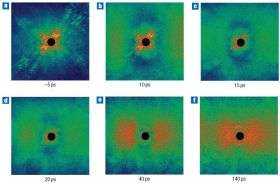
Soft X-rays from the FLASH laser capture the action as a tiny silicon nitride wafer explodes.

Flash imaging of nanoscale objects undergoing ultrafast changes is now a technical possibility, according to a recent paper published in the June 22 edition of Nature Photonics. The results are a direct precursor to research that will be conducted using SLAC’s Linac Coherent Light Source (LCLS).

The experiments, carried out by a team of researchers that included SLAC scientists Sebastien Boutet, Janos Hajdu and Mike Bogen, used the Free-Electron Laser in Hamburg (FLASH laser) at Deutsches Elektronen-Synchrotron (DESY) in Germany.

To create the images, an artificial sample—a silicon nitride wafer less than one thousandth the width of a human hair and etched with a simple nanoscale pattern—was shot with an optical laser, which ultimately caused the tiny wafer to explode. But less than a few billionths of a second (picoseconds) after the first laser—before the sample actually had a chance to disintegrate—a second, soft X-ray laser captured an image of the sample as the disintegration process began.

By repeating the experiment with slight variations in timing between the two lasers, the researchers captured a sequence of images that follow the changes occurring in the sample as it explodes.

Similar to FLASH, the LCLS at SLAC will create ultrafast pulses of coherent X-ray laser light. Pulses from the LCLS, however, will fall in the hard X-ray range, which has a much shorter wavelength, enabling single-shot imaging of even smaller objects, on the scale of individual molecules.

Source: by Brad Plummer, SLAC

Explore further: Physicists develop revolutionary low-power polariton laser

add to favorites email to friend print save as pdf

Related Stories

Facebook joins Web freedom group

1 hour ago

Facebook on Wednesday became a full member of the Global Network Initiative, a non-governmental organization promoting Internet freedom and privacy rights.

Fragile mega-galaxy is missing link in history of cosmos

1 hour ago

Two hungry young galaxies that collided 11 billion years ago are rapidly forming a massive galaxy about 10 times the size of the Milky Way, according to UC Irvine-led research published Wednesday in the journal ...

Recommended for you

Physicists help design, build cargo X-ray scanners

5 hours ago

(Phys.org) —Two SLAC physicists with decades of particle accelerator experience helped a Silicon Valley company design and build X-ray devices that scan cargo containers for nuclear materials and other ...

Theorists weigh in on where to hunt dark matter

5 hours ago

(Phys.org) —Now that it looks like the hunt for the Higgs boson is over, particles of dark matter are at the top of the physics "Most Wanted" list. Dozens of experiments have been searching for them, but ...

Breakthrough calls time on bootleg booze

May 20, 2013

(Phys.org) —Using a laser, the St Andrews scientists can now carry out detailed analysis of a spirit sample no bigger than a teardrop and can even confirm whether it is toxic or not. It's hoped the testing ...

User comments : 0

More news stories

Theorists weigh in on where to hunt dark matter

(Phys.org) —Now that it looks like the hunt for the Higgs boson is over, particles of dark matter are at the top of the physics "Most Wanted" list. Dozens of experiments have been searching for them, but ...