Visualizing atomic-scale acoustic wavesin nanostructures
Jul 03, 2008
Visualizing atomic-scale acoustic waves in nanostructures
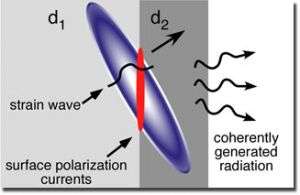
Electromagnetic radiation is produced when an acoustic wave (purple) generates electric currents (red) as it propagates past an interface between two piezoelectric materials. The radiation propagates outside of the materials and can be detected to determine the shape of the acoustic wave with nearly atomic scale resolution.

Acoustic waves play many everyday roles - from communication between people to ultrasound imaging. Now the highest frequency acoustic waves in materials, with nearly atomic-scale wavelengths, promise to be useful probes of nanostructures such as LED lights. However, detecting them isn't so easy.

Enter Lawrence Livermore National Laboratory scientists, who discovered a new physical phenomenon that enables them to see high frequency waves by combining molecular dynamics simulations of shock waves with an experimental diagnostic, terahertz (THz) radiation. (The hertz is the base unit of frequency. One hertz simply means one cycle per second. A terahertz is 10^12 hertz.).
Visualizing atomic-scale acoustic waves in nanostructures
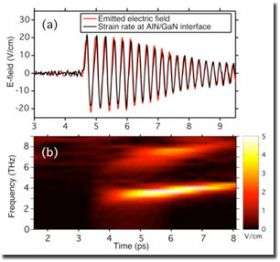
Top: Comparison of strain rate in a molecular dynamics simulation at a AlN/GaN interface to the calculated electric field measured 1 mm from the inter- face for a shock wave with properties given in the text. The time-dependence of the electric field is closely related to the strain rate at the interface enabling direct resolution of THz frequency strain waves. Bottom: Frequency as a function of time for the electromagnetic radiation. An 8 THz harmonic of a 4 THz fundamental corresponds to atomic scale spatial structure around 5 angstroms.

The Livermore scientists performed computer simulations of the highest frequency acoustic waves forming spontaneously at the front of shock waves or generated by sub-picosecond pulse-length lasers.

They discovered that, under some circumstances, when such a wave crosses an interface between two materials, tiny electric currents are generated at the interface. These currents produce electromagnetic radiation of THz frequencies that can be detected a few millimeters away from the interface. Part of the wave is effectively converted to electromagnetic radiation, which propagates out of the material where it can be measured.

Most molecular dynamics simulations of shock waves connect to experiments through electronic properties, such as optical reflectivity.

"But this new approach connects to the much lower frequency THz radiation produced by the individual atoms moving around in the shock wave," said Evan Reed, lead author of a paper that appears in the July 7 edition of the journal, Physical Review Letters. "This kind of diagnostic promises to provide new information about shocked materials like the dynamics of crystals pushed to ultra-high strain rates."

Using molecular dynamics simulations, the team, made up of Livermore's Reed and Michael Armstrong in collaboration with Los Alamos National Laboratory colleagues shows that the time-history of the wave can be determined with potentially sub-picosecond, nearly atomic time and space resolution by measuring the electromagnetic field.

Reed and colleagues studied the effect for an interface between two thin films, which are used in LED (light-emitting diode) nanostructures, and are piezoelectric (electric currents that are generated when they are squeezed). Piezoelectric materials have been used for decades as arrival time gauges for shock-wave experiments but have been limited by electrical equipment that can only detect acoustic frequencies less than 10 gigathertz (GHz), precluding observation of the highest frequency acoustic waves. The new THz radiation technique can help improve the time resolution of such approaches.

The technique has other applications as well. It can be applied to determine the structure of many kinds of electronic devices that are constructed using thin film layered structures, such as field-effect transistors.

"The detection of high frequency acoustic waves also has been proposed for use in imaging of quantum dot nanostructures used in myriad optical devices, possibly including solar cells in the future," Reed said. "The technology is not there yet for that application, but our work represents a step closer."

Source: Lawrence Livermore National Laboratory

Explore further: Tailoring optical processors: Arranging nanoparticles in geometric patterns allows for control of light with light

add to favorites email to friend print save as pdf

Related Stories

Making frequency-hopping radios practical

May 15, 2013

The way in which radio spectrum is currently allocated to different wireless technologies can lead to gross inefficiencies. In some regions, for instance, the frequencies used by cellphones can be desperately ...

Studying how flocculation affects acoustic reflection

May 09, 2013

In inland estuaries and shallow coastal waters, small particles of organic matter, such as organic waste and debris or bacteria, clump together to form an aggregate known as floc. Flocculated particles can span a range of ...

The surprising ooze factor of glass

May 01, 2013

(Phys.org) —Reach for a tall glass of iced tea. Don't drink. Look at the glass instead. The glass is an amorphous solid, consisting of molecules jumbled in disarray. It's the complete opposite of the ice ...

Using sound to protect aquatic life

Apr 22, 2013

The large cargo ships that steam daily into Newark Bay unload more than the colorful containers stacked on deck - from their holds they also can release millions of gallons of water teeming with tiny sea creatures from faraway ...

Recommended for you

Engineers' nanoantennas improve infrared sensing

May 20, 2013

(Phys.org) —A team of University of Pennsylvania engineers has used a pattern of nanoantennas to develop a new way of turning infrared light into mechanical action, opening the door to more sensitive infrared ...

Stacking 2-D materials produces surprising results

May 16, 2013

(Phys.org) —Graphene has dazzled scientists, ever since its discovery more than a decade ago, with its unequalled electronic properties, its strength and its light weight. But one long-sought goal has proved ...

User comments : 0

More news stories

How gold nanoparticles can help fight ovarian cancer

Positively charged gold nanoparticles are usually toxic to cells, but cancer cells somehow manage to avoid nanoparticle toxicity. Mayo Clinic researchers found out why, and determined how to make the nanoparticles effective ...

Radioactive nanoparticles target cancer cells

Cancers of all types become most deadly when they metastasize and spread tumors throughout the body. Once cancer has reached this stage, it becomes very difficult for doctors to locate and treat the numerous tumors that can ...

New method for producing clean hydrogen

Duke University engineers have developed a novel method for producing clean hydrogen, which could prove essential to weaning society off of fossil fuels and their environmental implications.