Pocket-sized magnetic resonance imaging
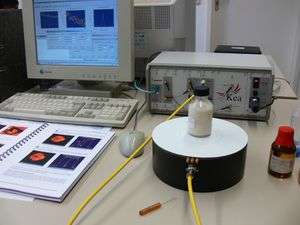
The term “MRI scan” brings to mind the gigantic, expensive machines that are installed in hospitals. But research scientists have now developed small portable MRI scanners that perform their services in the field: for instance to examine ice cores.
Magnetic resonance imaging yields deep insights – into the atomic structure of a biomolecule, for instance, or into the tissues of a patient's body. Magnetic resonance imaging is one of the most important imaging methods used in medicine. However, MRI scanning has one major disadvantage: The machines are huge and extremely expensive, and almost impossible to transport.
The Magnetic Resonance working group at the Fraunhofer Institute for Biomedical Technology Engineering IBMT in Sankt Ingbert has made magnetic resonance imaging mobile. They collaborated with the New Zealand company Magritek to develop small portable devices. Dr. Frank Volke, head of the Magnetic Resonance working group, explains the core technology: "Instead of the large superconducting magnets that have to be cooled with liquid helium and nitrogen, extra-strong permanent magnets are installed in our devices. There is no need for cooling anymore."
To make this possible, several permanent magnets are so arranged that the magnetic field lines overlap to form a homogeneous field. In this way, the developers have succeeded in developing small, less expensive, and above all portable magnetic resonance spectrometers that can even be powered by batteries.
Physicians and researchers alike can benefit from the mobile pocketsized nuclear magnetic resonance (NMR) devices: The first "Kea NMR moles" are already in use in the Antarctic, helping researchers to study the effects of environmental change by analyzing the structure of ice masses or drilled ice cores.
Nevertheless, they cannot replace clinical MRI scanners for whole human body studies. There are many more potential applications for such devices, including delivering important data – directly and online – during production processes. Industrial manufacturers of sausages, cheese or candies, for instance, can use them to analyze the fat or water content of their food products.
The spectrometers can also be employed to measure the humidity of materials, characterize the molecular structure of polymers, or determine the quality of trees for wood production. Together with Magritek, the Fraunhofer researchers provide technical instruction for users in Germany and Europe and support them with device maintenance.
Source: Fraunhofer-Gesellschaft


