Man versus machine poker re-match
Jul 01, 2008
Man versus machine poker re-match
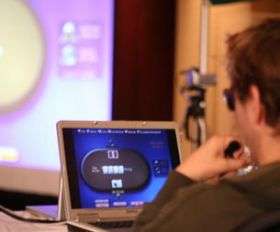
Poker pro Phil "The Unabomber" Laak faces off against Polaris during last year's challenge.

Polaris, the University of Alberta poker playing computer program, is heading to Las Vegas for a re-match against humans.

From July 3-6, the university's poker team will be pitting Polaris against a number of opponents, including Stoxpoker.com coaches Nick Grudzien and IJay Palansky, as well as contributor Matt Hawrilenko, all of whom can boast well over $1 million USD in lifetime winnings. This year's showdown will be at the Rio All-Suite Hotel & Casino in Las Vegas. This match runs concurrently with the 2008 World Series of Poker as part of the 2008 Gaming Life Expo.

This type of tournament was first held in July of 2007, where Phil "The Unabomber" Laak and Ali Eslami won two matches, drew one match, and lost one match. In the same format as last year, Polaris will play against professional human players in a game of limit Texas Hold'em poker.

Each match will consist of 500 hands with the cards dealt in duplicate, meaning that Polaris will receive the same cards in one room that the professional receives in the other room and vise-versa. The duplicate system will be employed in order to balance out the luck of the cards and emphasize the capabilities of the participants.

"It's possible, given enough computing power, for computers to play 'perfectly,' where over a long enough match, the program cannot lose money," said associate professor Michael Bowling, leader of the university's computer poker research group. "Humans will always make some mistakes, meaning the program will have an advantage.

"We're still quite far from the necessary computing power for perfect play. However, we've been able to take what we learned last year and apply it to improving this year's program."

With the popularity of poker and the entertainment value of a man versus machine battle, it is easy to forget that this competition is an academic pursuit. Games are an excellent domain for artificial intelligence research because games have well defined rules and clear goals. The techniques that are learned from succeeding at games can be applied to real-world problems where the "rules" are not so well defined.

The department of computing science at the University of Alberta is one of the foremost institutions in the world to study artificial intelligence. The university's computer poker research group consists of 15 researchers and graduate and undergraduate students whose primary focus is artificial intelligence.

The University of Alberta Computer Poker Research Group: poker.cs.ualberta.ca/

Source: University of Alberta

Explore further: What makes people click? Researchers analyze online news preferences

add to favorites email to friend print save as pdf

Related Stories

Wii U: New console launches in a sea of gadgets

Nov 18, 2012

In the six years since the last major video game system launched, Apple unveiled the iPhone and the iPad, "Angry Birds" invaded smartphones and Facebook reached a billion users. In the process, scores of ...

Gift Guide: Winners for every kind of gamer

Dec 06, 2010

Nearly three-quarters of American households own a device that's used specifically for video games, whether it's a console, a handheld device or a dedicated computer, according to Nielsen Co. Add to that all ...

Computing project combats Blackjack card counting

Oct 11, 2009

(PhysOrg.com) -- A University of Dundee graduate has created a computer system with the potential to make the game of Blackjack fairer by detecting card counters and dealer errors.

Recommended for you

US spy chief: Plot against Wall Street foiled

8 hours ago

The U.S. foiled a plot to bomb the New York Stock Exchange because of the sweeping surveillance programs at the heart of a debate over national security and personal privacy, officials said Tuesday at a rare ...

Poland may delay launch of nuclear plants

8 hours ago

Poland could delay building its first nuclear power plants as natural gas, including shale gas, becomes less costly, the prime minister of the central European heavyweight said Tuesday.

User comments : 4

Adjust slider to filter visible comments by rank

Display comments: newest first

Glis
5 / 5 (1) Jul 01, 2008
I thought it would have nifty stuff like a bloodpressure/heartbeat meter and maybe something to watch pupil dialation.

A computer beating a human at a game of statistics isn't very exciting...
yuri
not rated yet Jul 01, 2008
its not a strictly statistical game, it involves strategy, reaction to the way other people play and etc, there is not one way to win the game.. perhaps if computer played against computer, you would have a statistical match and after playing many games they will have each won 50% of games, but a human brain brings in uncertainty and behavior which computer doesn't possess.
x646d63
not rated yet Jul 02, 2008
This software is more than just playing statistics. It's well programmed for strategy, and includes "bluffing" as part of its program.

The system's behavior is programmed to not be predictable because that is easily beaten by professional players.
kombizz
not rated yet Jul 02, 2008
it is amazing that how computer came to this addicted game.
I wonder if the computer go for strip poker?

More news stories

Mozilla lab wants scientists to step out of analog age

(Phys.org) —Talk about big ideas. Not satisfied to rest on laurels of having brought forth the open source browser Firefox, Mozilla—defined by some as a global project, by others as one of the key open-source ...

3D printing tiny batteries

(Phys.org) —3D printing can now be used to print lithium-ion microbatteries the size of a grain of sand. The printed microbatteries could supply electricity to tiny devices in fields from medicine to communications, ...

Origins of 'The Hoff' crab revealed (w/ Video)

The history of a new type of crab, nicknamed 'The Hoff' because of its hairy chest, which lives around hydrothermal vents deep beneath the Southern Ocean and Indian Ocean, has been revealed for the first ...