A plane with wings of glass?
Jun 22, 2008
A plane with wings of glass?
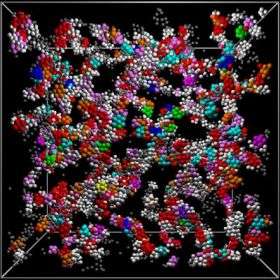
Colloidal particles, that mimic atoms, form a gel with the structure of glass. Credit: Paddy Royall, University of Bristol, UK

Imagine a plane that has wings made out of glass. Thanks to a major breakthrough in understanding the nature of glass by scientists at the University of Bristol, this has just become a possibility.

Despite its solid appearance, glass is actually a 'jammed' state of matter that moves very slowly. Like cars in a traffic jam, atoms in a glass can't reach their destination because the route is blocked by their neighbours, so it never quite becomes a 'proper' solid.

For more than 50 years most scientists have tried to understand just what glass is. Work so far has concentrated on trying to understand the traffic jam, but now Dr Paddy Royall from the University of Bristol, with colleagues in Canberra and Tokyo, has shown that the problem really lies with the destination, not with the traffic jam.

Publishing today (22 June 2008) in Nature Materials, the team has revealed that glass 'fails' to be a solid due to the special atomic structures that form in a glass when it cools (ie, when the atoms arrive at their destination).

Royall explained: "Some materials crystallize as they cool, arranging their atoms into a highly regular pattern called a lattice. But although glass 'wants' to be a crystal, as it cools the atoms become jammed in a nearly random arrangement, preventing it from forming a regular lattice.

"Back in the 1950s, Sir Charles Frank in the Physics Department at Bristol University suggested that the arrangement of the 'jam' should form what is known as an icosahedron, but at the time he was unable to provide experimental proof. We set out to see if he was right."

The problem is you can't watch what happens to atoms as they cool because they are just too small. So using special particles called colloids that mimic atoms, but are just large enough to be visible using state-of-the-art microscopy, Royall cooled some down and watched what happened.

What he found was that the gel these particles formed also 'wants' to be a crystal, but it fails to become one due to the formation of icosahedra-like structures – exactly as Frank had predicted 50 years ago. It is the formation of these structures that underlie jammed materials and explains why a glass is a glass and not a liquid – or a solid.

Knowing the structure formed by atoms as a glass cools represents a major breakthrough in our understanding of meta-stable materials and will allow further development of new materials such as metallic glasses.

Metals normally crystallize when they cool, unfortunately stress builds up along the boundaries between crystals, which leads to metal failure. For example, the world's first jetliner, the British built De Havilland Comet, fell out of the sky due to metal failure. If a metal could be made to cool with the same internal structure as a glass and without crystal grain boundaries, it would be less likely to fail.

Source: University of Bristol

Explore further: How soon could car seats enter the 3-D comfort zone?

add to favorites email to friend print save as pdf

Related Stories

World's smallest droplet

May 17, 2013

(Phys.org) —Physicists may have created the smallest drops of liquid ever made in the lab. That possibility has been raised by the results of a recent experiment conducted by Vanderbilt physicist Julia Velkovska and her ...

Metallic glass: How nanoscale islands react under strain

May 08, 2013

Quick-cooling molten atoms give metal alloys a glassy, or random, atomic structure that generates higher elasticity and better wear- and corrosion-resistance than their crystalline alloy counterparts. However, ...

Recommended for you

How soon could car seats enter the 3-D comfort zone?

2 hours ago

New 3D textiles made of recyclable polyester fibres could contribute help cars be easier to recycle. But recycling technology has yet to progress in separating seat material from other car components.

NASA: Austin, calling Austin. 3-D pizzas to go

19 hours ago

(Phys.org) —The idea of living with 3-D printed food is neither unthinkable nor new; designers and futurists have been looking to 3-D printing as food's next frontier. In 2012, there was news that the Thiel ...

User comments : 14

Adjust slider to filter visible comments by rank

Display comments: newest first

NeilFarbstein
3.4 / 5 (7) Jun 22, 2008
There's nothing in that article that says glass might replace metals. The title is garbage
earls
3.3 / 5 (3) Jun 22, 2008
Agreed. Granted it literally does, but the articles seems to repeat itself two or three times over.

We get it.
gondomondo
5 / 5 (5) Jun 22, 2008
Are we talking transparent aluminum Mr. Scott?
WolfAtTheDoor
2 / 5 (2) Jun 22, 2008
So glass is like a traffic jam? I don't buy it.
SmartK8
4.5 / 5 (2) Jun 23, 2008
Wings of glass ? No, no, no.
Trippy
4.5 / 5 (2) Jun 23, 2008
It's a double entendree.

They don't mean glass as in silica, they mean glass as in the structural type.

What the article is saying is that if we can artificially prevent metals from crystalizing, and force them into a glass-like structure, then they will be stronger - no crystal boundaries, less places for stress fractures to form.
Sepp
3.3 / 5 (3) Jun 23, 2008
Well, it's not really wings of glass, but metal wings with glass in them. That would make them more stable because they could accomodate a certain degree of motion. The glass would act like pieces of rubber capable of absorbing the relative motion between chunks of crystallized metal.
Stotty
5 / 5 (1) Jun 23, 2008
I concur with Trippy - what we need to do is diffentiate between 'glass' as a state of matter and 'silica glass' i.e glass as we know it, as just one example of matter in this state. If it can be achieved then, for example, aluminium glass may not be transparent but it will be 100% aluminium and have some very interesting other properties
seanpu
5 / 5 (1) Jun 23, 2008
OMG imagine the horror, looking out the window and the wings SHATTER just like glass, and the fuselage plummets out of the sky like a WW2 bomb at over 700km/h!!!
lengould100
not rated yet Jun 23, 2008
Items:

a) Honeywell has been selling metglass (an amorphous eg. non-crystaline form of iron) for use in high-performance high-frequency electric motor stators for a long time. What's new here?

b) Avoiding crystal grain boundaries by creating boundaries at every atom (glass) may not improve the mechanical properties of a metal.
Mercury_01
not rated yet Jun 23, 2008
We ned a new word for glass- state metals. I hereby coin the term glassarific. I will now invent the glassarific projectile that will destroy my fellow man.
KB6
5 / 5 (1) Jun 23, 2008
This is not about glass in the "conventional" sense of silicon-based window glass. It is about the difference between typical crystalline metals (like most of the metal you see every day) and metallic glasses. Metallic glass may be stronger or more resistant to metal fatigue from the lack of crystal boundaries but it is also much harder to fabricate. Metals crystallize unless they are cooled very rapidly, before the individual atoms have a chance to array themselves into crystals. This is relatively easy to do with thin sheets of metal or wires, for example. But it's more complicated with bulky forms where you have to overcome the surface to interior temperature differential.
Even then, only certain "special" alloys (e.g.: Zirconium or Palladium based) lend themselves well to glass formation.
And no, the wings wouldn't shatter like glass, unless perhaps they were incredibly cold. ;)
googleplex
not rated yet Jun 25, 2008
Glass (Si02) is viscous liquid and is not a solid. Are they saying the same about the metal.
Rawley
not rated yet Jun 29, 2008
This is basically what is known as bulk-metallic glasses, they've been around a while.
Glasses, even metallic glasses, fail via brittle mechanism. This is NOT suitable for airplane wings. Grains in metals and ceramics actually strengthen the material and increase its fracture resistance. There's a trend that the finer the grain structure, the more superior the properties.
Grains actually impede dislocation movement (the cause of ductility), so the more grain boundaries the more resistant a material is to deformation.

More news stories

Solar plane sets distance record on US tour

The first manned aircraft that can fly day and night powered only by solar energy set a new distance record Thursday when it landed after the second leg of a cross-country US tour.

Engineers pioneer flat spray-on optical lens

A University of British Columbia engineer and a team of U.S. researchers have made a breakthrough utilizing spray-on technology that could revolutionize the way optical lenses are made and used.

Chemists find new compounds to curb staph infection

(Phys.org) —In an age when microbial pathogens are growing increasingly resistant to the conventional antibiotics used to tamp down infection, a team of Wisconsin scientists has synthesized a potent new ...