Pyrite deposits across the state may be tied to an Eocene meteor
In 2003, during construction of Interstate 99 in Centre County, Pennsylvania, state road builders hit the mother lode. That's a bad thing.
At a place called Skytop Mountain, 10 miles west of State College, PennDOT engineers encountered a huge deposit of iron pyrite laced through the sandstone ridge. Exposed to air and water, this highly reactive material became an environmental nightmare, leaching sulfuric acid into a nearby stream and groundwater. Subsequent efforts to contain the damage have so far cost more than $79 million.
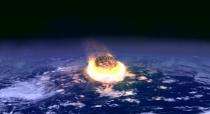
What caused this massive -- and unexpected -- sulfide deposit? Barry Scheetz and his colleague Ryan Mathur pin the blame on a meteor that crashed 35 million years ago smack into Chesapeake Bay.
Scheetz, a professor of materials, civil and nuclear engineering at Penn State and an expert on acid mine drainage, was contracted by PennDOT shortly after the Skytop remediation began, and asked to help predict where such deposits might exist elsewhere around the state.
The first step was analyzing the material at hand. Isotopic tests conducted by Ryan Mathur, a geochemist at nearby Juniata College, showed that the Skytop pyrite was 35 million years old, and was molten (about 400 degrees C) at the time of placement. "It came from the mantle," Scheetz concluded. So how did it get to the surface?
"You need a competent host," Scheetz said, meaning a substrate of rock hard enough that "when it fractures and opens up, it stays open." The sandstone at Skytop fits the bill. The fractures there, called lineaments, formed 250 million years ago when the Appalachian mountains pushed up, and extend all the way to bedrock.
"That's your plumbing system," Scheetz said. "And the last thing you need is a driver. So the question becomes, what the hell happened 35 million years ago?"
The answer, he said, is a cataclysmic impact. During the late Eocene epoch, a massive object up to three miles in diameter and moving at 12 miles per second slammed into the coastal shallows of what is now the Tidewater region of Virginia. The evidence for this event, known as the Chesapeake Bay impact crater, runs some 52 miles across and nearly as deep as the Grand Canyon. Hidden under the sediments of the bay, the crater was not even suspected until 1983. Its full extent was not known until the mid-1990s.
"My guess is it probably changed the axis of the Earth," Scheetz said of the collision. "Everything within a 600-mile radius was utterly destroyed." The result below the surface was similarly dramatic.
"Have you ever seen pictures of people shooting at jugs of water?" Scheetz asks. "How the water just explodes because of the hydraulic impact? That's exactly what happened here. This thing hit and this enormous hydraulic pulse surged into the mantle. The fluids that were present there shot up through these pre-existing fractures," and wound up near the surface at Skytop.
“But it’s not just Skytop,” he said. Scheetz and colleagues have tested samples from nine other deposits, six in nearby Blair and Huntingdon counties, two in York County and one as far away as Montgomery County, in the southeastern part of the state. All have the same isotopic signature. “The fact that we have found 10 of these things tells me they could be anywhere in Pennsylvania,” he said.
He and a graduate student, Chad Ellsworth, have mapped some of the major lineaments in the ridge and valley region, using telltale landscape features like wind and water gaps and the presence of sandstone to locate additional deposits along these fractures. They have mapped 150 known deposits so far -- many, Scheetz suspects, have the potential to result from the same wayward meteor. He is looking for funding that would allow him to incorporate aerial reconnaissance and electromagnetic sensing into the search.
"Being able to predict where these isolated deposits are likely to pop up," he says, "could prevent future Skytops around the state and beyond."
Source: By David Pacchioli, Research/Penn State


