NASA Tests Lunar Robots and Spacesuits on Earthly Moonscape
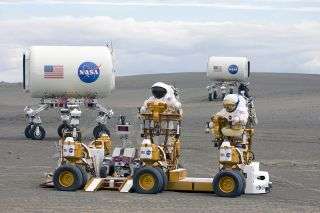
Conditions on the moon will be harsher, but prototype NASA robotic vehicles braved sand storms and unprecedented temperature swings this month on sand dunes near Moses Lake, Wash., to prepare for future lunar expeditions. Teams from seven NASA centers and several universities conducted the tests from June 2-13.
"The goal was to gain hands-on experience with specific technical challenges anticipated when humans return to the moon by 2020, begin to explore the lunar surface, and set up outposts," said Test Director Bill Bluethmann of NASA's Johnson Space Center in Houston.
NASA's Human Robotic Systems Project, part of the agency's Exploration Technology Development Program, focused on human and robotic mobility systems for the moon, but also looked at communication and command and control systems that will connect the explorers with Earth and each other. The Moses Lake dunes provided a wide variety of soil consistencies and terrain that allowed the team to put prototype scout robots, rovers, cargo carriers, cranes and spacesuits through tests in a harsh and changing environment.
The prototype tests will be used to inform developers of specific requirements needed in lunar surface support systems for the Constellation Program. The program is building the launch vehicles and spacecraft that will take a new generation of explorers to the moon, as well as lunar landers, habitats, life support systems, vehicles and robots to support them. A ground control team located thousands of miles away at Johnson operated the robots and coordinated the movements of the suited explorers.
NASA's Ames Research Center in Moffett Field, Calif., tested two K10 rovers that surveyed simulated lunar landing sites and built topographic and panoramic 3-D terrain models. One rover used a ground-penetrating radar to assess subsurface structures. The other used a 3-D scanning laser system known as LIDAR to create topographic maps. The scout robots are designed to perform highly repetitive and long-duration tasks, such as site mapping and science reconnaissance.
"It's as close as we can get in a terrestrial environment to the lunar environment," said Brian Wilcox, principle investigator for the All-Terrain Hex-Legged Extra-Terrestrial Explorer robot, known as ATHLETE, at NASA's Jet Propulsion Laboratory in Pasadena, Calif.
JPL tested two ATHLETE cargo-moving rovers. Each rover has six legs capable of rolling or walking over extremely rough or steep terrain. This will allow robotic or human missions on the surface of the moon to load, manipulate, deposit and transport payloads to desired sites. The team includes members from Johnson, Ames, Stanford University and The Boeing Co. of Chicago.
NASA's Glenn Research Center in Cleveland, and Carnegie Mellon University of Pittsburgh tested an autonomous drilling rover that could be used to search for valuable resources under the lunar surface in the moon's polar regions. The team also includes members from Ames, Johnson, NASA's Kennedy Space Center, the Canadian Space Agency and the Centre for Advanced Technology Inc. in Sudbury, Ontario.
Engineers from Johnson tested a crew mobility chassis prototype, or lunar truck, and advanced spacesuit designs that could be used to greatly expand the exploration range of human explorers. NASA's new concept for a lunar truck was built in less than a year with unique features that allow each of its six wheels to move independently, giving the vehicle the ability to drive in any direction. Human drivers stood in turrets on the trucks that can pivot 360 degrees, contributing to easy steering.
To practice soil-moving techniques for the moon, Kennedy developed a bulldozing blade for the lunar truck, named the Lunar Attachment Node for Construction Excavation, or LANCE. A lightweight, composite technology such as LANCE will be used on the moon to clear landing pads and protect outposts from dust and debris generated by arriving spacecraft. The tests will help NASA evaluate the feasibility of excavating lunar soil, or regolith, for landing pads, blast protection berms, pathways, foundations and lunar operations areas.
NASA's Langley Research Center of Hampton, Va., demonstrated a lunar surface crane that could be used to lift and reposition heavy cargo, including modules used for crew quarters. The Lunar Surface Manipulator System is a lightweight lifting and precision positioning device that could give astronauts a helping hand during early outpost construction and follow-on operations. The crane can be operated autonomously, remotely or manually in backup mode, and can be reconfigured to perform different tasks. NASA's Goddard Space Flight Center of Greenbelt, Md., provided lunar payload mockups that were used with the lunar crane to demonstrate payload handling operations.
Participants in the June tests will evaluate their data and prepare for additional tests in October at another site, yet to be announced, with moon-like conditions.
Source: NASA


