New algorithm increases accuracy of air-pollution predictions
When air-quality monitors and environmental regulators inspect the pollution levels of certain cities, the difference of one or two parts per million in the concentration of pollutants like ozone and carbon monoxide can mean the difference between achieving a target and having to implement additional costly provisions to get failing areas back on track.
Because of the high stakes involved in meeting air-quality targets, scientists, city officials and regulators all desire an effective and accurate way not only to measure air quality but also to predict where pollution "hot spots" will occur and plan for additional control strategies.
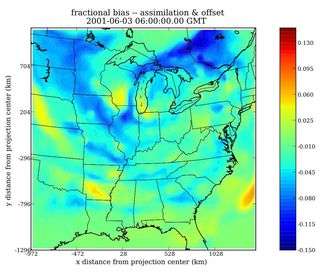
To assist in that effort, environmental scientist Rao Kotamarthi of the U.S. Department of Energy's Argonne National Laboratory, in collaboration with Alexis Zubrow, now at the University of North Carolina, and Li Chen, now at Bristol University, U.K., developed a computer algorithm that quickly and accurately assimilates observational data into climate models to generate more reliable forecasts.
"By incorporating observation data into our models, we can refine our predictions," Kotamarthi said. "Meteorologists have been doing it for a while, but people in the chemical trace gas and aerosol modeling community have just started doing it."
When scientists include measurement data in their models, the uncertainties in those measurements compound the uncertainties already present in the model. Compensating for these new uncertainties requires a mathematically rigorous analysis, so Kotamarthi and his colleagues decided to launch many simulations with slightly different initial conditions. This ensemble-based approach creates a better method to correct for uncertainty, he said.
"We need to generate better forecasts of ozone, carbon monoxide and other trace gases for air-quality applications," Kotamarthi said. "And the way to do that is by assimilating the data taken today into the forecast for tomorrow. But the data come with certain types of uncertainty that most models are unable to accommodate."
The ensemble methods will give policy-makers another tool to guide their decisions, Kotamarthi added. "There's very little merit in trying to decide a policy based on a single emissions scenario," he said. "We need to combine different measurements with a suite of new mathematical techniques in order to help reduce the uncertainty in our forecasts."
Although Kotamarthi's model looks expressly at carbon-monoxide emissions, he claimed that researchers could use similar algorithms to examine the atmospheric concentrations of carbon dioxide and other greenhouse gases and aerosols. Kotamarthi and Argonne environmental scientist Paul Hovland have initiated a NASA-funded project to develop data assimilation methods for worldwide chemical transport models that can incorporate satellite measurements of several atmospheric gases.
Data assimilation may also boost researchers' ability to project likely climate scenarios for the "near-term decadal scale"—approximately 10 to 20 years—which would help public officials assess the consequences of their decisions that concern climate change.
The results of the study were published in the Journal of Geophysical Research.
Source: Argonne National Laboratory


