New study finds most North Pacific humpback whale populations rebounding
May 21, 2008
Scientists Study Humpback Whales
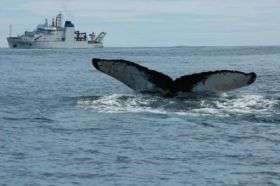
NOAA ship Oscar Dyson stands watch as researchers gather information from humpback whales. Humpback whale flukes, like the one shown here, are unique to each animal just like a fingerprint. This whale could be identified thousands of miles away by its distinctive markings. Credit: NOAA

The number of humpback whales in the North Pacific Ocean has increased since international and federal protections were enacted in the 1960s and 70s, according to a new study funded primarily by NOAA and conducted by more than 400 whale researchers throughout the Pacific region.

However, some isolated populations of humpbacks, especially those in the Western Pacific Ocean, have not recovered at the same rate and still suffer low numbers.

The new research reveals that the overall population of humpbacks has rebounded to approximately 18,000 to 20,000 animals. The population of humpback whales in the North Pacific, at least half of whom migrate between Alaska and Hawaii, numbered less than 1,500 in 1966 when international whaling for this species was banned. In the 1970s, federal laws including the Marine Mammal Protection Act and the Endangered Species Act provided additional protection.

“NOAA is proud to have played a key role in initiating and funding this study,” said retired Navy Vice Adm. Conrad C. Lautenbacher, Ph.D., under secretary of commerce for oceans and atmosphere and NOAA administrator. “It is only through this type of international cooperation that we can gauge our success and measure what additional work needs to be accomplished to protect highly migratory marine mammals.”

The results of this new report come from SPLASH (Structure of Populations, Levels of Abundance and Status of Humpbacks), an international effort involving more than 50 organizations. Launched in 2004, the project determined whale migratory patterns and estimated population sizes by using a library of 18,000 photographs of whale flukes to identify 8,000 individual whales.

Cascadia Research in Olympia, Wash., the central coordinator for the SPLASH project, matched photographs from six different feeding and breeding areas. By matching whale flukes photographed in their feeding areas with those photographed in the wintering areas, researchers were able to determine the patterns of individual whale movements, as well as estimate the sizes of different populations.

In addition to whale fluke photographs, SPLASH researchers collected more than 6,000 biopsy samples for studies of genetics and pollutants, along with thousands of additional photographs to determine how levels of scarring from line entanglement and ship strikes vary among regions. The samples, which are yet to be analyzed, will provide valuable insights into the complex population structure and current threats to further recovery.

Source: NOAA National Marine Fisheries Service

Explore further: Bold action, big money needed to curb Asia floods

add to favorites email to friend print save as pdf

Related Stories

New Caledonia bans shark fishing

Apr 24, 2013

The government of the Pacific paradise of New Caledonia said Wednesday it had decided to ban fishing of sharks, which are being decimated to feed growing demand for luxury goods.

Sea mammals find US safe harbor

Apr 11, 2013

(Phys.org) —In 1972, a U.S. Senate committee reported, "Many of the great whales which once populated the oceans have now dwindled to the edge of extinction," due to commercial hunting. The committee also ...

Wiring the ocean

Feb 18, 2013

For most people, the sea is a deep, dark mystery. That is changing, though, as scientists find innovative ways to track the movements of ocean-going creatures.

Recommended for you

Bold action, big money needed to curb Asia floods

3 hours ago

Asia's flood-prone megacities should fund major drainage, water recycling and waste reduction projects to stem deluges and secure clean supply for their booming populations, experts said Sunday.

Heat-related deaths in Manhattan projected to rise

5 hours ago

Residents of Manhattan will not just sweat harder from rising temperatures in the future, says a new study; many may die. Researchers say deaths linked to warming climate may rise some 20 percent by the 2020s, ...

Dire outlook despite global warming 'pause': study

5 hours ago

A global warming "pause" over the past decade may invalidate the harshest climate change predictions for the next 50 to 100 years, a study said Sunday—though levels remain in the danger zone.

Chinese, Indian airlines face EU pollution fines

May 18, 2013

Eight Chinese and two Indian airlines face fines of up to several million euros for not paying for their greenhouse gas emissions during flights within the bloc, the European Commission said on Friday.

User comments : 0

More news stories

Heat-related deaths in Manhattan projected to rise

Residents of Manhattan will not just sweat harder from rising temperatures in the future, says a new study; many may die. Researchers say deaths linked to warming climate may rise some 20 percent by the 2020s, ...

Bold action, big money needed to curb Asia floods

Asia's flood-prone megacities should fund major drainage, water recycling and waste reduction projects to stem deluges and secure clean supply for their booming populations, experts said Sunday.

Mice, gerbils perish in Russia space flight

A number of mice and eight gerbils sent into space in a Russian capsule destined to find out how well organisms can withstand extended flights perished during their journey, scientists said Sunday as the ...

Kinks and curves at the nanoscale

One of the basic principles of nanotechnology is that when you make things extremely small—one nanometer is about five atoms wide, 100,000 times smaller than the diameter of a human hair—they are going ...