Mechanical locomotion principles from jumping insects applied to microrobots
May 21, 2008
A biomimetic jumping microrobot
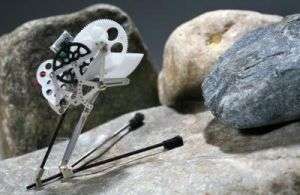
About the size of a locust and weighing on 7 grams, this tiny robot can jump 27 times its own size. Credit: Alain Herzog, EPFL

Researchers from the Laboratory of Intelligent Systems at EPFL are unveiling a novel, grasshopper-inspired jumping robot at the IEEE International Conference on Robotics and Automation May 21 in Pasadena, California.

The robot weighs a miniscule 7 grams, and can jump 1.4 meters, or more than 27 times its body size -- ten times farther for its size and weight than any existing jumping robot.

These jumpers could be fitted out with tiny sensors to explore rough, inaccessible terrain or to aid in search and rescue operations.

"This biomimetic form of jumping is unique because it allows micro-robots to travel over many types of rough terrain where no other walking or wheeled robot could go," explains EPFL Professor Dario Floreano. "These tiny jumping robots could be fitted with solar cells to recharge between jumps and deployed in swarms for extended exploration of remote areas on Earth or on other planets."

Small jumping animals such as fleas, locusts, grasshoppers and frogs use elastic storage mechanisms to slowly charge and quickly release their jumping energy. In this way, they can achieve very powerful jumps and very high accelerations. The jumping robot presented here uses the exact same principle, charging two torsion springs via a small 0.6-gram pager motor and a cam.

In order to be able to optimize the jumping performance, the legs can be adjusted for jumping force, takeoff angle and force profile during the acceleration phase. The tiny battery on board allows it to make up to 320 jumps at intervals of 3 seconds.

This work will be presented by Mirko Kovac May 21 in Pasadena, California during the ICRA's "Dynamic Walking" Session."

Source: Ecole Polytechnique Fédérale de Lausanne

Explore further: Multiview 3-D photography made simple

add to favorites email to friend print save as pdf

Related Stories

Winners and losers at this week's E3

19 hours ago

Since the first battles over "Pong" machines in local arcades four decades ago, video gamers have loved good competition. And this year's Electronic Entertainment Expo—the industry's largest annual gathering—presented ...

Recommended for you

Multiview 3-D photography made simple

12 hours ago

Computational photography is the use of clever light-gathering tricks and sophisticated algorithms to extract more information from the visual environment than traditional cameras can.

Giant 3-D printed bugs shed light on insect anatomy

12 hours ago

Minute insects, from the Australian National Insect Collection, have been super sized by up to forty times using a novel 3D scanning system and printed using a state of the art 3D printer.

Mathematical algorithms cut train delays

Jun 18, 2013

Commuters are already seeing a reduction in delays and waiting times thanks to new software able to adapt railway schedules in real time following unforeseen disruptions.

User comments : 1

Adjust slider to filter visible comments by rank

Display comments: newest first

mabarker
1 / 5 (4) May 21, 2008
Once again, secular scientists are taking note of what they see in creation and then attempt to mimic what they see.
More power to them - the Creator thought of it first.
When I took graduate-level entomology we had to study the elastic molecule responsible for the fleas jumping - constantly - for days on end wi/o stopping. I never heard how random genetic mistakes 'created' this molecule. As a zoologist I see it as evidence for design.

More news stories

Microsoft mulled buying Nokia unit

Microsoft was in talks to boost its position in the mobile phone market by buying the devices business from Nokia but failed to seal a deal, the Wall Street Journal reported Wednesday.

Kim Dotcom slams Megaupload 'data massacre'

Megaupload founder Kim Dotcom Thursday condemned a Dutch company's decision to delete million of files belonging to users of his defunct website, calling it "the largest data massacre in the history of the ...

The broken symphony of swinging metronomes

An experiment with 30 metronomes reveals chimera states which combine aspects of synchrony and of disorder. Researchers had been looking for such states for ten years.

Wooden beam could be detached part of shipwreck

A wooden beam that has long been the focus of the search for a 17th century shipwreck in northern Lake Michigan was not attached to a buried vessel as searchers had suspected, but still may have come from the elusive Griffin ...