Cambridge researcher creates revolutionary vehicle suspension design
Apr 28, 2008
The E-springs invention set to shape the next generation of vehicle suspension systems
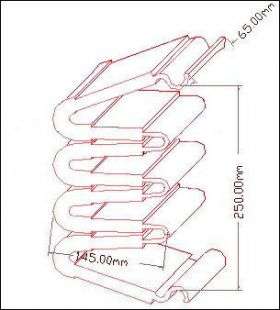
3D View of E-spring. Credit: Cambridge University

A new form of suspension that promises to revolutionise the experience of people who drive heavy goods vehicles has been designed by a Cambridge academic.

The novel E-shaped suspension will enhance driver control, improve comfort and increase safety. It will also reduce fuel consumption and cut the cost of fitting specialist equipment to vehicles so that they can cope with different loads.

At the moment, commercial and heavy good vehicles need to have their suspension fine-tuned in accordance with the load they are carrying, so that drivers can control them.

For example, a vehicle with soft suspension is suitable for light loads, but becomes difficult to control if it has to carry extra weight. On the other hand, giving a vehicle hard suspension can make it easy to handle with a heavy load, but the driver and passengers will be in for a bumpy ride once the load is removed.

PhD researcher Salah Elmonselhy, from the Department of Engineering at the University of Cambridge, has proposed an E-shaped suspension design that gets around the problem by using two springs instead of the single spring used in standard suspension.

The springs are placed opposite to one another, but can work together when needed. The first operates under light loads, while the second is more tightly set, so that it provides greater stiffness only when the weight of the vehicle’s load is heavier. As a result, the vehicle’s suspension adjusts itself, according to the vehicle’s needs.

“Suspension is an ongoing problem for commercial and heavy goods drivers as it can’t always be tuned to a level that balances control, comfort and safety,” Salah said.

“This innovation will give drivers more control over their vehicles whatever the weight the suspension has to bear. The good news is that no extra tuning will be required due to the E-shape.”

During driving, the vehicle’s suspension is also pushed or pulled by other forces which are created by braking, cornering and acceleration. Salah’s proposed idea is so flexible that with a few additions, the suspension is not affected by these forces.

Salah Elmonselhy has already received an international honour from the Society of Automotive Engineers (SAE), in recognition of his “E-springs” invention. The Society of Automotive Engineers is the world premier society for advancing mobility in Land, Sea, Air, and Space.

For a demonstration of how the suspension works please follow the link: www.eng.cam.ac.uk/news/stories/2008/e_spring/animation_03.avi

Source: Cambridge University

Explore further: Researchers use light projector and single-pixel detectors to create 3-D images

add to favorites email to friend print save as pdf

Related Stories

NASA rover lands on Mars (Update 4)

Aug 06, 2012

NASA has successfully landed its $2.5 billion Mars Science Laboratory and Curiosity rover on the surface of the Red Planet, breaking new ground in US-led exploration of an alien world.

Wheel hub motor concept drives hybrid progress at MTSU

Jul 24, 2012

(Phys.org) -- When news broke in 2009 that a former IBM engineer had devised a kit that turns any car into a plug-in hybrid for between $3,000 and $5,000, those interested in going-green technologies took ...

Caltech Rover ready for rock-yard competition in Houston

May 29, 2012

(Phys.org) -- Later this week, a four-wheeled robot designed and built by Caltech undergraduate students will maneuver, apparently under its own guidance, through various challenges at the NASA Johnson Space ...

Recommended for you

GPS solution provides 3-minute tsunami alerts

May 17, 2013

Researchers have shown that, by using global positioning systems (GPS) to measure ground deformation caused by a large underwater earthquake, they can provide accurate warning of the resulting tsunami in ...

Innovative concrete to facilitate building rehabilitation

May 16, 2013

The Structural Technology Group of the Universitat Politècnica de Catalunya, BarcelonaTech (UPC), in collaboration with the company PROMSA, is participating in the rehabilitation of the Gaudí House Museum in Barcelona's P ...

User comments : 3

Adjust slider to filter visible comments by rank

Display comments: newest first

bhiestand
5 / 5 (1) Apr 29, 2008
An elegant solution. I hope to see this become common in the future.
Pedro16
5 / 5 (1) Apr 30, 2008
Zig-zag springs are not new. For an example see http://www.google...AAAAEBAJ&dq
Two-spring systems with coil or leaf springs are also well known. So what is new here except exaggerated claims?
Finally, how can anyone call it E-shaped and keep a straight face?
Zig158
4 / 5 (1) Apr 30, 2008
Most heavy trucks now days use air bags for suspension.

More news stories

German energy shift faces headwinds

Tense engineers have their eyes peeled on complex colour-coded diagrams on a wall-sized screen that makes their control room look like the inside of a spaceship.

Internet in 'coma' as Iran election looms

Iran is tightening control of the Internet ahead of next month's presidential election, mindful of violent street protests that social networkers inspired last time around over claims of fraud, users and ...

China police billions spell profit opportunity

Mannequins in riot gear, armoured cars and drones line a police equipment and "anti-terrorism technology" trade fair in Beijing as vendors seek to profit from China's huge internal security budget.

Honeybees trained in Croatia to find land mines

(AP)—Mirjana Filipovic is still haunted by the land mine blast that killed her boyfriend and blew off her left leg while on a fishing trip nearly a decade ago. It happened in a field that was supposedly ...

Bold action, big money needed to curb Asia floods

Asia's flood-prone megacities should fund major drainage, water recycling and waste reduction projects to stem deluges and secure clean supply for their booming populations, experts said Sunday.

Mice, gerbils perish in Russia space flight

A number of mice and eight gerbils sent into space in a Russian capsule destined to find out how well organisms can withstand extended flights perished during their journey, scientists said Sunday as the ...