Creating Faster Integrated Circuits by Slowing Light
As the pace of photonic device development quickens, researchers at UC San Diego have shown that actually slowing light can accelerate future development in this promising field.
Slowing light, something that college physics textbooks don't even mention, is now increasingly looked upon by scientists as a viable way to enable the transport of information optically rather than with wires, a breakthrough that, in theory, would significantly enhance computer performance and lower the power required by future computer systems.
To further fuel this theory, two UCSD research groups have merged two previously unrelated areas of cutting-edge research in optics – slow light and Anderson localization – and have shown in a paper published in the journal Nature Photonics that structures being considered as prime building blocks for nanophotonic integrated circuits are very susceptible to the effects of disorder, including Anderson localization. (Anderson localization is a general wave phenomenon that affects the transport of electrons as well as electromagnetic waves such as light, both in crystals and in waveguides to be used as optical interconnects).
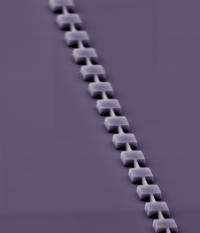
The new findings were led by UCSD electrical and computer engineering professor Shayan Mookherjea in collaboration with UCSD mechanical engineering professor Prabhakar Bandaru. Using equipment at the California Institute for Telecommunications and Information Technology’s (Calit2’s) new Nano3 clean room facility under the supervision of Calit2 senior engineer Bernd Fruhberger, graduate student Jung Park in Mookherjea’s Micro/Nano-Photonics research group fabricated a slow-wave optical waveguide in a silicon-on-insulator chip. The researchers have shown that Anderson localization of light can occur in such waveguides, and that disorder not only limits how much the speed of light can be slowed, but that it can also localize light within the chip-scale waveguide, something that has not been demonstrated before.
“The fact that the slowing of light occurs together with localization opens the door for more research in this area of photonics,” Mookherjea said. “We have already shown by analytical and numerical modeling that disorder is a serious limiting factor in the anticipated performance of optical devices such as buffers, which try to use slow light. But localization of light – an interesting physical phenomenon with potential applications in the context of lasers and optical interconnects (as yet unexplored) – was only recently predicted, and has just now been observed in these structures.”
Mookherjea pointed out that two other papers published in the last few months in Physical Review Letters by researchers from Harvard University and from the Weizmann Institute in Israel, have also studied Anderson localization in similar chip-scale structures.
“Light localization enables us to control photons and the various aspects of their propagation and interaction with matter,” said Bandaru, who works in the electrical properties of nanometer scale structures.
Slowing and controlling light on a nano scale could lead to the development of optical buffering, which has long been sought after in the photonics community. This development may be a step closer to reality thanks to the UCSD researchers’ detailed study of disorder and associated physical phenomena such as localization in fabricated devices.
“We continue to see optics on a tabletop scale do wonderful things with slow light,” Mookherjea said. “To be able to squeeze all this interesting science onto a compatible silicon chip platform will really enhance the impact of photonics in an inter-disciplinary way. In our work, we’re opening a window between optical localization research – traditionally the domain of physicists – and research in optical interconnects and novel waveguides, where electrical engineers are leading the way.”
The UCSD researchers will be presenting their work at the upcoming Conference on Lasers and Electro-Optics (CLEO) to be held in San Jose, CA, on May 7.
Source: UC San Diego


