Ceramic, heal thyself
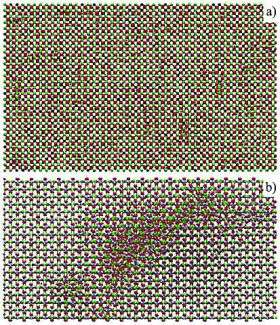
A new computer simulation has revealed a self-healing behavior in a common ceramic that may lead to development of radiation-resistant materials for nuclear power plants and waste storage.
Researchers at the Department of Energy's Pacific Northwest National Laboratory found that the restless movement of oxygen atoms heals radiation-induced damage in the engineered ceramic yttria-stabilized zirconia.
Scientists Ram Devanathan and Bill Weber modeled how well that ceramic and other materials stand up to radiation. "If you want a material to withstand radiation over millennia, you can't expect it to just sit there and take it. There must be a mechanism for self-healing," said Devanathan.
"This research raises the possibility of engineering mobile defects in ceramics to enhance radiation tolerance," Weber said. He noted that materials capable of handling high-radiation doses also "could improve the durability of key equipment and reduce the costs of replacements."
The researchers approached their investigation in three steps. First, they analyzed yttria-stabilized zirconia, a compound of yttrium and zirconium oxides that contains random structural defects called "vacancies." The defects occur because yttrium has a smaller electrical charge than zirconium. To correct the charge imbalance, zirconia gives up oxygen atoms. But the loss of these oxygen atoms leaves empty oxygen sites. The remaining oxygen atoms constantly jump in and out of those sites.
"It is like a classroom full of fidgety kids," said Devanathan. "When the teacher turns her back, the kids constantly jump into empty chairs, leaving their own chairs vacant until another kid leaps into the seat."
Next, the scientists simulated an atom undergoing alpha decay. An alpha particle shoots out of the atomic nucleus with such force that the remainder of the atom recoils in the opposite direction. The recoiling atom can cause significant damage to surrounding atomic structures.
Finally, the researchers used data analysis algorithms developed at PNNL to look for atoms knocked out of place. The results showed that displaced oxygen atoms in the yttria-stabilized zirconia "found seats" in the pre-existing vacancies throughout the ceramic.
Although the self-healing activity does not completely repair the material, the defects are less apt to cause problems because they are spread out. This characteristic indicates that yttria-stabilized zirconia, which is used today in such items as solid oxide fuel cells and oxygen sensors, might be suitable for nuclear applications.
The researchers also simulated the impact of radiation on zircon, a ceramic that is a candidate for immobilizing high-level nuclear waste. The simulation defects clustered together in simulations of zircon, changing the properties of the material. "Clustered defects are much more difficult to repair than isolated defects, Devanathan said.
The scientists now are refining the simulations and applying them to other materials.
Reference: Ram Devanathan and William J. Weber. "Dynamic annealing of defects in irradiated zirconia-based ceramics," published in the Journal of Materials Research, March 2008, 23(3):593-597.
Source: Pacific Northwest National Laboratory


