Sandia licenses its improved flash-bang technology
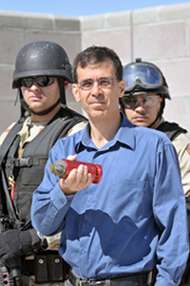
Sandia National Laboratories recently licensed its safer fuel air diversionary device technology to Defense Technology Corporation of America, located in Casper, Wyo.
Diversionary devices — also called stun grenades or flash-bangs — are a less-than-lethal device used in a wide variety of law enforcement and military operations. Like a grenade, the device is activated by pulling a pin. When thrown, the flash-bang creates a loud sound and bright flash of light to temporarily distract or disorient an adversary.
Flash-bangs are used in law enforcement and military operations such as hostage rescue, room-clearing, crowd control and other specialized operations. Military or law enforcement personnel will typically break down a door or smash a window of a building and toss in the diversionary device during a forced entry.
More than 20 years ago, Paul Cooper and Ed Graeber, both now retired from Sandia, created the original Mk 141 flash-bang diversionary device, which was intended for limited (and specialized) applications. It was state of the art for its day. Paul’s protégé, Mark Grubelich, built on that original groundbreaking work and came up with an improved flash-bang – one far safer for law enforcement and the military
Flash-bangs that use existing pyrotechnic technology function like an explosive device – once ignited a “flash powder” mixture of aluminum & potassium perchorate powders quickly reacts, resulting in an explosive output,” Grubelich says. “They function like any other explosive devise but without any shrapnel, just a flash and a bang.”
Like any other explosive device, flash-bangs can be damaged in the field, poorly manufactured, or incorrectly deployed. With the older pyrotechnic technology employed by the previous generation of flash-bangs, any of these types of problems can result in serious injuries.
“There are a number of disadvantages associated with currently available diversionary devices,” says Grubelich. “Serious injuries have resulted from their improper use both operationally and in training.” Because safety is of paramount importance, the new fuel air technology was developed to address the issues associated with the severe over pressure that is produced in the near field of older-style diversionary devices.
In this new diversionary device the flash-bang produces a dust explosion on a very small scale – a gas generator rapidly ejects and ignites aluminum powder. That deflagrating cloud of burning aluminum powder provides an intensely bright light and an ‘explosive’ noise. The body of the diversionary device itself does not explode, making the operation safer for the person deploying the item and for anyone in the area. This lessens the likelihood of injury and also the severity of the consequences should a mishap occur.
Grubelich recently appeared on the History Channel series “Modern Marvels” where he explained how the improved technology functioned and also demonstrated the device.
The new flash-bang can be made into many body styles appropriate for fielding by the military and law enforcement for a variety of applications, says Grubelich. Economical and refillable versions can be made for training purposes. A heavier version of the flash-bang could also allow it to be thrown though windows.
The technology was originally licensed in 2002 to a different company, but the licensee failed to bring the product to market. “Sandia looks forward to Defense Technology making a safer device available to the military and to law enforcement agencies all over the country,” Grubelich says.
Source: Sandia National Laboratories


