Folks below the 'digital divide' would use the Internet more if they had it, research suggests
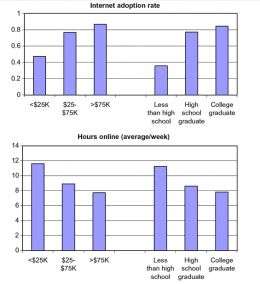
There is still a "digital divide." Rich people are connected to the Internet more than poor people, and some worry that this creates an "electronic underclass" unable to access important services. Subsidies to help low-income households get online have been suggested.
If connected, these families would use the Internet more than the affluent, according to research by Jeff Prince, assistant professor of applied economics and management at Cornell, and Avi Goldfarb of the University of Toronto. And Prince said that much of that use could benefit society and the national economy.
The study, reported in the March 2008 issue of the journal Information Economics and Policy, shows that low-income households spend more time on the Internet than others, using it for e-mail, researching purchases, finding health information and reading news, just as other users do, although spending more time on chat and gaming than the affluent.
"From the perspective of an economist, some of these activities benefit not only those partaking in them, but other members of society as well, making it possibly in the government's interest to encourage them," Prince said. "For sure they may use it for things we don't care about like chat and games, but we also predict that a decent proportion would use it for things we might think socially beneficial. We find some argument for a subsidy."
The researchers analyzed data on 18,439 Americans from a 2002 study of technology choices by Forrester Research and found that families with incomes below $25,000 a year who had access to the Internet used it a bit over 11.6 hours a week on average. Families with income between $25,000 and $75,000 averaged a little more than 8.9 hours a week and those with incomes over $75,000 used it a little more than 7.7 hours. Similar numbers appeared when comparing education levels, with college-educated people using the Internet less than high school graduates, and users with no high school diplomas spending the most time online.
The numbers were statistically corrected for such factors as race, age, number of children in the family and urban vs. rural environment.
The researchers conclude that the main reason for the difference in Internet use was the "opportunity cost of leisure time" -- that low-income users have fewer other uses for the time that they find more valuable. People in all income groups reported having about the same amount of leisure time.
Other possible explanations are that low-income people find the Internet more useful, giving them access to services they can't find elsewhere, and that low-income people who are willing to pay the cost of Internet access probably value it more highly and therefore use it more often. Analyzing how people use the Internet and statistically correcting for self-selection, respectively, show these explanations to be far less likely, the researchers said.
Prince cautioned that the analysis is based on data from several years ago, and that the benefits they find must be weighed against the costs before deeming subsidies a good policy decision. Also, he said, the rise of widespread broadband access may have changed the social landscape, and he hopes to study that in the future.
Source: Cornell University


