Road safety: the uncrashable car?
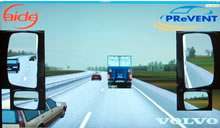
The largest road safety research project ever launched in Europe will usher in a series of powerful road-safety systems for European cars. But, in the long term, its basic, experimental research could lead to a car that is virtually uncrashable.
A truck exits suddenly from a side road, directly into your lane only dozens of metres ahead. Suddenly, your car issues a warning, starts applying the brakes and attempts to take evasive action. Realising impact is unavoidable; in-car safety systems pre-tension the safety belts and arm the airbag, timing its release to the second before impact.
Such is the promise of the uncrashable car, coming to a dealer near you in the perhaps not-too-distant future. The system is part of the basic research undertaken by the largest research initiative into road safety ever undertaken in Europe.
PReVENT has a budget of over €50 million and 56 partners pursuing a broad, but highly complementary programme of research. A dozen sub-projects focus on specific road-safety issues, but all projects support and feed into each other in some way.
PReVENT’s is studying relatively cheap, even simple, technologies – such as parking sensors and existing satellite navigation – that can be retooled to enhance driver safety. But as part of its broad and deep approach to car safety, it is also diving into more experimental and medium- to long-term systems, innovations that could appear in five-to-ten years.
The uncrashable car is a theoretical construct that concerned a handful of PReVENT’s sub-projects. But it could become far more of a reality than anyone expected.
Of course, it is impossible to stop all car collisions, but the technology could be pushed to make it increasingly unlikely and mitigate crashes when they do occur.
For example, PReVENT project WILLWARN uses wireless communication with other vehicles to alert the driver about potentially dangerous situations ahead, while MAPS&ADAS reads sat-nav maps to track approaching hazards, like bends, dips or intersections. SASPENCE looks at safe driving distances and speed, while LATERALSAFE finally brings active sensing to the blind spot.
All have their role in the uncrashable car, as do many others within the broader project. But two projects, APALACI and COMPOSE, take this a step further, actively tracking the speed and trajectories of surrounding vehicles and other road users in real time. If one vehicle suddenly stops, or a pedestrian suddenly steps onto the road, they swing into action to rapidly calculate the implications.
Predictive collision detection
APALACI is an advanced pre-crash mitigation system built round the registration of other motorists and cyclists. In the APALACI system, sensors monitor the street or road immediately around the vehicle and collect as much information about a collision as possible, before it even starts to take place.
The system uses this data to decide on the ideal safety reaction strategy. Examples include controlled braking manoeuvres, controlled activation of the occupant restraint systems or pre-arming airbag systems. The car can react far faster than the driver, cutting speed by crucial amounts to ensure unavoidable accidents are less severe.
APALACI also developed a so-called ‘Start Inhibit System’ for trucks. It surveys the blind spot immediately in front of a truck and protects pedestrians or cyclists by preventing dangerous manoeuvres.
APALACI was tested in a series of vehicles like the Fiat Stilo, the Volvo FH12 truck, the Alfa Romeo 156 and Mercedes E350. It used laser sensors, radar, software decision assistance and a variety of other technologies to achieve the goal.
Tiny changes have a huge impact
COMPOSE, on the other hand, aims more specifically to keep others, as well as its driver, safe. It can apply the brakes if a pedestrian steps onto the road, or extend the bumper, and raise the bonnet to enhance occupant protection.
Tiny differences have a huge impact on car safety. Dropping speed by 1km/h can reduce accidents with injury by 3 per cent, while braking fractions of a second sooner is enough to reduce the damage caused dramatically.
The systems were tested in the BMW 545i and the Volvo FH12 truck, and they do appreciably enhance safety. But, for all their potential, these systems remain, for now, the preserve of the future.
“The teams developed sophisticated algorithms to track all these elements in the landscape,” explains Matthias Schulze, coordinator of the EU-funded PReVENT project and Senior Manager for ITS & Services at Daimler AG. “But they require enormous computer power to keep track of all the various elements, so this work is aimed at basic research, establishing how it could be done. It will be a while before in-car computers are sophisticated enough to use these systems.”
Nonetheless, they do provide tools that automakers can use to mitigate the potential for accidents, and they provide a clear research roadmap for the uncrashable car of the future.
Source: ICT Results


