Jules Verne ATV given 'go' for docking
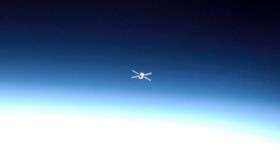
Cosmonaut Yuri Malenchenko, Expedition 16 flight engineer, aboard the International Space Station used a digital still camera to record several images of the Jules Verne Automated Transfer Vehicle (ATV) during a rendezvous test on March 29, 2008. Malenchenko fitted the camera with an 800mm lens typically employed for Shuttle RPM photography while the ATV sat 2.1 statute miles from the ISS during the first of two demonstration days in the lead up to a first ISS docking attempt on April 3. On March 31, Demonstration Day 2 will see ATV approach to within 11 meters of the ISS. Credits: NASA
Jules Verne was today formally cleared to proceed with the first ISS docking attempt, scheduled for 3 April 2008 at 16:41 CEST (14:41 UT). The official go-ahead came from the International Space Station Mission Management Team (IMMT) after two flawless demonstration days in which Jules Verne proved its operational capabilities.
"We have proven that Jules Verne's systems are safe, reliable and ready to dock to the Station. Everyone has worked very hard to get to this point, and we have also proven that the team on the ground is fully ready for tomorrow's first attempt," said John Ellwood, ESA's ATV Project Manager.
The formal permission came during today's IMMT meeting held at 13:00 CEST (11:00 UT), in which ESA together with its ISS partners reviewed the Automated Transfer Vehicle's (ATV) performance from Demonstration Day 2.
Demo Day 2, held on 31 March, saw Jules Verne conduct a series of challenging manoeuvres and confirm that the spacecraft could autonomously navigate itself using optical guidance and close to station keeping point S41, just 11 m from the ISS. Jules Verne also reacted perfectly to an 'Escape' command issued by astronauts on board the ISS, proving that the vessel can automatically withdraw to a safe location when so commanded.
Tomorrow's docking attempt will see Jules Verne move past station keeping point S41 to actually dock with the Russian ISS module's docking port. Contact of the vessel's docking probe is expected at 16:41 CEST (14:41 UT), with full capture scheduled at 17:15 CEST (15:15 UT). If the docking does not occur for any reason, the next possible window occurs 48 hours later on Saturday, 5 April.
The rendezvous and docking will be monitored from ESA's ATV Control Centre in Toulouse, France, in cooperation with the Russian control centre in Moscow and the NASA control centre in Houston.
The rendezvous and docking will be broadcast live by ESA TV, 16:00-17:15 CEST (14:00-15:15 UT); details are available on the ESA TV web page under http://television. … ion.esa.int/.
Source: European Space Agency
-
From lemons to lemonade: Reaction uses carbon dioxide to make carbon-based semiconductor,
32 comments
-
Thioridazine kills cancer stem cells in human while avoiding toxic side-effects of conventional cancer treatments,
3 comments
-
SpaceX private rocket blasts off for space station (Update),
42 comments
-
Climate scientists say they have solved riddle of rising sea,
31 comments
-
SpaceX capsule has 'new car' smell, astronauts say (Update),
4 comments
-
Distance of planets from stars and revolution
9 hours ago
-
revamping general concept and cosmological principle
May 25, 2012
-
Transiting Exoplanet Light Curve
May 25, 2012
-
Math behind Theoretical Physics
May 24, 2012
-
Do we know whats at the center of galaxies yet?
May 23, 2012
-
Structure of the Milky Way?
May 20, 2012
- More from Physics Forums - General Astronomy
More news stories
Land and sea species differ in climate change response: study
(Phys.org) -- Marine and terrestrial species will likely differ in their responses to climate warming, new research by Simon Fraser University and Australia’s University of Tasmania has found.
7 hours ago |
3.8 / 5 (4) |
5
|
Yale study concludes public apathy over climate change unrelated to science literacy
Are members of the public divided about climate change because they don't understand the science behind it? If Americans knew more basic science and were more proficient in technical reasoning, would public consensus match ...
9 hours ago |
4.8 / 5 (5) |
20
|
10 million years needed to recover from mass extinction
It took some 10 million years for Earth to recover from the greatest mass extinction of all time, latest research has revealed.
Space & Earth / Earth Sciences
9 hours ago |
4 / 5 (4) |
1
|
Sophisticated simulations predict future warming
The chances of our planet being hit by a global warming of 3 degrees Celsius by 2050 is as likely as it being hit by an increase of 1.4 degrees, new research shows. Presented in the journal Nature Geoscience, the British study ...
Space & Earth / Earth Sciences
May 22, 2012 |
3.8 / 5 (11) |
51
Aliens don't want to eat us, says former SETI director
Alien life probably isnt interested in having us for dinner, enslaving us or laying eggs in our bellies, according to a recent statement by former SETI director Jill Tarter.
Space & Earth / Space Exploration
May 25, 2012 |
4.4 / 5 (15) |
41
Stunning image of smallest possible five-ringed structure
Scientists have created and imaged the smallest possible five-ringed structure about 100,000 times thinner than a human hair and you'll probably recognise its shape.
'Unzipped' carbon nanotubes could help energize fuel cells, batteries
Multi-walled carbon nanotubes riddled with defects and impurities on the outside could replace some of the expensive platinum catalysts used in fuel cells and metal-air batteries, according to scientists at ...
Change in developmental timing was crucial in the evolutionary shift from dinosaurs to birds: study
At first glance, it's hard to see how a common house sparrow and a Tyrannosaurus Rex might have anything in common. After all, one is a bird that weighs less than an ounce, and the other is a dinosaur that ...
Computer model used to pinpoint prime materials for efficient carbon capture
When power plants begin capturing their carbon emissions to reduce greenhouse gases and to most in the electric power industry, it's a question of when, not if it will be an expensive undertaking.
T cells 'hunt' parasites like animal predators seek prey, study shows
By pairing an intimate knowledge of immune-system function with a deep understanding of statistical physics, a cross-disciplinary team at the University of Pennsylvania has arrived at a surprising finding: T cells use a movement ...
Scientists develop ultra-sensitive test that detects diseases in their earliest stages
Scientists have developed an ultra-sensitive test that should enable them to detect signs of a disease in its earliest stages, in research published today in the journal Nature Materials.