Scientists discover massive Jurassic marine reptile
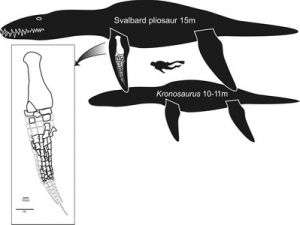
University of Alaska Museum of the North earth sciences curator Patrick Druckenmiller spent several weeks last summer working with a Norwegian research team to excavate a large pliosaur specimen in the remote Norwegian archipelago of Svalbard. At the time, they knew the Jurassic fossil was significant.
After months of preparing and conserving the specimen at the Natural History Museum at the University of Oslo, researchers confirmed their earlier suspicions: the 150-million-year-old Jurassic marine reptile is perhaps the largest ever found.
A pliosaur is a type of plesiosaur, a group of extinct reptiles that lived in the world's oceans 205-65 million years ago. Pliosaurs are characterized by tear-drop shaped bodies with two pairs of powerful flippers used to propel them through the water. They were top predators during their day, preying upon fish, squid-like animals and other marine reptiles.
They averaged 16-20 feet in length with flippers 3-4 feet long. One of the largest known pliosaurs, the Australian Kronosaurus, measures 33-36 feet long with 6-foot-long flippers. By comparison, the Svalbard specimen, nicknamed "The Monster" by the research team, is estimated to be 50 feet long with 10-foot-long flippers.
"This is one of the largest and relatively complete plesiosaur specimens ever found," says Druckenmiller, whose research focuses on plesiosaurs. "Its discovery in Svalbard also demonstrates that these gigantic animals inhabited the northern seas during the age of dinosaurs."
Led by Norwegian paleontologist Jørn Hurum, the international research team, including Druckenmiller, discovered the specimen in summer 2006. Judging from the fragments they recovered at the time, they knew the find was significant and returned the next year to retrieve more of the specimen. During the three-week field season in summer 2007, the team excavated the specimen from the surrounding shale, removing several tons of rock by hand in the process.
Though they didn't find the entire skeleton, they recovered several critical parts used to identify the specimen and compare it to other known plesiosaurs: portions of the skull, including the teeth; much of the neck and back; the shoulder girdle; and a near-complete forelimb. One of the key questions researchers hope to answer is whether this specimen represents a species new to science.
In addition to "The Monster" pliosaur specimen, the crew also discovered parts of three other marine reptiles nearby: a long-necked plesiosaur, an ichthyosaur and another pliosaur. Based in part on these discoveries and several others made by the team, scientists now recognize Svalbard as home to one of the richest accumulations of marine reptile fossils in the world.
"The scientific value of such a large locality with unknown species of marine reptiles is just staggering," says Hurum. Druckenmiller will join Hurum and the Oslo team on another research expedition to Svalbard in August 2008.
Source: University of Alaska Fairbanks


