Dutch University Tests Windmill for Seawater Desalination
Feb 29, 2008
Dutch University Tests Windmill for Seawater Desalination
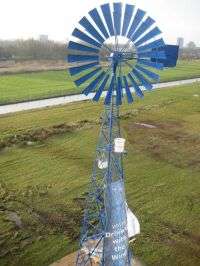
A traditional windmill which drives a pump: that is the simple concept behind the combination of windmill/reverse osmosis developed by the Delft University of Technology in the Netherlands. Credit: Evgenia Rabinovitch

A traditional windmill which drives a pump: that is the simple concept behind the combination of windmill/reverse osmosis developed by the Delft University of Technology (TU Delft) in The Netherlands. In this case, it involves a high-pressure pump which pushes water through a membrane using approximately 60 bar. This reverse osmosis membrane produces fresh water from seawater directly. The windmill is suited for use by, for instance, small villages in isolated, dry coastal areas.

The combination of windmills and desalination installations is already commercially available. These windmills produce electricity from wind power, the electricity is stored and subsequently used to drive the high-pressure pump for the reverse osmosis installation. The storage of electricity in particular is very expensive. Energy is also lost during conversion.

In the TU Delft installation, the high-pressure pump is driven directly by wind power. Water storage can be used to overcome calm periods. The storage of water is after all a great deal cheaper than that of electricity.

The chosen windmill is normally used for irrigation purposes. These windmills turn relatively slowly and are also very robust. On the basis of the windmill’s capacity at varying wind speeds, it is estimated that it will produce 5 to 10 m3 of fresh water per day: enough drinking water for a small village of 500 inhabitants.

A water reservoir will have to ensure that enough water is available for a calm period lasting up to five days. Three safeguards (in the event of the installation running dry, a low number of revolutions or a high number of revolutions) are also performed mechanically so that no electricity is needed.

The first prototype has been built and is already working at a location near the A13 motorway near Delft. This prototype is to be dismantled and transported to Curaçao the first week of March. There the concept will be tested on seawater.

Source: Delft University of Technology

Explore further: Researchers use light projector and single-pixel detectors to create 3-D images

add to favorites email to friend print save as pdf

Related Stories

DNA through graphene nanopores

Jul 12, 2010

A team of researchers from Delft University of Technology (The Netherlands) announces a new type of nanopore devices that may significantly impact the way we screen DNA molecules, for example to read off their sequence. In ...

Recommended for you

GPS solution provides 3-minute tsunami alerts

May 17, 2013

Researchers have shown that, by using global positioning systems (GPS) to measure ground deformation caused by a large underwater earthquake, they can provide accurate warning of the resulting tsunami in ...

Innovative concrete to facilitate building rehabilitation

May 16, 2013

The Structural Technology Group of the Universitat Politècnica de Catalunya, BarcelonaTech (UPC), in collaboration with the company PROMSA, is participating in the rehabilitation of the Gaudí House Museum in Barcelona's P ...

User comments : 0

More news stories

US seizes Bitcoin operator accounts

US authorities seized the accounts of a Bitcoin digital currency exchange operator, claiming it was functioning as an "unlicensed money service business," court documents showed Friday.

Yahoo Japan suspects 22 million IDs stolen

Yahoo Japan Corp. has said it suspects up to 22 million user IDs may have been stolen during an unauthorised attempt to access the administrative system of its Yahoo! Japan portal.

Facebook, Twitter announce apps for Google's Glass

Google says it's still figuring out the best ways to use Glass, but the company announced Thursday that Facebook, Twitter and several other media firms have built their own applications for the futuristic-looking wearable ...

New colonoscope provides ground-breaking view of colon

A ground-breaking advance in colonoscopy technology signals the future of colorectal care, according to research presented today at Digestive Disease Week(DDW). Additional research focuses on optimizing the minimal withdrawal ...

Alaska volcano shoots ash 15,000 feet into the air

(AP)—One of Alaska's most restless volcanoes has shot an ash cloud 15,000 feet into the air in an ongoing eruption that has drawn attention from a nearby community but isn't expected to threaten air traffic.

Chinese, Indian airlines face EU pollution fines

Eight Chinese and two Indian airlines face fines of up to several million euros for not paying for their greenhouse gas emissions during flights within the bloc, the European Commission said on Friday.