Researchers demonstrate a new type of optical tweezer
Feb 25, 2008
Microfabricated Fresnel Zone Plate Optical Tweezer
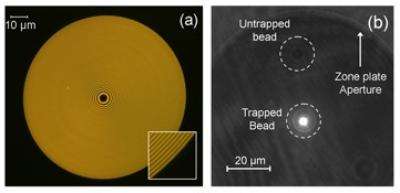
(a). Photograph of microfabricated Fresnel Zone Plate optical tweezer, consisting of concentric gold rings (50 nm thick) on a microscope slide. The Zone Plate outer diameter is 100¼m, and the focal length is 8¼m. (b). CCD camera image of fluorescent bead (2¼m diameter) trapped in Zone Plate focus. Credit: Ken Crozier, Harvard School of Engineering and Applied Sciences

Researchers at the Harvard School of Engineering and Applied Sciences (SEAS) demonstrated a new type of optical tweezer with the potential to make biological and microfluidic force measurements in integrated systems such as microfluidic chips. The tweezer, consisting of a Fresnel Zone Plate microfabricated on a glass slide, has the ability to trap particles without the need for high performance objective lenses.

The device was designed, fabricated, and tested by postdoctoral fellow Ethan Schonbrun and undergraduate researcher Charles Rinzler under the direction of Assistant Professor of Electrical Engineering Ken Crozier (all are affiliated with SEAS). The team's results were published in the February 18th edition of Applied Physics Letters and the researchers have filed a U.S. provisional patent covering this new device.

"The microfabricated nature of the new optical tweezer offers an important advantage over conventional optical tweezers based on microscope objective lenses," says Crozier. "High performance objective lenses usually have very short working distances -- the trap is often ~200 mm or less from the front surface of the lens. This prevents their use in many microfluidic chips since these frequently have glass walls that are thicker than this."

The researchers note that the Fresnel Zone Plate optical tweezers could be fabricated on the inner walls of microfluidic channels or even inside cylindrical or spherical chambers and could perform calibrated force measurements in a footprint of only 100x100μm.

Traditional tweezers, by contrast, would suffer from crippling aberrations in such locations. Moreover, in experimental trials, the optical tweezers exhibited trapping performance comparable to conventional optical tweezers when the diffraction efficiency was taken into account.

The researchers envision using their new tweezer inside microfluidic chips to carry out fluid velocity, refractive index, and local viscosity measurements. Additional applications include biological force measurements and sorting particles based on their size and refractive index. Particle-sorting chips based on large arrays of tweezers could be used to extract the components of interest of a biological sample in a high-throughput manner.

Source: Harvard University

Explore further: Error sought & found: State-of-the-art measurement technique optimised

add to favorites email to friend print save as pdf

Related Stories

Physicists 'turn signals' for neuron growth

Dec 15, 2011

(PhysOrg.com) -- A new paper scheduled for publication in the January issue of Nature Photonics describes the use of spinning microparticles to direct the growth of nerve fiber, a discovery that could allow ...

Recommended for you

Engineers pioneer flat spray-on optical lens

11 hours ago

A University of British Columbia engineer and a team of U.S. researchers have made a breakthrough utilizing spray-on technology that could revolutionize the way optical lenses are made and used.

How do cold ions slide

13 hours ago

Things not always run smoothly. It may happen, actually, that when an object slides on another, the advancement may occur through a 'stop and go' series in the characteristic manner which scientists call ...

User comments : 1

Adjust slider to filter visible comments by rank

Display comments: newest first

superhuman
not rated yet Feb 25, 2008
>"High performance objective lenses usually have very short working distances -- the trap is often ~200 mm or less from the front surface of the lens. "
micrometers i presume not millimeters

More news stories

A quantum simulator for magnetic materials

Physicists understand perfectly well why a fridge magnet sticks to certain metallic surfaces. But there are more exotic forms of magnetism whose properties remain unclear, despite decades of intense research. ...

Engineers pioneer flat spray-on optical lens

A University of British Columbia engineer and a team of U.S. researchers have made a breakthrough utilizing spray-on technology that could revolutionize the way optical lenses are made and used.

Researchers forward quest for quantum computing

Research teams from UW-Milwaukee and the University of York investigating the properties of ultra-thin films of new materials are helping bring quantum computing one step closer to reality.

How do cold ions slide

Things not always run smoothly. It may happen, actually, that when an object slides on another, the advancement may occur through a 'stop and go' series in the characteristic manner which scientists call ...

Controlling mood through the motions of mitochondria

(Medical Xpress)—Regulating the distribution of power in neurons is done by a system that makes the national electric grid look simple by comparison. Each neuron has several thousand mitochondria confined ...

Google Drive sports new view and scan enhancements

(Phys.org) —Google Drive has a new look and functions. The makeover in Google Drive features scanning and interface enhancements that put the user into "card" mode. The enhancements make it easy for the ...