Get Ready For Total Lunar Eclipse Wednesday Night
Feb 19, 2008
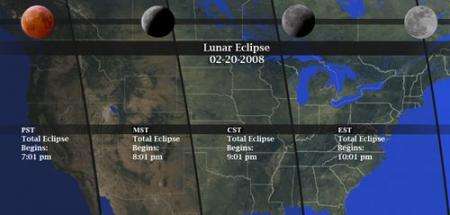
This map shows when the eclipse will be visible across the United States. Credit: NASA

In the late night hours of Feb. 20, 2008, a total lunar eclipse will dazzle the night sky. And this lunar eclipse may be worth staying up for, because it will be the last one until December 2010.

A lunar eclipse occurs when the Earth lines up directly between the sun and the moon, casting a shadow over the moon's surface. The February 20, 2008 eclipse will last for nearly 3 and a half hours. For a full 50 minutes of that time the moon will be in totality - the period when the lunar surface is completely covered by the Earth's shadow.

During an eclipse the moon changes color, going from a light gray color to an orange or deep red shade. This is totality. The moon takes on this new color because indirect sunlight is still able to pass through the Earth's atmosphere and cast a glow on the moon.

The exact color that the moon appears depends on the amount of dust and clouds in the atmosphere. If there are extra particles in the atmosphere, from say a recent volcanic eruption, the moon will appear a darker shade of red.

Residents of the Americas, Europe and Africa will have the best view of this eclipse.

Here in the United States, the entire eclipse will be visible for the majority of the country. However, residents on the West Coast will miss out on watching the early stages of the eclipse, as it begins before moonrise.

This Wednesday night, hope for clear skies, try to stay awake and enjoy a spectacular lunar eclipse.

Source: NASA's Goddard Space Flight Center, by Laura Motel

Explore further: Collisions of coronal mass ejections can be super-elastic

add to favorites email to friend print save as pdf

Related Stories

SDO observes Earth, lunar transits in same day

Mar 11, 2013

On March 2, 2013, NASA's Solar Dynamics Observatory (SDO) entered its semiannual eclipse season, a period of three weeks when Earth blocks its view of the sun for a period of time each day. On March 11, however, ...

The 'habitable edge' of exomoons

Mar 05, 2013

Astronomers have their fingers crossed that within the haul of data collected by NASA's Kepler mission, which has already detected nearly three thousand possible exoplanets, hide the signatures of the very ...

Lunar eclipse turns moon blood red

Jun 16, 2011

The longest lunar eclipse in more than a decade turned the moon blood red on Thursday, yielding a rare visual treat for stargazers across a large swathe of the planet from Australia to Europe.

Australia witnesses partial lunar eclipse

Jun 04, 2012

The first partial lunar eclipse of the year provided dramatic scenes across Asia late Monday, with a clear moon visible to many as the event unfolded.

Recommended for you

Forecast for Titan: Wild weather could be ahead

21 hours ago

(Phys.org) —Saturn's moon Titan might be in for some wild weather as it heads into its spring and summer, if two new models are correct. Scientists think that as the seasons change in Titan's northern hemisphere, ...

SDO observes mid-level solar flare

22 hours ago

UPDATE 16:30 p.m. EDT: The M7-class flare was also associated with a coronal mass ejection or CME, another solar phenomenon that can send billions of tons of particles into space. While this CME was not Ea ...

NASA's IRIS mission readies for a new challenge

May 22, 2013

(Phys.org) —The time draws near. NASA is getting ready to launch a new mission, a mission to observe a largely unexplored region of the solar atmosphere that powers its dynamic million-degree outer atmosphere and drives ...

User comments : 0

More news stories

A hidden population of exotic neutron stars

(Phys.org) —Magnetars – the dense remains of dead stars that erupt sporadically with bursts of high-energy radiation - are some of the most extreme objects known in the Universe. A major campaign using ...

Russia evacuates drifting Arctic research station

Russia has ordered the urgent evacuation of the 16-strong crew of a drifting Arctic research station after ice floe that hosts the floating laboratory began to disintegrate, officials said Thursday.

A quantum simulator for magnetic materials

Physicists understand perfectly well why a fridge magnet sticks to certain metallic surfaces. But there are more exotic forms of magnetism whose properties remain unclear, despite decades of intense research. ...

Scientists discover molecule triggers sensation of itch

Scientists at the National Institutes of Health report they have discovered in mouse studies that a small molecule released in the spinal cord triggers a process that is later experienced in the brain as the sensation of ...